

How Your Cat’s Five Senses Compare to Human Senses
It shouldn’t come as a surprise to hear that your cat has some very acute senses. It seems that while humans have become mushy and out of touch with our environments since our days of being vulnerable to predators, cats have kept their instincts and senses sharp. But how much better are they?

Smell
Our sense of smell is determined by how many odor-sensitive cells we have in our nostrils. Humans have 5 million. That sounds like a lot, right? Well, you may be surprised to hear that you cat has around 200 million! She uses her amazing sense of smell to seek out bits of food and hidden mice, but she also uses her nose to “read” communications left for her by other cats through gland secretions or urine markings.

Sound
Sound is measured by vibrations– specifically how many vibrations a particular sound produces each second (which is called frequency). The unit measurement of frequency is called a hertz. Cats can hear very, very high frequencies. In fact, while humans can hear 20,000 hertz, cat’s can pick up 100,000! It helps that cats have such amazing ears, which act like satellites with their shape and ability to swivel them to hone in on subtle sounds.

Sight
Cats have razor sharp vision, thanks to their superior peripheral vision and the fact that their pupils can dilate in a way that gives them more of a panoramic view– two benefits that help them detect even the slightest movements. Like us though, cats do have a blind spot, located under their nose about 4-5 inches from their face. Even with the blind spot, their sensitive whiskers help them detect danger in the area.

Touch
Cats explore their environments with their paws and whiskers (which are located on the fronts and backs of her legs as well as her face). Whiskers are very sensitive and help your cat stalk and navigate in dim light. Your cat also uses her whiskers to help her determine whether or not she’ll be able to squeeze through a tight space. For the average human, touch is the most underutilized of all of our senses when it comes to gaining information about our environments.
Taste
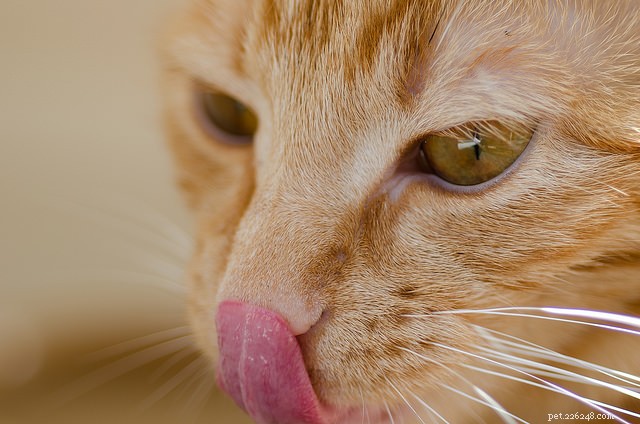
Finally a sense human have an advantage with! The sense of taste, as you know, is determined by the number of tastebuds an animal has on their tongue. Humans have 9,000 tastebuds, while cats have a measly 473. This is why cats use their strong senses of smell to determine whether food or water is fresh.
It’s clear that cats have the overall advantage when it comes to understanding their environments in great detail. And, given this information, it’s no wonder we find them sometimes staring at a wall watching something that “isn’t there”. There may be something there after all, we are just too unskilled to see it.
- Pet Behavior
- Pet Breeds
- Pet Names
- Pet Adoption
- Pet Training
- Cat Stories
- Pet Health
- Adorable Pets
- Cats
- Why Do Cats Frequently Lick Their Own Rear? The Science Explained
- The Impact of Your Mood and Behavior on Your Cat’s Well-Being
- Guide to Introducing Your Cat to Their New Bed: Simple Steps for Comfort and Bonding
- How Cats' Five Senses Compare to Humans: Surprising Strengths & Differences
- 5 Expert Ways to Show Your Cat You Love Them in Their Own Language
- Decode Your Cat’s Body Language: Expert Guide to Spotting Comfort and Anxiety
- Mastering Cat Stroke Techniques for a Calm Bond