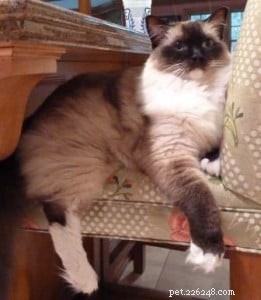
 Ragdoll Cat Stereotypes
Guest Post by MeLinda Hughes of Merlin’s Hope Ragdoll Rescue
All Siamese are loud; all Bengals are hyper; all Persians are sweet and gentle; all Ragdolls are floppy. These are stereotypes cat caregivers deal with every day. The problem is what I tell my writing students, “Not ‘all’ is ever anything.” In other words, you cannot determine a cat’s personality solely based on its breed. Yes, certain breeds tend to have certain personalities, but you cannot just say, “I want a Ragdoll because all Ragdolls love other cats, love dogs, love children, love all people, sit in laps, sleep in the bed with you, flop over when you touch them, and do not shed” and expect your Ragdoll to conform. Ragdolls, like all cats, in fact like living beings, are individuals with their own personalities and their own quirks. To condemn them to be one way or another because of their breed is to seriously shortchange this magnificent breed.
Over the years in rescue, I have seen Ragdolls dumped at shelters and surrendered to rescue because they were not what their owners expected. “He’s not friendly enough,” “he doesn’t get along with my children,” “he swats at my dog,” and my personal favorite, “he sheds, and I was told Ragdolls don’t shed.” These cats are being just what they are: cats. In fact, I have found in a number of situations that cats that are surrendered for these reasons actually go into homes with dogs, or other cats, or children and do exceptionally well. They may even become lap-cats, and yes, cats that are not lap cats in certain situations can definitely become lap cats, but it sometimes takes effort on the part of the owner. You can’t expect your cat to immediately become what you want; you have to help her become what you want. Now, that does not mean you can force her to become anything. A cat that has a very independent personality is not necessarily going to become a lap cat, but she might actually become friendlier with incentives; yes, you reward cats to get them to do what you want them to do.
You want your Ragdoll to get along with your other cats; then, you need to be sure you introduce them correctly. You have to expend the effort to make the right environment for your cat to get along with


its other companions. You want your cat to get along with dogs; then, make sure you spend the time you need to make sure your dog makes the right impression. It might include training for your dog. Galaxy Jackson recently did an episode on My Cat from Hell where he encouraged the people to work with their dog as much, if not more, than with the cats to make the situation work, and it did, but only with the effort to make sure the cats were comfortable in their own home. Amy Shojai has written a book called Competability: A Practical Guide to Building a Peaceable Kingdom Between Cats and Dogs. She also has a book called ComPETability: Solving Behavior Problems In Your Multi-Cat Household. There are also a multitude of other books discussing how to integrate cats with other cats and dogs with cats. There are also a number of wonderful articles available at http://www.littlebigcat.com/category/behavior. Please don’t assume that your Ragdoll can’t get along; give her a chance and be sure that you actually give everyone an equal chance.
If you want your cat to sleep with you or sit with you, then you need to give her encouragement. She can only have treats when she is on the bed or she can only have treats when she sits with you. If you want her to spend time with you, then make sure you are spending time with her. Are you playing with her? Jean Hofve talks about the importance of interacting with your cat in her article “Indoor Enrichment for Cats”. Are you actively giving her the attention she needs? Jackson Galaxy in another My Cat From Hell episode talks about what he calls: “Eat, play, love.” You feed your cat, you play with her, and then you spend time loving on her. Your reward for the extra time you spend with your Ragdoll is a true companion whether she sits in your lap or sleeps on your bed with you. Isn’t that what you really want? A truly happy cat?
If your Ragdoll and your children are not getting along, ask yourself if you spent time making sure your children knows to respect your cat and her boundaries. There are a number of wonderful sources discussing how to create a bond between your Ragdoll and your children. There is an awesome article about introducing children to cats. Children, no matter the age, need to respect your cat. Additionally, be sure you include your children in your “eat, play, and love” time. If your cat does not love your child, she isn’t forcing you to choose your child over her; she is asking you to share equal time.
The excuse I find the most offensive for people who are giving up their Ragdolls is the hair. Yes, of course, Ragdolls shed. Cats shed. It is a fact of life. However, you can minimize the problems caused by shedding with diligent cleaning, dedicated grooming, and a good diet. You’ve heard that you are what you eat; well, that literally applies to your Ragdoll. The higher the quality of the food you feed, the better coat your cat will have, the less shedding you should expect. Regular grooming is also essential, but it doesn’t have to be a chore. Make it part of your routine; give your cat a special treat or time with a special toy as a reward each time you groom, and she will learn to love it.
The fact is that Ragdolls are awesome cats and they can be good companions for dogs, other cats, children, and you, but you must be willing to invest equal time into this relationship. The more time you spend, the more you will receive, and the better the chance you have at finding the perfect cat for your home.

