

Cat Enema: When It's Needed, How to Administer, and What to Expect
Constipation is extremely common, for cats and humans alike. But in some cases, recovering from it requires more than a simple laxative. When these are not efficient, the cats need to get enemas to get relief. Usually, it’s a vet who administers the enema to the cat.
But, in some cases when cats need to get enemas regularly or when taking the cat to the vet so many times becomes a major stressor for it, pet parents need to administer the enemas on their own, at home.
While it might seem like a daunting task, administering an enema to your cat is not as difficult as you might think. Please keep in mind that you should only do this after talking to your vet and using the medication they instruct. In this article, I want to shed some light on the process of giving your cat an enema, so if you ever need to, you’ll know what to do and how to do it.
Jump to:
- My Experience with Administering Enemas to My Cat
- Enemas for Cats
- What You Need for the Procedure
- Preparing the Room
- Steps for Giving the Enema
- The Effects of the Enema
- What is constipation?
- How can constipation be treated?
- What is megacolon?
My Experience with Administering Enemas to My Cat
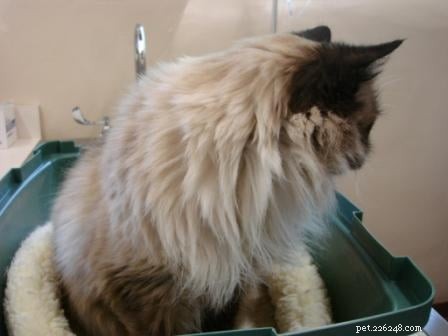
When Rags stopped going number 2, he tried giving him all sorts of things from Metamucil to Enulose (Generic Name: lactulose (LAK too lose) to canned pumpkin. He hated it all.
I also started giving him fluids, in hopes that would help the kidneys run better and help the motion of everything in that area get-a-movin! So, as a last result, he has started getting cat enemas.
I believe Rags needs this help because of his age (he’ll be 19 in two short months) and his kidneys are not functioning as they once were. Please see photos of the procedure below. Different vets do a cat enema different ways. Rags is currently getting his cat enemas done at Mariposa Veterinary Center in Lenexa, KS.
Before he had it done at KC Cat Clinic. KC Cat Clinic required that he have X-rays done of his colon to see how much poop was in there, then, they would administer the enema and make him stay all day to have it done. Which costs in the upwards of $115 for everything, including, fluid therapy, day ward charge, visit/consultation, etc. Mariposa, on the other hand, has a relatively quick and painless procedure. They only charge about $29.
Dr. Chappell fills a container with water and KY jelly and mixes it up. Then she shoves a small red tube into Rags’ colon and fills the red tube (which eventually empties out into Rags’ colon) with the KY jelly and water solution and squirts it all into Rags’ colon. Once she is done, he is put in a cage with a litter box and usually does his business in the first 5-10 minutes and then we go home.
As the owner of Rags, I am much happier with this procedure because I know Rags’ stress is kept to a minimum because he isn’t stuck at the vet all day. And certainly, I save nearly $100 by having it done at Mariposa. You cannot complain about that! I think the best thing for me was that Dr. Chappell allowed me to watch the procedure and watch my cat, so that I felt comfortable with everything that was going on.
Even though I have thought about Rags’ dignity with the photos that were taken, I am sure that he is willing to help other cats and their owners so there are a bunch of clean colons out there. I have talked to Dr. Chappell about giving Rags enemas at home. I will be picking those up next week. So I will start giving Rags enemas at home, which I am sure he will prefer–and I will have no problem doing it, as I hate being constipated myself!
Rags Before His Enema on 6-25-08 – Probably dreading what’s coming…
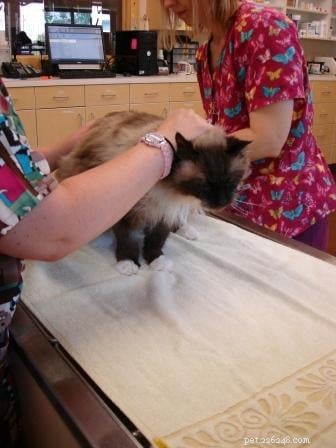
Rags During His Enema on 6-25-08 Vet Tech, Nicole, holds his neck and body, while Dr. Chappell administers the enema (a solution made up of water, KY Jelly and a little bit of soap!)
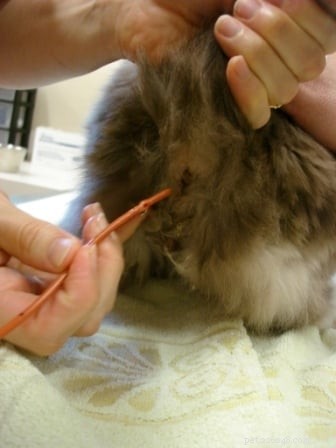
Insertion of Red Enema Tube into Rags’ Colon
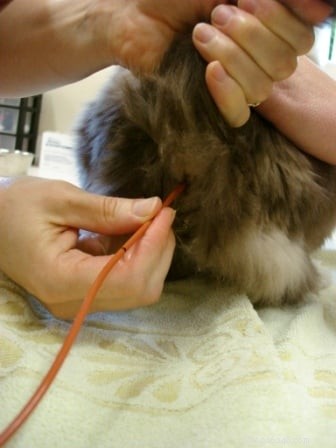
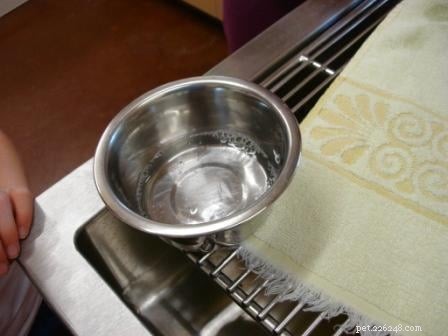
Dr. Chappell lifts Rags’ tail out of the way and inserts the red enema tube into his colon and then takes a syringe and fills it with the enema solution Dr. Chappell has created (water, KY Jelly and soap)–see this solution in the silver bowl in the picture below.
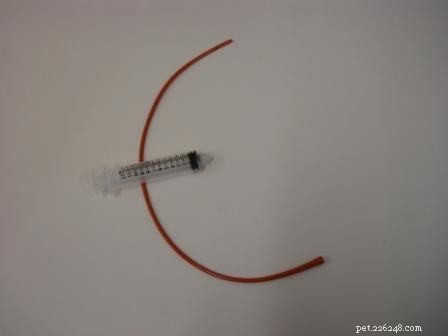
This is the red tube and the syringe before the Enema… Rags is given 1 tablet every night of Standard Process Feline Enteric Support to help him with his pooping problems. Enulose Information Check out the other procedures that Rags received:
- Rags’ Dental
- Rags’ Lymphoma
- Rags’ Blood Draw
- Rags’ B12 Shots/Acupressure
- Administering Fluids
Enemas for Cats
Enemas are recommended in mild to moderate episodes of constipation, or if the constipation is recurrent. Depending on the particularities of the case, doctors might recommend one of the following types of enemas:
- Warm tap water enema – a quantity of 5-10 mL/kg (0.8 – 0.15 fluid ounces/ pound) of lukewarm tap water will be used for the enema
- Warm isotonic saline enema – a quantity of 5-10 ML/kg (0.08 – 0.15 fluid ounces/ pound) of lukewarm isotonic saline solution will be used for the enema. You can make the saline solution yourself, but getting it at the pharmacy might be simpler.
- This might be enriched with a mild soap, which acts as a local irritant
- DSS (Dioctyl Sodium Sulfosuccinate 5% ) enema – a quantity of 5-10 mL/kg (0.08 – 0.15 fluid ounces/ pound) of DSS surfactant will be used for the enema
- Lactulose enema – a quantity of 5-10 mL/kg (0.08 – 0.15 fluid ounces/ pound) of lactulose will be used for the enema
- Mineral oil enema – a quantity of 5-10 mL/kg (0.08 – 0.15 fluid ounces/ pound) of mineral oil will be used for the enema
Let’s say your cat weighs 10 pounds. You would need 0.8 – 1.5 fluid ounces for the enema. It is very important to respect the quantity instructions because administering too little liquid will not be efficient and administering too much liquid in the enema might be dangerous. The veterinarian will instruct the ideal type of enema for your cat, as well as the quantity of liquid you need.
Warning! DO NOT USE SODIUM PHOSPHATE ENEMAS FOR CATS because they are toxic for them. Phosphate enemas are available for human use, but they can be very dangerous for cats. They absorb the sodium and the phosphate in this solution and it can lead to severe dehydration and electrolytes imbalance, which is potentially life-threatening.
If you are administering the enema without having contacted the veterinarian, it is ideal to use either warm water, mineral oil, or isotonic saline solution enema.
What You Need for the Procedure
Here’s a short checklist for what you need to give your cat an enema.
Materials for the enema
- A clean bowl
- This should preferably be a glass or metal bowl, try to avoid plastic ones.
- A syringe (without the needle)
- This can be a 10-25 mL syringe or larger one – a smaller one might be difficult to use because reloading your syringe might be difficult to do during the procedure because the cat will be agitated.
- A feeding tube
- Make sure this is lined with Vaseline or KY Jelly at the end that goes into the cat’s rectum for lubrication.
- The liquid solution for the enema
- Make sure to respect the quantity ranges listed above. Weigh your cat before the procedure and calculate the correct liquid quantity for its exact weight. Make sure you administer the minimum quantity and try not to surpass the maximum quantity.
Preparing the Room
Giving an enema to your cat has great potential to become quite messy, so you might want to do this in your bathroom or somewhere where you can clean easily. You can be sure that your cat will be agitated during the procedure, so you will need help. Get somebody to hold the cat while you are administering the enema.
To make it easier for you to do the procedure, it is very useful to place the cat on a table or an elevated place – it should be similar to the consultation table at the vet’s office. But please keep in mind that if your cat is aggressive, you might not succeed.
You should also make sure that there is a litter box close by because your cat will need to use it soon after the enema.
Steps for Giving the Enema
Now that everything is in place – your solution, your syringe, and Vaseline-lined feeding tube – and your cat is, hopefully, unsuspecting, it’s time to get started. Here are the steps you should follow:
- Draw the liquid solution for the enema into your syringe and connect it to the feeding tube to have everything ready. Make sure there is Vaseline at the loose end of the tube.
- Your sidekick should hold the cat firmly. You can wrap the cat in a towel to immobilize it and to try to prevent scratches. You need to face the cat’s tail and rectum, which must be out of the towel and accessible.
- Lift the cat’s tail and use your dominant hand to insert the feeding tube into the cat’s rectum. Be very gentle as the area might already be sensitive because of the constipation. The tube should be inserted 2-3 inches into the rectum – or less if you hit the hardened feces with the tube.
- Push the syringe pump to administer the liquid. Do it slowly, even if your cat is agitated. Administering it too quickly might be dangerous for the cat.
- Take out the tube and release the cat.
How long does it take to work?
The desired effect is for the cat to eliminate the now-softened stool. For some cats, this could happen soon after you’ve administered the enema. After 5-10 minutes, they will go to the litter box on their own and eliminate the stool.
But, in other cases when the stool is significantly hardened, it might take an hour or two for it to soften enough for the cat to eliminate it on its own. If you see your cat struggling to eliminate the stool, be ready to intervene. Wear gloves and use one finger to gently push the exposed stool out. Do not insert your finger in the cat’s rectum.
If the cat is struggling to eliminate the stool, call the veterinarian and ask what are the best steps forward. The vet might suggest a second enema or you may need to take the cat to the vet’s office.
The Effects of the Enema
When the cat eliminates the stool, don’t be scared if you see a small quantity of bright red blood on top of the stool. The hardened stool might cause small rectal lesions as it exits the rectum. However, more than a couple of drops of blood are certainly not normal and you need to take your cat to the vet immediately because rectal bleeding might signal a serious internal injury.
Bright red blood on the surface of brown stool signals a recent bleeding. You also need to look for blood inside the stool – this might be a brownish dark red area on a brown stool. If the eliminated stool is very dark brown to black, then it might signal bleeding in the upper portion of the digestive tract.
The best thing to do is to collect the eliminated stool in a freezer bag to show the vet. You can take a picture with your phone to send to the vet, then bag the stool and store it in the fridge (use another bag or a plastic container to place the bagged stool in) until you take it to the vet.
Passing the hardened feces can put a strain on the cat’s general state. After administering enemas, some cats might have other digestive symptoms such as vomiting or diarrhea. You may also notice some general symptoms such as lethargy, but this should pass in a few hours.
What is constipation?
Constipation occurs when a cat experiences difficulty defecating, which causes the retention of feces, or when it stops defecating altogether. The cat is bloated and agitated. It will try to defecate and if it is not successful, then its belly might become painful. By performing abdominal palpation, you can usually feel the hardened abdomen. When the cat does manage to evacuate the feces, these are usually dry and hardened.
In most cases, constipation can be easily treated with a mild laxative like glycerine to help the cat eliminate the hardened stool and then make some changes in its diet. The cat should eat highly digestible food after a constipation episode.
However, in some cases, evacuating the feces might not be so simple. The longer the dry feces stays inside, the harder it will get because the water inside the stool will be absorbed in the intestine. This makes the stool increasingly difficult to pass. If the cat is unable to eliminate the stool on its own, the constipation turns into obstipation.
This is when enemas should be administered. The role of the enema is to rehydrate the hardened stool located in the terminal portion of the rectum and to lubricate it so that it is easier for the cat to pass it.
In advanced cases, the constipation might be caused by an obstruction in the intestine which is preventing the fecal matter from passing through the intestine. More fecal matter gathers before the obstruction, causing the intestine to get distended. This is a life-threatening condition and the cat needs to get emergency surgery to eliminate the obstruction.
To diagnose an obstruction, the veterinarian will have to take abdominal radiographs or to perform an ultrasound.
How can constipation be treated?
To properly treat constipation, the doctor must first determine the cause. In most cases, the solution is simply changing the cat’s diet. Dietary therapy includes highly digestible diets, usually rich in fiber and cellulose, as well as proper hydration. Cat water fountains for cats could be very useful because they help cats drink more water.
If the constipation reoccurs, then the doctor will have to perform some tests like blood work (CBC) and urinalysis to rule out underlying diseases that might cause this symptom such as acute kidney disease, chronic renal disease, diabetes, hyperthyroidism, or many others.
If the cat develops chronic constipation, then the condition must be thoroughly monitored.
Owners must check the litter box on a daily basis to make sure that the cat has defecated. Ideally, they should check faecal consistency regularly to make sure that the feces are not dry.
If they notice tenesmus (the cat struggling with the difficult evacuation of feces) or if the cat has not managed to defecate, the owner must intervene quickly and administer a laxative (at first) to prevent obstipation, which may require them to give the cat an enema.
What is megacolon?
Megacolon is a condition that occurs when the cat’s large intestine becomes dilated and loses motility (its ability to perform peristaltic contractions that stimulate the passage of the intestine contents along the digestive tract towards the rectum).
Since the intestinal content is no longer pushed down the digestive tract, it accumulates in the colon, making it dilated. As mentioned above, when fecal matter stagnates in the intestine, it hardens because the water is absorbed from it. The result is the massive enlargement of the diameter of the colon. This portion of the large intestine is filled with the hardened fecal bulk, which the cat is unable to eliminate on its own.
Megacolon might be caused by a previous pelvic trauma that the cat has suffered, which affects caudal spinal cord function. Other causes include tumors, obstruction caused by the ingestion of foreign bodies, or large hairballs. Unfortunately, in many cases, megacolon is idiopathic, which means that an exact cause of the improper function of the affected portion of the colon cannot be determined.
How can megacolon be treated?
If the megacolon is caught early, then the vet can try medical treatment. Using laxatives, stool softeners (like polyethylene glycol or other hyperosmotic laxatives that work by retaining water in the stool, which leads to softer stools as well as more frequent bowel movements), enemas, highly digestible diets (dry diets should be avoided entirely), and colon wall stimulants, the condition might be kept under control for a while.
Please note that this type of treatment will not cure the megacolon. The affected area of the intestine will not regain motility, but the treatment might help the cat avoid constipation and obstipation.
However, after a while – it can be a few months or a few years – the treatment will stop working and the megacolon will require surgical treatment. This entails the surgical removal of the affected portion of the colon (subtotal colectomy) under general anesthesia. The remaining portion of the colon will be connected to the anus and the cat will soon be able to defecate on its own.
- Pet Behavior
- Pet Breeds
- Pet Names
- Pet Adoption
- Pet Training
- Cat Stories
- Pet Health
- Adorable Pets
- Cats
- Choosing the Perfect Cat Tree or Condo: Boost Your Kitty’s Health & Happiness
- Hyperthyroidism in Cats: Symptoms, Diagnosis, and Care
- Cats and COVID-19: What Pet Owners Must Know About Risks and Protection
- Is an Outdoor Cat Shelter Essential for Your Feline’s Winter Safety?
- Expert Guide: How to Bathe Your Cat Safely & Stress‑Free
- Understanding Cat Hairballs: Causes, Prevention, and Care
- Should You Bathe Your Cat? Expert Guide to Cat Bathing