

The Truth About Declawing Cats: Risks, Alternatives, and Why You Should Think Twice
I am very opposed to declawing.
25% of cats in the U.S. are declawed, and a lot of people continue to declaw their cats simply because they are unaware of what the surgery entails – they assume that it is just the removal of the cat’s claws. However, the procedure actually involves removing part of the cat’s bone as well, since the entire last joint has to be cut off, not just the claw. The Paw Project is trying to educate people on the dangers of declawing through their documentary The Paw Project Movie, and cat expert Jackson Galaxy – who calls the surgery “de-knuckling” – described the practice as inhumane and barbaric in his YouTube video “Declawing: Jackson Galaxy Just Says No!” Below are some facts to consider regarding problems with declawing, as well as alternatives that can help you maintain a nice home without hurting a beloved pet.
PROBLEMS
MeLinda Hughes of Merlin’s Hope Ragdoll Rescue has five cats who have all been declawed – and every one of them suffers from various issues as a result. Hughes argues in her article “Declawing Cats: Alternatives, Problems, and More from a Ragdoll Rescue Expert” that declawing cats causes both physical harm and psychological damage, resulting in long term medical and behavioral problems. Her cats experienced everything from arthritis, to spine problems, to anti-social behaviors, and more. As a rescuer, she has noticed that over 50% of the declawed cats who end up in shelters are there because of behavior issues related to declawing.
Hughes’s story is part of a large body of anecdotal evidence demonstrating the negative effects of cat clawing (include mention of/link to the facebook post?). But not only cat owners have noticed these issues; experts in addition to Jackson Galaxy are speaking out as well. Holistic veterinarian Jean Hofve, DMV, expounded on the topic and listed many problems associated with the procedure in her article “Declawing: A Rational Look”:
- Surgical Issues – As with any procedure, there is always the risk of mistakes: tourniquet problem, inexperience, an off day, bad technique, or a positioning issue could all cause complications such as irreversible nerve damage. Some suggest that laser declawing is a less messy alternative, but laser surgery still does not reduce the amount of pain that a cat experiences.
- Complications During Recovery – Cats can experience issues such as claws growing back or abscesses up to several years after the surgery, and they might even experience permanent or occasional lameness for the rest of their lives. One study followed declawed cats 5 months after their surgery and found that almost 1/3 of the cats experienced some sort of complication.
- Death – In extreme cases, cats can even die as a result of anesthesia complications or profuse bleeding. Cats who end up in shelters as a result of behavior issues might also be likely to be put down. Abandoned cats also run the risk of being stolen for use in laboratories or as bait for training fighting dogs.
- Chronic Pain – Cats might not be able to express their pain in human terms, but signs such as half closed eyes, pulled back whiskers, and a reluctance to place weight on their paws are all evidence of the post surgical pain they experience. In addition, we can infer from human amputation experiences that cats probably experience “phantom” sensations—including pains—in their missing joints, which can last a lifetime. Physiologically, this makes perfect sense, since cats’ nervous systems are very similar to humans’. Some owners of declawed cats have noticed that their cats still scratch at scratching posts even though they are declawed, possibly as a result of the phantom sensations of their missing joint and claw.
- Arthritis/Joint Problems – Another possible explanation of a cat’s tendency to continue to scratch after declawing is that it is a desperate attempt to stretch contracted tendons. Once a cat is declawed, their joints retract and remain retracted for the rest of their life. Anatomically, cats are built to walk resting a lot of their weight on their toes, so surgery requires cats to shift their weight back to the pads of their feet. This unnatural posture can cause stress on their spine and leg joints, leading to joint damage and arthritis in multiple places.
- Behavioral Issues – Some experts, including Jackson Galaxy, cite biting issues as a negative result of declawing. Cats use their claws as one of their first lines of defense, but when they realize that this is not available to them, they might turn to biting as their next best way of reacting to unpleasant situations or trying to get attention—which then defeats the purpose of getting a cat declawed to stop them from harming people. In addition to biting issues, many cat owners complain of a variety of psychological changes in their cat after the surgery, such as anti-social, fearful, and depressed behavior.
- Urination Problems – Statistics support the idea that cats who have been declawed have more litter box issues (95% of declawed cats, according to one survey), because walking on the litter becomes painful to the cats’ altered feet and they are unable to dig to eliminate waste. Again, this defeats the purpose of getting cats declawed to prevent material damage to a house, as urine can damage carpets, subfloors, and drywall.
- Mistreatment and Abandonment – Sometimes cats who experience the side effects of declawing, such as behavior issues or litter box problems, can be neglected, abused, or gotten rid of by their owners. They might be sent to a shelter, locked in a specific part of the house, or exiled outdoors – where they are no longer able to protect themselves from predators because they are without their natural defenses and unable to climb to escape danger. There is no way of knowing how many of the cats in shelters ended up there because of declawing problems, but it is a pattern that rescuers have noticed, and clearly contradicts the claim made by many veterinarians that declawing keeps cats in good homes.
There are a lot of psychological and health problems associated with cat declawing, and the negative side effects sometimes even counteract the purpose of the surgery in the first place.
ALTERNATIVES
If you are concerned about your cat scratching humans or damaging your house and furniture, there are other ways of dealing with these issues that simply require a little research and perhaps some training. Here are a few common alternatives to declawing, as suggested in the Jackson Galaxy article “Cats and Claws – Living Happily Ever After”:
Clipping
Clipping a cat’s nails regularly is one simple solution to the scratching problem. Cats might not enjoy the process at first, but start when the cats are young and work to clip the sharp tip on a weekly basis so that they will become used to it. If your cat tries to escape, consider wrapping them in a towel and gently taking out one paw at a time to clip the claws, pressing your thumb on the paw gently until the claws are splayed. Avoid the dark center of the claw, as this is the quick, and will cause pain and bleeding if clipped. Be sure also that your clippers are not dull, as this can crush the nail.
Scratching Posts
We now know from recent insights into cat behavior and psychology that scratching is a natural urge for cats. Consider getting them a scratching post, a cat condo, or a cat tree, and training them to use these instead of scratching household objects. It is important to try to find the best option for your cat’s preferences—for instance, there are horizontal cardboard scratchers for cats who tend to scratch carpet, small ramps for cats who like to scratch furniture, and upright post that simulate trees—which is what cats often want to scratch in the first place. Pay attention as well to the material of the post, aiming for what most resembles what the cat likes to scratch.
Deterrents
Sometimes you can put something on the furniture that deters a cat from wanting to scratch it. You might use scents, such as certain pheromones or some lemon/lime water since most cats do not like the smell of citrus. You can also put something on the surface, such as tin foil or Sticky Paws, a product that functions like double sided tape and is unpleasant for the cat to touch.
Soft Claws or Soft Paws
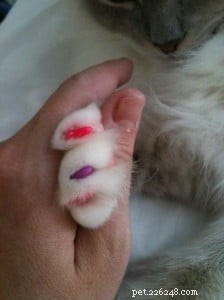
This is another product just for cats, and is useful for cats who refuse to use a scratching post. They are nail caps that a groomer or vet can put on, but pet owners can also learn to do it themselves. The only downside to this option is that they need to be replaced every few weeks, which can get expensive if you do not learn to replace them yourself.
Check out the article “Do Not Declaw Your Cat(s), Ever!” for more information on declawing and solutions to getting a cat to stop scratching floors and furniture.
A major part of getting your cat to stop scratching where you do not want them to is training, which requires, a lot of time, patience, and positive reinforcement. Declawing a cat might be a more expedient option, but it is definitely not the most humane, effective, or even cost efficient solution to scratching problems. Many vets and breeders are even coming around to this conclusion, and as a result many vets are refusing to do the procedure and breeders are asking owners to sign contracts not to declaw their cats. As the side effects of declawing are becoming more and more publicized, educate yourself on what you might be doing to your cat and the other options that are available.
- Pet Behavior
- Pet Breeds
- Pet Names
- Pet Adoption
- Pet Training
- Cat Stories
- Pet Health
- Adorable Pets
- Cats
- Bolt & Keel: Trailblazing Cats Captivating Social Media
- Discover the Fascinating History of Cats – From Ancient Egypt to Modern Times
- Common Urinary Tract Issues in Dogs and Cats: Symptoms, Causes & Care
- Declawing Cats: Alternatives, Issues, and Expert Insights from a Ragdoll Rescue Specialist
- Understanding Cat Urine pH: Protecting Your Feline’s Urinary Health
- 7 Celebrity Cat Lovers and Their Feline Friends
- The Truth About Cat Declawing: Risks, Benefits, and Safer Alternatives