

Expert Guide: Feeding My Ragdoll Cat Prossimo with a Raw Diet
Originally published Jun 13, 2014
I wanted to rerun this post by Christy because I get a lot of comments on this video that I did as a result of this post:
I’d like to share how I feed Prossimo. Let me start by saying that, based on my experience, while I am an advocate for raw feeding I have no personal opinion about how other people feed. I am writing this to share and it is not a judgement!
Also, you should know that I am a huge fan of exclamation points(!!) and simply an uneducated person giving my opinion. Whatever you decide to feed your pets you will need to embark upon on your own research, draw your own conclusions and make your decisions independent of my experiences and opinions. I am not a professional nor do I play one on TV!
While all of this may seem overwhelming and a lot of work, take it from a Certified Lazy Pants, it’s really quite easy!
First, there are basically four types of raw:
1) Commercial “kibble” type raw
2) Ground (either commercial or homemade)
3) Franken-Prey
4) Whole Prey
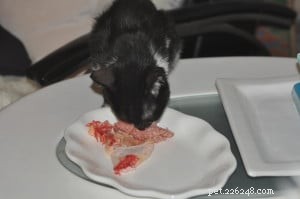 Personally, I am not a fan of “commercial” raw (ground or kibble) as there is typically way too much bone content, other fillers (peas, rice, etc…), the benefits of crunching/ripping/tearing are lost and the risk of bacterial overload is higher since there is more surface area of the meat for bad bacteria to come in contact with and grow. It’s also generally much more expensive.
Some people do find that employing commercial raw for transition or for a particular reason helpful.
I used increasing amounts of raw meat with decreasing amounts of commercial kibble-type raw, canned kitten food and tuna juice to transition Prossimo over four days. From what I gather, this quick of a transition is quite unusual for a cat so don’t use my experience to compare your progress. Every bite of meat is a success!
I use the ratio of 85% meat, 5% bone, 10% organ (5% liver and 5% other organs). I started Prossimo with chicken, turkey, pork, beef and lamb. Cats can’t make Taurine but they need it. All meat contains Taurine but parts that are used a lot or those with electrical activity have higher amounts (thigh, heart, eyes, brain, tongue, etc…).
The items I fed were primarily sourced from grocery stores. Since the animals were a bit older and moved around some resulting is using their muscles (as much as factory farming allows for), I did not supplement with Taurine.
Next, you need to find out how much to feed your cat (fyi, it’s the same calculation for a dog). You’ll need the ideal adult weight of your cat multiplied by 2% – 4% based on their activity level. If your cat is a couch potato and thinks moving is akin to devil worship, then feed closer to 2%. If your cat doesn’t know the meaning of a nap, closer to 4% or more is where you want to start. If you are lazy and bad at math like me, here’s a handy dandy calculator (scroll to the bottom of the page).
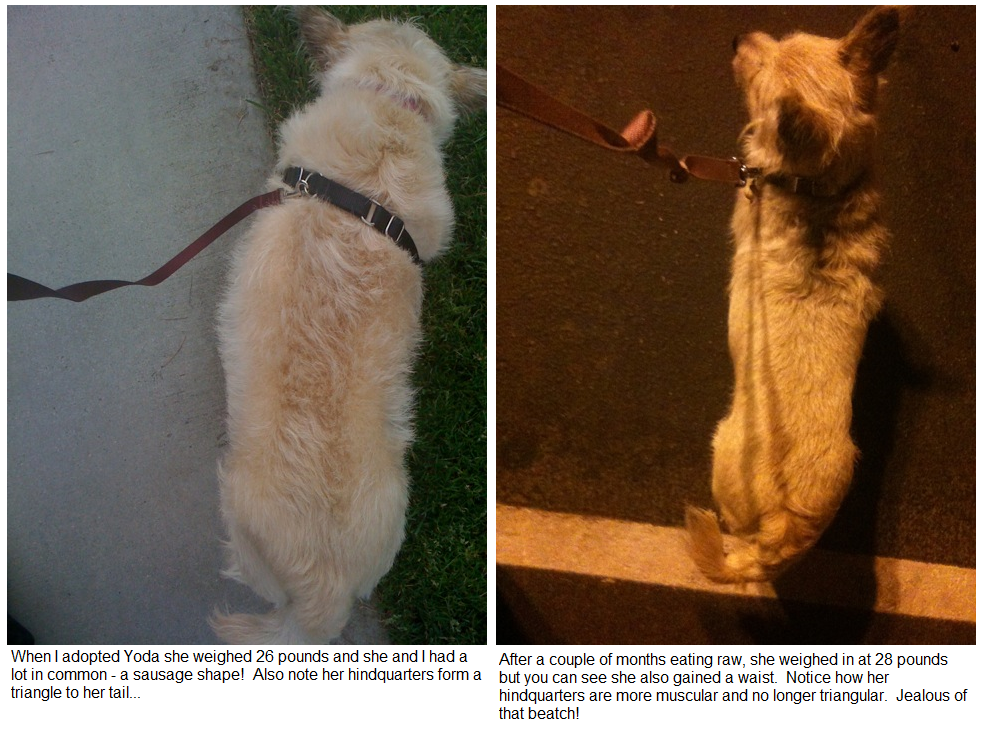
I have only had one animal (my current dog, Yoda), not self-regulate on a raw diet so if your calculations show that your cat should be offered 5oz. food a day but he’s screaming at you for more, go ahead and feed him more. If he wants less, don’t stress. Just keep an eye on his weight. Please note, raw fed animals will typically gain weight but their shapes will change showing that the gain is from muscle; they are not overweight.
Here’s some pictures of Yoda (clearly not a cat!) that are a great visual of this:
Personally, I am not a fan of “commercial” raw (ground or kibble) as there is typically way too much bone content, other fillers (peas, rice, etc…), the benefits of crunching/ripping/tearing are lost and the risk of bacterial overload is higher since there is more surface area of the meat for bad bacteria to come in contact with and grow. It’s also generally much more expensive.
Some people do find that employing commercial raw for transition or for a particular reason helpful.
I used increasing amounts of raw meat with decreasing amounts of commercial kibble-type raw, canned kitten food and tuna juice to transition Prossimo over four days. From what I gather, this quick of a transition is quite unusual for a cat so don’t use my experience to compare your progress. Every bite of meat is a success!
I use the ratio of 85% meat, 5% bone, 10% organ (5% liver and 5% other organs). I started Prossimo with chicken, turkey, pork, beef and lamb. Cats can’t make Taurine but they need it. All meat contains Taurine but parts that are used a lot or those with electrical activity have higher amounts (thigh, heart, eyes, brain, tongue, etc…).
The items I fed were primarily sourced from grocery stores. Since the animals were a bit older and moved around some resulting is using their muscles (as much as factory farming allows for), I did not supplement with Taurine.
Next, you need to find out how much to feed your cat (fyi, it’s the same calculation for a dog). You’ll need the ideal adult weight of your cat multiplied by 2% – 4% based on their activity level. If your cat is a couch potato and thinks moving is akin to devil worship, then feed closer to 2%. If your cat doesn’t know the meaning of a nap, closer to 4% or more is where you want to start. If you are lazy and bad at math like me, here’s a handy dandy calculator (scroll to the bottom of the page).
I have only had one animal (my current dog, Yoda), not self-regulate on a raw diet so if your calculations show that your cat should be offered 5oz. food a day but he’s screaming at you for more, go ahead and feed him more. If he wants less, don’t stress. Just keep an eye on his weight. Please note, raw fed animals will typically gain weight but their shapes will change showing that the gain is from muscle; they are not overweight.
Here’s some pictures of Yoda (clearly not a cat!) that are a great visual of this:
 I started Prossimo with about 6oz. of food a day. Here’s an example of a day’s worth of “franken-prey” that I fed him:
Frankenprey diet for cats:
M turkey thigh (skin-on, boneless – 2.5 oz +/-)
M pork roast (boneless, skinless – 2.5 oz +/-)
B quail (.3 oz)
OO pork kidney (.3 oz)
OL pork liver (.3 oz)
So, the M stands for meat and can be substituted for any meat that you can get and your cat likes. The darker/redder the meat the better (fyi pork is only a “white” meat for marketing purposes!) I would buy stew meat when I was really lazy since I didn’t need to cut it. Heart is a good meat (when feeding raw it’s muscle, not an organ), as are gizzards. Please note, cats need fat so don’t feed them like Jack Sprat!
Fish is totally unnecessary but if you do decide to feed it, make sure it’s wild and sparingly fed. Whole eggs can be a good choice.
Bone, indicated by B, usually need to be smaller for a cat. I bought dressed quail from Whole Foods (two were $10-$15), which is expensive but really easy to cut up in the appropriate quantities. Dressed quail are heavy bone content so count them as all bone. Chicken “ribs”, wing tips, Cornish Game Hens, sliced rounds of chicken or turkey necks can all be good choices.
The first time I fed Prossimo a whole dressed quail he went nutso so I knew he liked it, so I stuck with it. He won’t eat bigger bone, not even adult chicken feet so for me quail became a one-stop bone source!
Another trick you can try (don’t guarantee it will work) is to wrap bone in a nice thick hand towel and take a hammer to it. If this works you can feed wings, thighs, etc… You can also grind up eggshells instead. I’ve never done this – I tried just breaking them up into tiny pieces but they were firmly rejected! As I understand it, you should dry out the eggshells, put them through a spice or coffee grinder and feed 1/2 teaspoon per pound of meat.
You can also try “ribboning” the meat. Basically cutting or pulling it in “ribbons” hanging (still attached) to the bone. You may need to start with both hammering the bone and ribboning the meat.
A word about rejection… if at first your cat stymies your success, try, try, try again!
OO or “other organ” is organ, other than liver that you can find. Find your community’s ethnic grocery stores, talk to farmers, backyard farmers, processors, hunters, etc…
Liver, indicated by OL above, is any liver you can get. Typically grocery stores will carry chicken and beef with regularity.
When feeding anyone in our families – people or four-legged – the food supply itself is not fed properly much anymore which means the balance of Omega’s are
I started Prossimo with about 6oz. of food a day. Here’s an example of a day’s worth of “franken-prey” that I fed him:
Frankenprey diet for cats:
M turkey thigh (skin-on, boneless – 2.5 oz +/-)
M pork roast (boneless, skinless – 2.5 oz +/-)
B quail (.3 oz)
OO pork kidney (.3 oz)
OL pork liver (.3 oz)
So, the M stands for meat and can be substituted for any meat that you can get and your cat likes. The darker/redder the meat the better (fyi pork is only a “white” meat for marketing purposes!) I would buy stew meat when I was really lazy since I didn’t need to cut it. Heart is a good meat (when feeding raw it’s muscle, not an organ), as are gizzards. Please note, cats need fat so don’t feed them like Jack Sprat!
Fish is totally unnecessary but if you do decide to feed it, make sure it’s wild and sparingly fed. Whole eggs can be a good choice.
Bone, indicated by B, usually need to be smaller for a cat. I bought dressed quail from Whole Foods (two were $10-$15), which is expensive but really easy to cut up in the appropriate quantities. Dressed quail are heavy bone content so count them as all bone. Chicken “ribs”, wing tips, Cornish Game Hens, sliced rounds of chicken or turkey necks can all be good choices.
The first time I fed Prossimo a whole dressed quail he went nutso so I knew he liked it, so I stuck with it. He won’t eat bigger bone, not even adult chicken feet so for me quail became a one-stop bone source!
Another trick you can try (don’t guarantee it will work) is to wrap bone in a nice thick hand towel and take a hammer to it. If this works you can feed wings, thighs, etc… You can also grind up eggshells instead. I’ve never done this – I tried just breaking them up into tiny pieces but they were firmly rejected! As I understand it, you should dry out the eggshells, put them through a spice or coffee grinder and feed 1/2 teaspoon per pound of meat.
You can also try “ribboning” the meat. Basically cutting or pulling it in “ribbons” hanging (still attached) to the bone. You may need to start with both hammering the bone and ribboning the meat.
A word about rejection… if at first your cat stymies your success, try, try, try again!
OO or “other organ” is organ, other than liver that you can find. Find your community’s ethnic grocery stores, talk to farmers, backyard farmers, processors, hunters, etc…
Liver, indicated by OL above, is any liver you can get. Typically grocery stores will carry chicken and beef with regularity.
When feeding anyone in our families – people or four-legged – the food supply itself is not fed properly much anymore which means the balance of Omega’s are
 off. For example, if cattle are fed grass the meat butchered from that animal will have a nice balance of Omegas with Omega 3 being higher (good!). If, on the other hand, cattle are fed grain will not have a nice ratio of Omegas – Omega 3’s will be lower (bad!). This is why Omega 3 supplements have become so popular.
Once you get your cat eating the diet, try incorporating one drop of an Omega 3 or Krill Oil capsule. It took nearly a 1.5 years for Prossimo to eat food with any Omega 3. I tried one drop a week and was soundly rejected each time! This is a good lesson in thinking “long-term”.
I bagged up enough food for 2-3 weeks at a time and would freeze each meal. Generally Prossimo ate 2x a day but there are days that he only ate once and others when he ate 4x. He’s a self-regulator and not overweight so if he’s telling me he’s hungry I believe him and feed him more. This meant that I bagged up 14 – 21 bags of food, at 6 ounces each. To make it super easy, using the sample menu above I would feed him 2.5oz of meat + .3oz of bone in one meal and 2.5 oz of meat and a “organ cube” (see below) for his 2nd meal.
off. For example, if cattle are fed grass the meat butchered from that animal will have a nice balance of Omegas with Omega 3 being higher (good!). If, on the other hand, cattle are fed grain will not have a nice ratio of Omegas – Omega 3’s will be lower (bad!). This is why Omega 3 supplements have become so popular.
Once you get your cat eating the diet, try incorporating one drop of an Omega 3 or Krill Oil capsule. It took nearly a 1.5 years for Prossimo to eat food with any Omega 3. I tried one drop a week and was soundly rejected each time! This is a good lesson in thinking “long-term”.
I bagged up enough food for 2-3 weeks at a time and would freeze each meal. Generally Prossimo ate 2x a day but there are days that he only ate once and others when he ate 4x. He’s a self-regulator and not overweight so if he’s telling me he’s hungry I believe him and feed him more. This meant that I bagged up 14 – 21 bags of food, at 6 ounces each. To make it super easy, using the sample menu above I would feed him 2.5oz of meat + .3oz of bone in one meal and 2.5 oz of meat and a “organ cube” (see below) for his 2nd meal.
 I have a Kitchen Binz! container in my fridge that I keep two baggies of food in. Cats usually like their food room temperature but your cat’s fussiness may vary! Prossimo will eat food right out of the fridge or room temperature. If you know you have to leave for work at 7:30am, pull one bag out when you wake up and let it come to room temperature while you curl your lashes and otherwise make yourself fabulous for the day. Do not put food in a microwave or in boiling water. If you are in a jam, you can put the baggie of food in a bowl of hot tap water.
The easiest way to “prepare” organs is to freeze them first. Bring them out to thaw just a bit and as soon as you can get your knife thru, start cutting. Being lazy, I would use simple math and ice cube trays to make this go by quick! Knowing that at .25oz a day of liver it would take 64 days to get thru one pound, I would first cut the a pound of liver into four. Put three of the pieces back in the freezer (depending on your freezer room and how many ice cube trays you have of course!).
I have a Kitchen Binz! container in my fridge that I keep two baggies of food in. Cats usually like their food room temperature but your cat’s fussiness may vary! Prossimo will eat food right out of the fridge or room temperature. If you know you have to leave for work at 7:30am, pull one bag out when you wake up and let it come to room temperature while you curl your lashes and otherwise make yourself fabulous for the day. Do not put food in a microwave or in boiling water. If you are in a jam, you can put the baggie of food in a bowl of hot tap water.
The easiest way to “prepare” organs is to freeze them first. Bring them out to thaw just a bit and as soon as you can get your knife thru, start cutting. Being lazy, I would use simple math and ice cube trays to make this go by quick! Knowing that at .25oz a day of liver it would take 64 days to get thru one pound, I would first cut the a pound of liver into four. Put three of the pieces back in the freezer (depending on your freezer room and how many ice cube trays you have of course!).
 Take the 4oz. piece and cut it into 16 pieces (16 x .25oz = 4oz). Put each of the 16 pieces in its own cube space. Repeat with kidney or other organ but put on top of the liver. Freeze. Once done, you will have 16 “organ cubes”!
Depending on your cat, you may find that eating organ frozen / cold or on the other end of the spectrum, seared works better. For Prossimo frozen was the preferred preparation. Eventually though he refused all organ which was one my motivators for switching to Whole Prey. More on that later…
Prossimo eats either on a towel or in a cabinet that I “made” (I took a old cabinet and drilled a hole in it for him to enter/exit thru. I have a “3 Strikes Your Out” rule – if either animal moves their food off the towel,
Take the 4oz. piece and cut it into 16 pieces (16 x .25oz = 4oz). Put each of the 16 pieces in its own cube space. Repeat with kidney or other organ but put on top of the liver. Freeze. Once done, you will have 16 “organ cubes”!
Depending on your cat, you may find that eating organ frozen / cold or on the other end of the spectrum, seared works better. For Prossimo frozen was the preferred preparation. Eventually though he refused all organ which was one my motivators for switching to Whole Prey. More on that later…
Prossimo eats either on a towel or in a cabinet that I “made” (I took a old cabinet and drilled a hole in it for him to enter/exit thru. I have a “3 Strikes Your Out” rule – if either animal moves their food off the towel,
 the food is taken away for a while. He sometimes takes his food elsewhere and I tell him “bring your food back to the towel, now”. More often than not, he comes back. If he doesn’t and I have to move it, I let him know if he does it again, the food is going away.
I rotate two towels that I feed the animals on. Once they are done with their meal, I put the towel in a cloth bag and store it in my furnace closet. Every couple of weeks I wash the towels and the bag. You may find a different method that works best for you. I have found that both cats and dogs don’t really appreciate plastic or ceramic for chunks of meat, they need the leverage cloth provides and it’s easy enough to move the meat or themselves around on.
A word about cleanliness. I wash my hands with soap and water. I clean my prep area. I clean like I do for my own food. You should do what you feel is best.
the food is taken away for a while. He sometimes takes his food elsewhere and I tell him “bring your food back to the towel, now”. More often than not, he comes back. If he doesn’t and I have to move it, I let him know if he does it again, the food is going away.
I rotate two towels that I feed the animals on. Once they are done with their meal, I put the towel in a cloth bag and store it in my furnace closet. Every couple of weeks I wash the towels and the bag. You may find a different method that works best for you. I have found that both cats and dogs don’t really appreciate plastic or ceramic for chunks of meat, they need the leverage cloth provides and it’s easy enough to move the meat or themselves around on.
A word about cleanliness. I wash my hands with soap and water. I clean my prep area. I clean like I do for my own food. You should do what you feel is best.
Personally, I am not a fan of “commercial” raw (ground or kibble) as there is typically way too much bone content, other fillers (peas, rice, etc…), the benefits of crunching/ripping/tearing are lost and the risk of bacterial overload is higher since there is more surface area of the meat for bad bacteria to come in contact with and grow. It’s also generally much more expensive.
Some people do find that employing commercial raw for transition or for a particular reason helpful.
I used increasing amounts of raw meat with decreasing amounts of commercial kibble-type raw, canned kitten food and tuna juice to transition Prossimo over four days. From what I gather, this quick of a transition is quite unusual for a cat so don’t use my experience to compare your progress. Every bite of meat is a success!
I use the ratio of 85% meat, 5% bone, 10% organ (5% liver and 5% other organs). I started Prossimo with chicken, turkey, pork, beef and lamb. Cats can’t make Taurine but they need it. All meat contains Taurine but parts that are used a lot or those with electrical activity have higher amounts (thigh, heart, eyes, brain, tongue, etc…).
The items I fed were primarily sourced from grocery stores. Since the animals were a bit older and moved around some resulting is using their muscles (as much as factory farming allows for), I did not supplement with Taurine.
Next, you need to find out how much to feed your cat (fyi, it’s the same calculation for a dog). You’ll need the ideal adult weight of your cat multiplied by 2% – 4% based on their activity level. If your cat is a couch potato and thinks moving is akin to devil worship, then feed closer to 2%. If your cat doesn’t know the meaning of a nap, closer to 4% or more is where you want to start. If you are lazy and bad at math like me, here’s a handy dandy calculator (scroll to the bottom of the page).
I have only had one animal (my current dog, Yoda), not self-regulate on a raw diet so if your calculations show that your cat should be offered 5oz. food a day but he’s screaming at you for more, go ahead and feed him more. If he wants less, don’t stress. Just keep an eye on his weight. Please note, raw fed animals will typically gain weight but their shapes will change showing that the gain is from muscle; they are not overweight.
Here’s some pictures of Yoda (clearly not a cat!) that are a great visual of this:
I started Prossimo with about 6oz. of food a day. Here’s an example of a day’s worth of “franken-prey” that I fed him:
Frankenprey diet for cats:
M turkey thigh (skin-on, boneless – 2.5 oz +/-)
M pork roast (boneless, skinless – 2.5 oz +/-)
B quail (.3 oz)
OO pork kidney (.3 oz)
OL pork liver (.3 oz)
So, the M stands for meat and can be substituted for any meat that you can get and your cat likes. The darker/redder the meat the better (fyi pork is only a “white” meat for marketing purposes!) I would buy stew meat when I was really lazy since I didn’t need to cut it. Heart is a good meat (when feeding raw it’s muscle, not an organ), as are gizzards. Please note, cats need fat so don’t feed them like Jack Sprat!
Fish is totally unnecessary but if you do decide to feed it, make sure it’s wild and sparingly fed. Whole eggs can be a good choice.
Bone, indicated by B, usually need to be smaller for a cat. I bought dressed quail from Whole Foods (two were $10-$15), which is expensive but really easy to cut up in the appropriate quantities. Dressed quail are heavy bone content so count them as all bone. Chicken “ribs”, wing tips, Cornish Game Hens, sliced rounds of chicken or turkey necks can all be good choices.
The first time I fed Prossimo a whole dressed quail he went nutso so I knew he liked it, so I stuck with it. He won’t eat bigger bone, not even adult chicken feet so for me quail became a one-stop bone source!
Another trick you can try (don’t guarantee it will work) is to wrap bone in a nice thick hand towel and take a hammer to it. If this works you can feed wings, thighs, etc… You can also grind up eggshells instead. I’ve never done this – I tried just breaking them up into tiny pieces but they were firmly rejected! As I understand it, you should dry out the eggshells, put them through a spice or coffee grinder and feed 1/2 teaspoon per pound of meat.
You can also try “ribboning” the meat. Basically cutting or pulling it in “ribbons” hanging (still attached) to the bone. You may need to start with both hammering the bone and ribboning the meat.
A word about rejection… if at first your cat stymies your success, try, try, try again!
OO or “other organ” is organ, other than liver that you can find. Find your community’s ethnic grocery stores, talk to farmers, backyard farmers, processors, hunters, etc…
Liver, indicated by OL above, is any liver you can get. Typically grocery stores will carry chicken and beef with regularity.
When feeding anyone in our families – people or four-legged – the food supply itself is not fed properly much anymore which means the balance of Omega’s are
off. For example, if cattle are fed grass the meat butchered from that animal will have a nice balance of Omegas with Omega 3 being higher (good!). If, on the other hand, cattle are fed grain will not have a nice ratio of Omegas – Omega 3’s will be lower (bad!). This is why Omega 3 supplements have become so popular.
Once you get your cat eating the diet, try incorporating one drop of an Omega 3 or Krill Oil capsule. It took nearly a 1.5 years for Prossimo to eat food with any Omega 3. I tried one drop a week and was soundly rejected each time! This is a good lesson in thinking “long-term”.
I bagged up enough food for 2-3 weeks at a time and would freeze each meal. Generally Prossimo ate 2x a day but there are days that he only ate once and others when he ate 4x. He’s a self-regulator and not overweight so if he’s telling me he’s hungry I believe him and feed him more. This meant that I bagged up 14 – 21 bags of food, at 6 ounces each. To make it super easy, using the sample menu above I would feed him 2.5oz of meat + .3oz of bone in one meal and 2.5 oz of meat and a “organ cube” (see below) for his 2nd meal.
I have a Kitchen Binz! container in my fridge that I keep two baggies of food in. Cats usually like their food room temperature but your cat’s fussiness may vary! Prossimo will eat food right out of the fridge or room temperature. If you know you have to leave for work at 7:30am, pull one bag out when you wake up and let it come to room temperature while you curl your lashes and otherwise make yourself fabulous for the day. Do not put food in a microwave or in boiling water. If you are in a jam, you can put the baggie of food in a bowl of hot tap water.
The easiest way to “prepare” organs is to freeze them first. Bring them out to thaw just a bit and as soon as you can get your knife thru, start cutting. Being lazy, I would use simple math and ice cube trays to make this go by quick! Knowing that at .25oz a day of liver it would take 64 days to get thru one pound, I would first cut the a pound of liver into four. Put three of the pieces back in the freezer (depending on your freezer room and how many ice cube trays you have of course!).
Take the 4oz. piece and cut it into 16 pieces (16 x .25oz = 4oz). Put each of the 16 pieces in its own cube space. Repeat with kidney or other organ but put on top of the liver. Freeze. Once done, you will have 16 “organ cubes”!
Depending on your cat, you may find that eating organ frozen / cold or on the other end of the spectrum, seared works better. For Prossimo frozen was the preferred preparation. Eventually though he refused all organ which was one my motivators for switching to Whole Prey. More on that later…
Prossimo eats either on a towel or in a cabinet that I “made” (I took a old cabinet and drilled a hole in it for him to enter/exit thru. I have a “3 Strikes Your Out” rule – if either animal moves their food off the towel,
the food is taken away for a while. He sometimes takes his food elsewhere and I tell him “bring your food back to the towel, now”. More often than not, he comes back. If he doesn’t and I have to move it, I let him know if he does it again, the food is going away.
I rotate two towels that I feed the animals on. Once they are done with their meal, I put the towel in a cloth bag and store it in my furnace closet. Every couple of weeks I wash the towels and the bag. You may find a different method that works best for you. I have found that both cats and dogs don’t really appreciate plastic or ceramic for chunks of meat, they need the leverage cloth provides and it’s easy enough to move the meat or themselves around on.
A word about cleanliness. I wash my hands with soap and water. I clean my prep area. I clean like I do for my own food. You should do what you feel is best.
- Variety: try to feed as much variety as you can so you don’t end up with a picky bugger of a cat.
- Feed to Tolerance: if your cat’s stools change or they hork things up, increase or decrease as necessary. Sometimes changes are no big deal, however “know thy cat” is a great mantra.
- Poops: watch poops as they tell you a lot! If they are grey, crumble, have bright red blood on the outside, are hard, etc… that’s telling you that they ate too much bone. If their poops are soft, pudding-y, more liquid, etc., that’s telling you it’s not enough bone and/or too much organ. Also, raw fed cats poop way less. Sometimes they poop once a day and at the other end of the spectrum, sometimes it’s once every five days.
- Rejection: cat’s are buggers, don’t give up.
 Time: cat’s are buggers, for most cats (except generally for kittens), the transition is work and takes time. It can be time consuming but remember, the end goal is one where you have figured out your cat’s likes & dislikes and you have much more confidence in your knowledge and can handle any curve ball your bugger cat bats your way!
- Long-Term: you are feeding for the long-term. If your cat is a bugger and doesn’t get all the liver it “should” in a week, don’t panic. As long as you know and are working toward it, that’s fine.
- Tricks: cats are buggers, don’t hesitate to employ tricks – canned tuna/salmon juice drizzled over food, slightly searing to cooking organs, crumbled cat treats on top of food – whatever works to get your fuzzy bugger interested in that bowl of food works. Cats can be more receptive to changes in their food if they are hungry. Push their feeding time back a bit and see if that helps with new foods. Remember, you won’t be employing these tricks long-term so try not to stress.
- Pet Behavior
- Pet Breeds
- Pet Names
- Pet Adoption
- Pet Training
- Cat Stories
- Pet Health
- Adorable Pets
- Cats
- How Much Should You Feed Your Cat? Expert Guide
- Ragdoll of the Week: Rescued Mystery Cat in Condo
- How to Pick Up and Hold a Ragdoll Cat with Confidence
- Ragdoll Cat Ownership Costs: Purchase Price & Ongoing Expenses Explained
- Is Your Cat a Ragdoll? Key Traits & Proven Identification Tips
- How to Verify If Your Cat Is a Genuine Ragdoll
- The Complete Guide to Feeding Your Cat for Optimal Health