

Understanding Hock Marks in Cats: Why They Matter for Show-Quality Breeds
Show-worthy purebred cats must reflect the characteristics of the breed perfectly, down to the smallest of details. Even the slightest deviation from this set of breed particularities will make the difference between cats fit to enter cat shows and pet quality cats. Among these minute details are hock marks. They might go unnoticed to the untrained eye, but breeding experts consider them a defect. But what are hock marks and why are they important?
What are hocks in cats?
The hock is the joint between the knee and the fetlock in quadrupled animals. As you can see in the picture below, the angle points vertically.
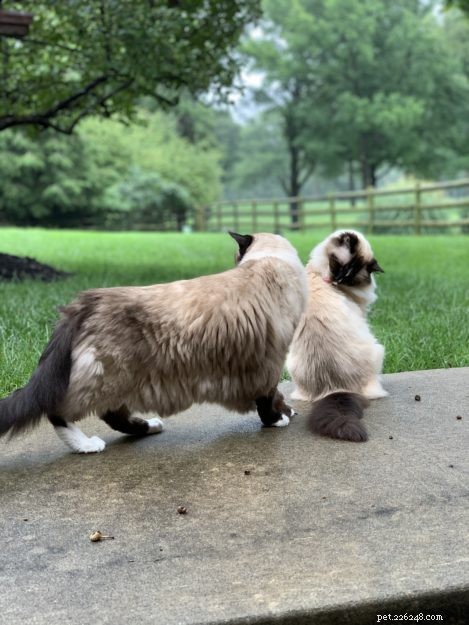
Source
This marks the difference between cats, which are digitigrade, and humans, which are plantigrade, While humans place the full length of their foot on the ground when they walk, cats only place their digits on the ground, but not the soles of their feet, which determines the vertical angle of the hock.
What are hock marks in cats?
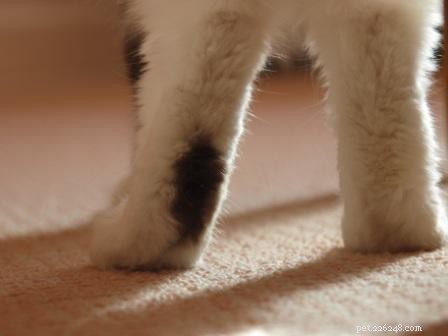
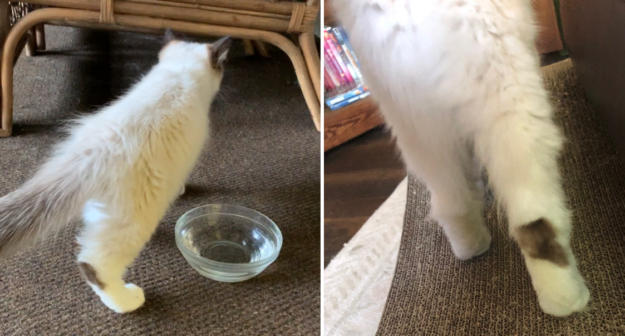
Hock marks are small areas in the hock area where the cat’s fur is colored differently than the rest of the fur on the cat’s leg (usually much darker). Since these colored patches are not included in the breed particularities, then they are considered to be a defect. For Ragdoll cats, hock marks will disqualify cats in cat shows. Ragdolls with hock marks are pet quality, not show quality.
In the pictures below you can see Ragdoll cats with hock marks.

Are cats with hock marks sick?
No, they are not. Hock marks are not a symptom of any disease or disorder in the cat. They are simply patches of darker colored fur.
Are hock marks hereditary?
Yes, they are. They are not generated by dominant genes, but recessive genes. This means that the hock marks will not be passed on every time from the parents to their offspring, but they might appear in some, also depending on the genetic background of the second parent.
If both parents have hock marks, then their offspring will also have hock marks. If one of the parents has the hock mark gene but does not have hock marks and the other parent has hock marks, then their offspring have a 50% chance of developing hock marks.
If both parents have the hock mark recessive gene but do not have hock marks, then their offspring have a 25% of developing hock marks.
Purebred cats with hock marks do not have official reproductive rights (they may not reproduce with other show-grade cats of that breed) precisely to exclude the chance of this defect being passed onto future generations.
Can you remove hock marks?
No, you can’t. Some have tried shaving the colored area repeatedly, but that can only lead to a slight change in color; it is enough to eliminate the hock marks.
To sum up, hock marks are small areas of fur colored differently than the rest of the fur on the cat’s hock and leg areas. These are not a health hazard, but they are a breed defect and they make cats unsuitable for being shown in cat shows. Cats with hock marks are pet quality.
Does your Ragdoll cat have hock marks? Tell us in the comments section below.
- Pet Behavior
- Pet Breeds
- Pet Names
- Pet Adoption
- Pet Training
- Cat Stories
- Pet Health
- Adorable Pets
- Cats
- Do Cats Experience Sadness? Decoding Their Emotional Signals
- Understanding and Managing Cat Allergies: Causes, Symptoms, and Solutions
- Understanding Cat Cholesterol: Causes, Risks, and Care
- Understanding Giardia in Cats: Risks, Symptoms, and Prevention
- Preventing Heatstroke in Cats: Signs, Risks, and Protective Tips
- Understanding Cat Bezoars: Causes, Symptoms & Treatment
- Understanding Cat Arthritis: Symptoms, Causes, and Care