

6 Common Causes of Cat Drooling and How to Help Your Feline
Drooling is not very common for most cats, so every time you notice it, it is best to try to understand why it is happening. Is drooling normal in cats? And if so, what is the difference between normal salivation and pathological drooling?
Is there something you can do to help your cat when it happens? When is it time to go to the vet? In this article, we will tell you everything you need to know about cat drooling, what causes it, and what you can do to help your cat when it happens.
Normal Salivation vs. Drooling
Salivation is absolutely normal in cats. It is a reflex (the salivary reflex), just like it is for humans, and it has a number of roles in the body’s neurophysiology. It is perfectly normal to salivate when you feel the smell of food you like, right?
And the hungrier you are, the more you salivate more when this happens. It is the same for cats. So, if you notice your cat is salivating a bit as you are about to give it its food bowl, then rest assured that they are simply eager to eat.
Salivation, however, stops being normal when it involves a large amount of saliva and when it happens for a long period of time. If you see saliva sliding down your cat’s mouth, then that is no longer normal and you should examine the cat to find out what is causing the drooling.
In some cases, you may even see saliva cascading out of the cat’s mouth or piling up in a puddle on the floor. If you notice this, then you are dealing with pathological drooling and you should call up your veterinarian.
Drooling is not very common for most cats, so every time you notice it, it is best to try to understand why it is happening. Click To TweetWhat Causes Drooling in Cats?
Excessive salivation, also called ptyalism appears in two types of situations:
- When the cat produces too much saliva.
- When the cat is unable to swallow the saliva that it produces.
In both these situations, the cat drools.
There can be many causes for excessive salivation, but the most serious of them all is rabies. This is the first cause that your veterinarian must exclude. If your cat has received a vaccine for rabies in the last 12 months, then it should be safe. However, if you also notice some of the other signs of rabies, such as sudden aggression, vocalization, muscle spasms, then you should get away from your cat, isolate it in a room, if possible, and call your veterinarian immediately.
Please note that rabies cases are not common anymore. This is largely due to vaccination, which is why it is essential that your cat receives this vaccine. You should, however, know the symptoms of rabies so that you are able to recognize it and keep yourself safe.
Aside from rabies, there are many other causes for a cat’s drooling. Here are the most common ones:
Aside from rabies, there are many other causes for a cat’s drooling. Click To Tweet1. Exposure to Toxins
When exposed to certain toxins, cats start to drool. In most cases, the drooling is quite dramatic – the salivation is continuous and in large quantities. Cats ingest, lick, or chew these toxic substances and then begin drooling. This includes pesticides, detergents, poisonous substances, special cleaning substances, etc. If your cat happens to lick or ingest detergents that you use around the house, one of the first signs is the drooling.
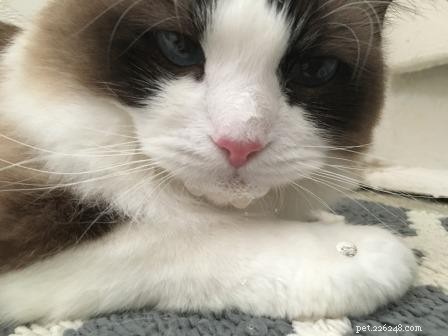
If you notice this, you need to take your cat to the vet as soon as possible. This is a medical emergency because these chemicals can cause tremendous damage to the cat’s organs in a matter of hours. If you notice that your cat is drooling continuously until the fur around its mouth and chest is wet, then it is best that you take it to the vet.
Sometimes, it might be difficult to figure out what the cat might have ingested. Don’t wait! It is best that you first take the cat into emergency care so that gets the first line of treatment. While detergents and pesticides are the first things you check when you suspect exposure to chemicals, there are other household items that are dangerous for your cat that you may have overlooked, such as air fresheners or plants. Read about the tragic story of a cat that was poisoned because of a faulty plug-in air freshener.
A common situation when cats are exposed to pesticides and start drooling is when external anti-parasitic medicine (for fleas and ticks) is applied. These are oily substances that come in small vials. They are usually applied on the back of the cat’s neck, precisely because this is an area that it cat’s reach. The oily substance is quickly absorbed into the skin, but some traces of it remain on the cat’s fur.
Then, when it starts to wash, it might get a very small quantity of the medicine on its paws, which it will lick. When the cat ingests a small quantity of anti-parasitic medicine, it starts to drool. In most cases, the drooling stops rather quickly, so there is nothing to worry about. However, if the drooling does not stop, then it is time to take the cat to the vet.
Ragdoll Reading:
Save on Litter-Robot
Why Does My Cat Scratch Around His Bowl?
Best Indoor Cat Tunnels
2.Oral Cavity Issues and Dental Disease
Drooling is a common symptom of oral and dental disease because the salivary reflex is activated. Here are only some of the cases when cats drool due to issues of the oral cavity:
- Tartar deposits – if a large quantity of tartar is deposited on the cat’s teeth, it will no longer be able to close its mouth properly, which will cause drooling. Such deposits are associated with periodontal disease.
- Periodontal disease – Typically caused by tartar deposits, periodontal disease affects the gums and the dental ligaments. The damage to the gums and teeth might be significant enough to cause drooling.
- Tooth pain – The pain caused by dental issues is sharp and difficult to bear. When this happens, the cat might open its mouth, which will trigger the drooling.
Cavities and other dental issues – Quite a few dental issues are associated with salivation because of the local trauma to the oral cavity and because the cat might try to reach the affected area. - Pathological growths in the oral cavity – This includes both benign growths and oral cancer. These often make it impossible for the cat to close its mouth properly, which triggers the salivary reflex.
- Dermatological issues of the lips and mouth – These include all types of rashes that occur on the cat’s lips, which may or may not encompass the entire mouth area
- How much is the cat drooling? – The quantity of saliva is extremely important. While heavy drooling is always an issue, a small quantity of saliva may be nothing to worry about.
- How long has the cat been drooling? – If the drooling is continuous, then the cause is most likely a serious one. Try cleaning the cat with a cloth or a paper towel. If the drooling persists, then you should not ignore this.
- How is the cat’s general state? – If the cat is alert and in good shape, then the cause might be minor. However, if the cat is apathetic, breathing heavily or breathing faintly, then the drooling is most likely the symptom of something serious. If the cat is drooling and its general state is affected, take your cat to the vet.
Examine the cat’s mouth
As you’ve seen in the list above, there can be a lot of cause for the drooling, but most of them are related to the oral cavity. That is where you will find a lot of relevant information about what happened, so you should examine the cat’s mouth.
Here’s what you can do:
- Examine the lips – Begin your examination with the lips. Look for rashes, scratches, bites, fur loss, inflammation, or anything out of the ordinary such as enlarged lips or the presence of blood. Most oral cavity trauma also presents with lip lesions.
- Examine the cat’s mouth – Wipe the saliva from the cat’s mouth and open it gently. Look for lesions, foreign objects, and growths. If you notice any blood in the cat’s mouth, you need to take the cat to the vet.
- Examine the cat’s jaw – Palpate the cat’s jaw gently to look for breaks or bumps. If you notice that the cat has its tongue out, this should be a sign that it can’t close its mouth. Palpate all the way to the temporomandibular joint. Try to see if the area is painful or inflamed. Please note that jaw fractures and issues of the temporomandibular joint are medical emergencies because they prevent the cat from eating and drinking. If you notice anything out of the ordinary in this area, it is best you speak to your vet.
- Examine the gums – Gently push up the cat’s upper lips to examine its gums. Their natural color is light pink. If you notice that the gums are white, reddish, or yellow, then you should speak to your vet about it. If you notice any lesions to the gums, you should mention those as well. Remember to look all the way to the back and then, switch to the lower area. Pull the cat’s lower lip down and examine the gums.
- Examine the teeth – Look for cavities or other lesions, tartar, or inflammations of the gum surrounding the teeth. Look for teeth that are broken or dislodged. Keep in mind that dental issues are usually painful, which might make the cat restless. If you notice any dental issues, then you should take your cat to see a veterinary dentistry specialist.
- Examine the tongue – The normal color of the tongue is pink. If you notice that the cat’s tongue is either paper white or dark red or if you notice any cuts, scratches, or other lesions, then you should take the cat to the vet because this is a delicate area.
Have you seen your cat drooling? What did you do when it happened? Did you find out what caused the drooling? Tell us all about it in the comments section below.
- Pet Behavior
- Pet Breeds
- Pet Names
- Pet Adoption
- Pet Training
- Cat Stories
- Pet Health
- Adorable Pets
- Cats
- Why Does My Cat Drool? Understanding Normal vs. Alarming Causes
- Understanding Cat Hissing: 6 Key Reasons Behind This Behavior
- Top 5 Causes of Cat Shaking and How to Address Them
- 8 Causes of Sudden Loss of Appetite in Your Cat – What You Should Know
- What Drives Your Cat to Meow at Night: Understanding Nocturnal Vocalizations
- Understanding Cat Drooling: Causes, Symptoms, and When to Seek Veterinary Care
- 7 Key Causes of Excessive Cat Pacing and How to Address Them