

Ragdoll Cat Genetics: Understanding Colors, Patterns, and Inheritance
Have you paid much attention to the colors and pattern of your Ragdoll cat? Maybe you’re a breeder who wants to learn more about what to expect from a litter. The subject of Ragdoll genetics is pretty fascinating as you get into it, as there is a tool you can use to predict the colors and patterns that each cat will carry.
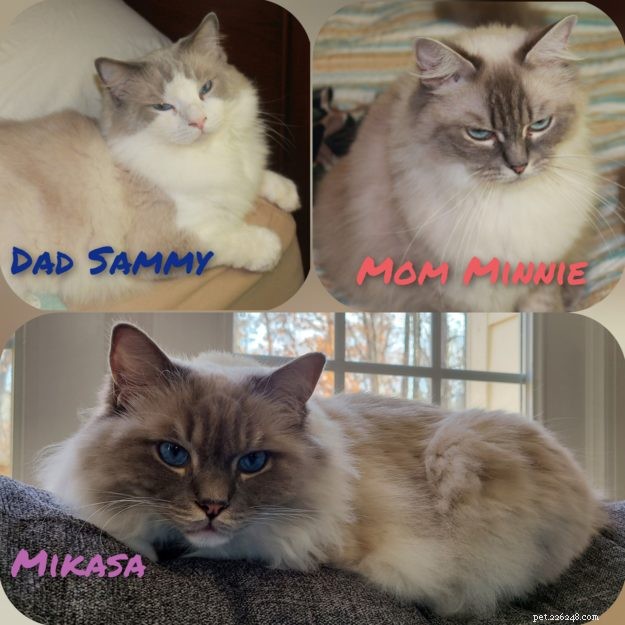
I recently asked readers to send me pictures of their Ragdoll and its parents, because it’s fun to see how the Ragdoll parents create the colors and patterns of their litter. It’s especially fun seeing whether the child looks more like mom or dad! And if you’re lucky enough to have a pregnant Ragdoll or you’re even getting into breeding, it’s possible to predict what the likely colors and patterns of the kittens will be.
Please note that this article may contain affiliate links. That means that if you buy something, I may earn a small commission. You can read my full disclosure at the bottom of the page.
Using Ragdoll genetics to predict a litter
There are various websites that you can use to predict the color and pattern of the kittens that a mating will produce. One of the best is from the British Ragdoll Cat Club. This lets you add in the color and pattern of the sire and the dam, and you’ll get a breakdown of the male and female kitten possibilities.
There are eight main colors of Ragdoll cat, with seal, red, cinnamon and chocolate being a primary color and blue, lilac, fawn and cream being dilutes. The difference is that the primaries are more dominant, so to specifically breed a dilute you need to be more selective. The most prominent color of traditional Ragdolls is seal while lilac is one of the rarest, despite its popularity – making lilacs in demand for breeders. Cinnamon and fawn aren’t too popular, but there are catteries actively breeding them.
You can find out more about the different combinations with these color charts:
- RFCI.org
- Ragdoll International Colors
- Ragdoll International Colors Part 2
- Ragdoll International Colors Part 3
Ideally, when predicting your mating results, you’ll know the prominent and the dilute genes that your cats carry. This will make the predictions much more accurate. It’s important for breeders to maintain the standards of purebred Ragdoll cats, and a lot of that is down to how protected the colors are. Tracing pattern is also important for breeders, as it helps to control the white spotting gene in a litter.
Most breeders in the US will stick to breeding cats with a High Mitted Bicolor pattern only since that ensures the white spotting gene doesn’t become too prominent. Other breeds will use True Bicolour or Mid High White but they do include more white. Or at least, they normally do, but there are variances. High Mitted cats express less white than True Bicolor or Mid-High Whites, but individual cats could look similar even with the different genetics. You might get a High Mitted that is at the max white it could be, which looks like it has an almost identical pattern to a Mid High White which is at the minimal white of the genetic pattern.
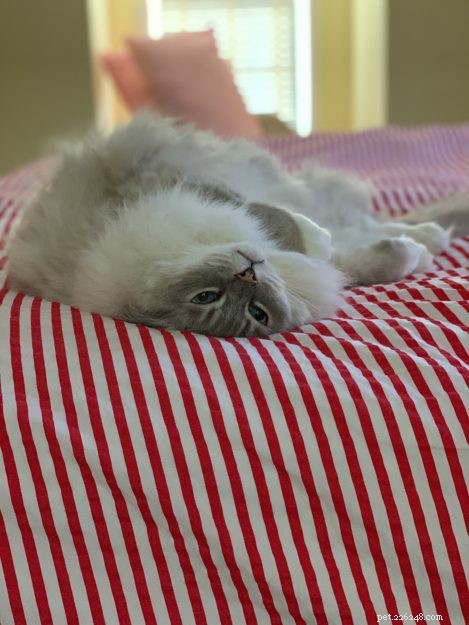
That’s why it’s important, if you’re a breeder, to know the pattern you’re working with at a genetic level – so you know for sure what patterns you’re working with and can accurately predict the patterns of kittens, and control the White Spotting Factor (WSF). The Ragdoll Fanciers Club International has a good technical explanation, or if you’re new to breeding and genetics and finding it a little tricky, then this website makes it a little clearer with a metaphor around lightbulbs and brightness.
I spoke to Stormi Nell, a breeder at FamilytimeRags Ragdolls, who said that her favorite mating will always be a Mitted-to-Mitted breeding, as it can produce all 3 patterns of Mitted, Colorpoint and Bicolor in the litter.
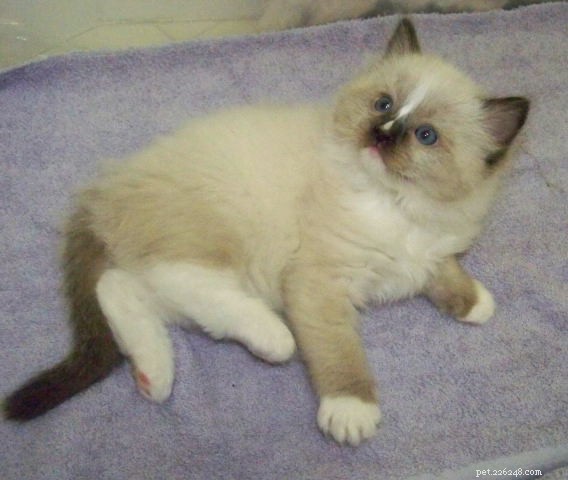
It’s worth noting that all Ragdoll kittens are born white – the color will develop over the first 8-10 weeks, although it’ll keep developing until the full color and coat are present somewhere in the first four years.
The history of Ragdolls – Josephine’s Genes
The history of Ragdoll cats begins in the 1960s with a breeder named Ann Baker, who borrowed cats from her neighbor Mrs. Pennels. These cats were the offspring of Josephine, a white semi-longhaired Angora. Josephine had a standoffish temperament, as did her kittens, until an accident where she was hit by a car.
After this, Josephine became much calmer, and so did her kittens. They were unusually docile and relaxed. They also had a tendency to go limp when they were picked up, which is where the name Ragdoll came from, and where Baker adopted the term Raggedy Ann for her cattery.
Baker bought more kittens from a neighbor and began selectively breeding for the traits of a Ragdoll, including large size, pointed colorization and that tendency to act like a Ragdoll and go limp when picked up. These were the first Ragdolls and they all carry Josephine’s genes.
Breed standards for Ragdolls
The breeding standards for Ragdolls were first established by Ann Baker. She formulated a complicated breeding policy and trademarked the name ‘Ragdoll’, with only breeders that were registered as a franchisee through her International Ragdoll Cat Association (IRCA) permitted to breed and register an official Ragdoll cat.
If you bred a Ragdoll without being a part of the IRCA on a franchise, you were refused permission to register the breed. Despite that, the nature of the cats made them popular and so many breeders still signed up.
The franchise structure was eventually broken when the courts ruled that Baker’s demands were too onerous. Since the franchise model was broken, the breed has been officially recognized and you can find the breeding standards for Ragdolls at the Cat Fancier’s Association website.
Specifically, when it comes to colors, the standards state that point colors can be solid, lynx and parti-colored including tortie. Subtle shading is permissible for the breed but a clean color is always preferred. All Ragdolls are pointed and the mask, ears, legs, feet and tail color should be dense and clearly defined and all in the same shade. The only exception is where there is white overlay in the Mitted, Bicolor and Van patterns.
With a Bicolor pattern, the specifics for the Ragdoll breed include the white inverted ‘V’ mask remaining within the outer edge of the eyes, ideally symmetrical. If the V extends beyond the outer edge then the point score for the breed will be penalized, and if the V has any dark spotting then the cat will be disqualified from the breed. Points are expected to be white but some spotting is acceptable.
On a cat with a Van pattern, the point color is restricted to the ears, tail and mask and it should be dense and clearly defined. Masks can show a gradual fade. Penalties are given where more than twenty percent of the body color is white, and the cat is disqualified if there is no point color on the head or tail. It’s worth noting that while the CFA permits the Van pattern, The International Cat Association (TICA) does not.
The Colorpoint pattern is for cats that have ears, feet, a tail and a mask that have a darker and well-defined color, with nose leather and paw pads that match the color. The chest, bib and chin can be a lighter color than the rest of the body. Disqualification is if there is any presence of a locket or a white spot anywhere on the cat’s body.
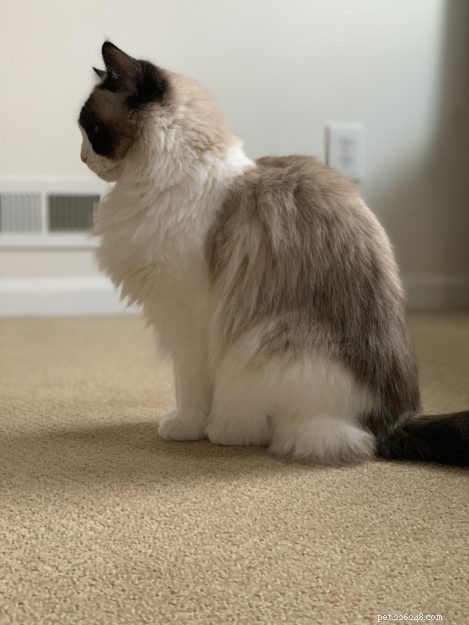
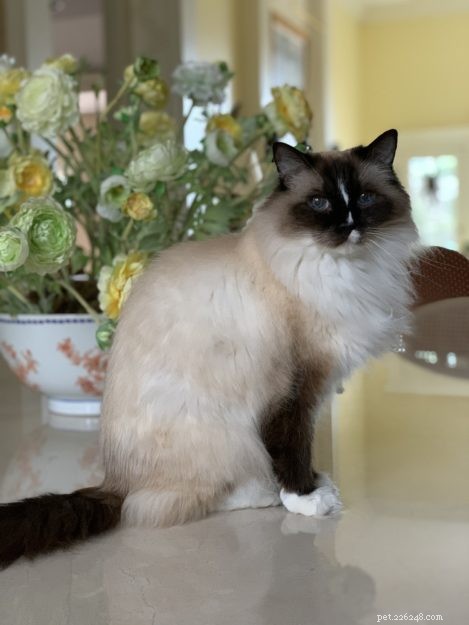
For the mitted pattern, cats should have legs (except feet), ears, marks and a tail with well-defined color, and the chin must be white and extend into a white belly stripe. There should be definite contrast between the body and the points, with white mittens present on both front feet ideally going up to the wrist joint.
Kittens may have ghost markings – the full color will develop within the first two years. Cats are disqualified if they do not have a white chin. There are other standards beyond color and pattern that a Ragdoll must meet too, although if you’re breeding Ragdolls then these should be fairly standard.
As a quick guide, the cat’s eyes should always be blue and they should have long fur with a minimal undercoat. There’s a point-scoring system for the head, body and coat too. Cats are penalized in the standards if they have a thick undercoat, the eyes are too small, too round or either too pale or dark, and if the cat has a roman nose or a shorter tail. As well as reading the official standards, I have a page all about colors and patterns where you can read more.
Thank you to all of the Ragdoll cat parents that sent in photos of their kitties with their parents – making this post possible.
Seal Ragdolls with Their Parents
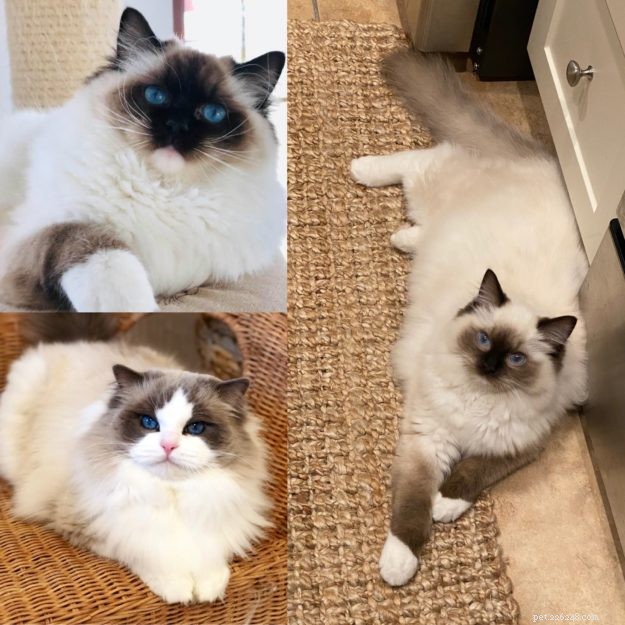
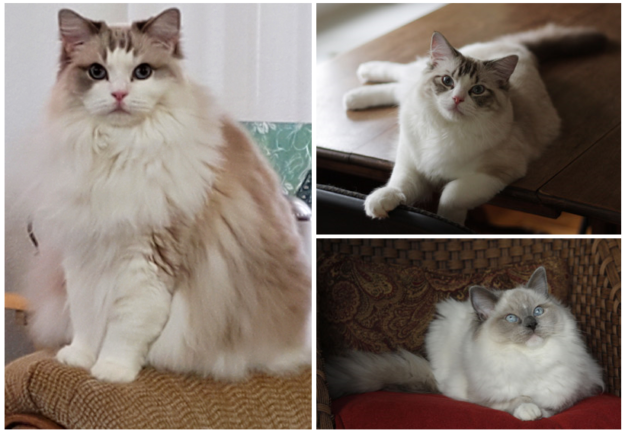
Blue Ragdolls with Their Parents
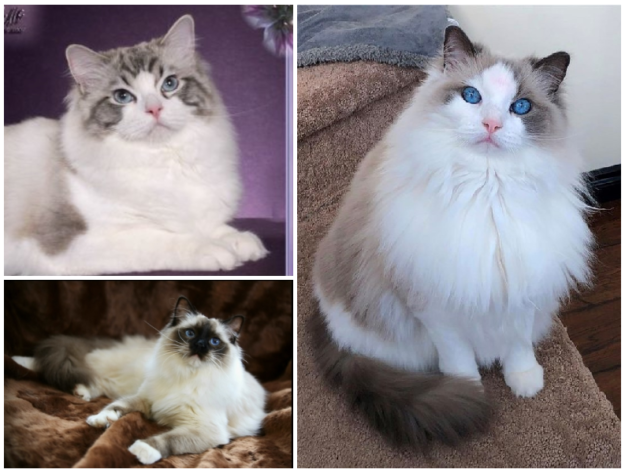
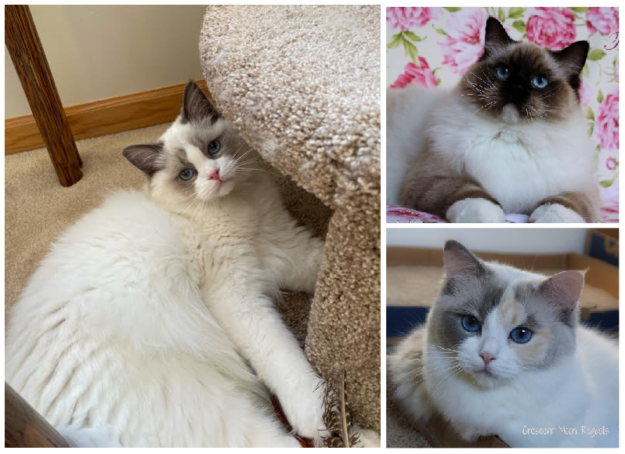
Chocolate Ragdolls and Their Parents
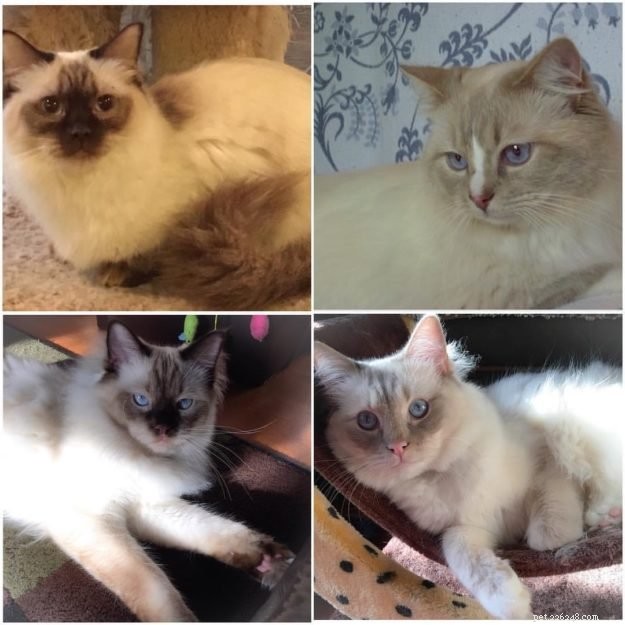
Red/Flame Ragdolls with Their Parents
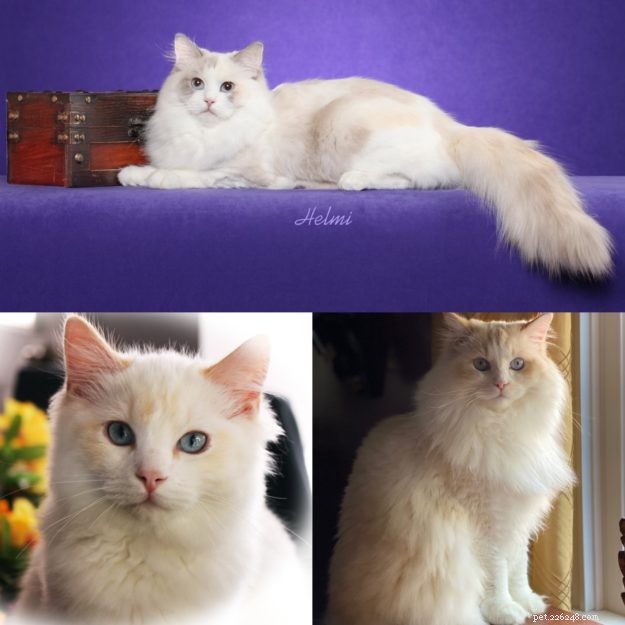
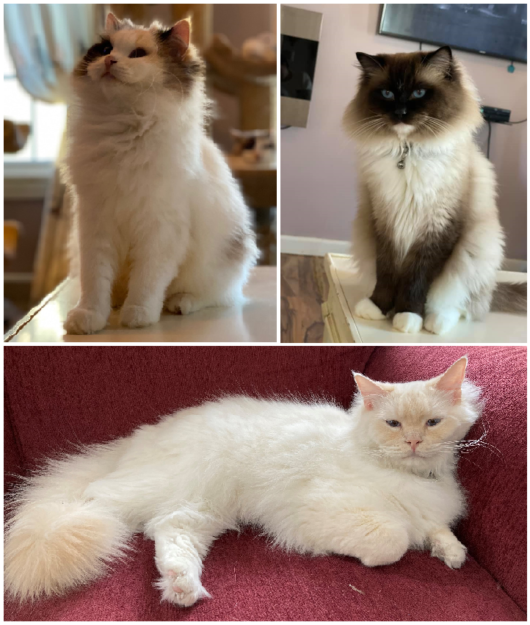
Mink Ragdolls with Their Parents


Genetic Testing
As I said, when you’re breeding Ragdolls it’s important to understand the genetic makeup of your cat including full coat color DNA so that you can better predict what you’ll get from a litter. If you don’t know all the details, you can take a genetic test. A simple swab of your cat can tell you more information about your cat’s genetics as well as helping identify signs of your cat developing a severe disease later in life. Speak to your veterinarian if you want to know more about genetic testing of your cat, although there are kits you can order online to do at home. It’s usually a cheek swab so causes your cat no pain, and you just need to make sure to keep them comfortable to avoid distress.
In Conclusion
If you have an interest in Ragdoll genetics or in breeding Ragdolls, there’s a huge amount of information available to help you breed the color and pattern that you want to, or to help you preserve the purebred standards and get official breed recognition. Genetic testing is useful if you’re starting out as a breeder as you can learn a lot about the dominant and recessive colors, as well as any genetic health conditions. If you have a specific plan to breed the diluted colors, such as the popular lilac Ragdolls, using a combination of genetic testing and the color/pattern predictor tools will help you have the best chance of success. Leave a comment below if you’ve looked into the genetics of your Ragdoll or if you’ve considered breeding, or even just to share a story about which parent your kitten looks most like! Further reading:
- TBRCC.co.uk
- RFCI.org Controlling White
- Ragalaxy.com Ragdoll Standards
- CFA.org
- RFCI.org Color Chart
- Ragdoll International Colors
- Ragdoll International Colors Part 2
- Ragdoll International Colors Part 3
- Pet Behavior
- Pet Breeds
- Pet Names
- Pet Adoption
- Pet Training
- Cat Stories
- Pet Health
- Adorable Pets
- Cats
- Do Ragdoll Cats and Dogs Get Along? Expert Tips & Insights
- Why Ragdoll Cats Are Perfect for Families with Kids
- How to Play Airplane with Ragdoll Cats Safely & Gently
- Custom Catio for Ragdoll Cats Leo & Shelby: A Stylish Outdoor Retreat
- Explore the Stunning Color Palette of Ragdoll Cats
- Ragdoll vs. Siamese Cats: What Sets Them Apart
- Ragdoll Cat Genetics: Understanding Colors, Patterns, and Breeding Outcomes