

Why Do Cats Become Addicted to Laser Pointers? The Science Behind the Hunt

Does your sleepy-eyed blob of a house cat turn into a bloodthirsty panther the moment you pull that $3 laser pointer out of your pocket? Does the tiniest quiver of that little red dot send your once slothful feline skittering at top speed over the ottoman and across the dining room table?
If so, you may have noticed that certain cats are obsessed with a laser pointer. I mean, obsessed.
Why are some cats crazy about laser pointers?

All cats are predators. Tigers are predators. Lions are predators. The feral cats who prowl our back alleys and old barns are predators. And yes, your sweet little fluffball, the one who would literally die without you because he doesn’t know how to use the can opener, is a predator, too.
If your cat wasn’t living on your couch, she’d be out hunting most of the day. She wouldn’t need a laser pointer because her intense, natural predatory drive would be satisfied by her lifestyle. She’d be chasing things for a living, not for fun.
An indoor cat is still a cat, even if he gets everything he needs to survive carefully plated and presented to him in his special food dish every day. Chasing a moving laser-pointer dot may look like pure fun (and certainly it is), but it’s also an outlet for the serious business of being a predator who has it easy.
Do cats know that a laser pointer isn’t really a mouse?

This is an interesting question because we’ll never know what a cat is really thinking. But we do know what humans think and if you ask a human, “Is the little dot from a laser pointer alive?” the answer would most certainly be “no.” “No” with a chuckle, maybe.
And yet, humans seem to be programmed, like cats, to look at certain kinds of movement in inanimate objects as signs of “life.” “The single leaf fluttering down on a breeze can confuse us – is it a butterfly, a bird?” wrote Ira Hyman, Ph.D., in Psychology Today.[1]
Scientists did a kind of “laser-pointer” study with humans and the results were fascinating. The study showed that humans, like cats, seem to perceive inanimate objects that move in certain ways to be “more alive” than inanimate objects that move in other ways.
Researchers at Rutgers University roped some students from their Intro to Psych class into participating. They showed the students white dots moving around on a black computer screen and asked them to rate which ones seemed “more alive” than the others.

If the dots moved in a very specific way – quickly changing direction and speed – they rated the dots as being more animate or more “alive.”[2]
Even tiny babies will make the distinction between animate and inanimate objects based on the way objects move[3] just like the Rutgers students. It shouldn’t surprise us then that cats do the same thing.
Another study showed that we humans focus more of our attention on inanimate things that move like living things, compared to inanimate things that move randomly. (Laser pointer, anyone?)
A different set of researchers studied people watching dots bouncing around on a computer screen and asked them to report when a dot disappeared from the screen.
The dots that were programmed to look more “alive” and then disappear were noticed more quickly by study participants than when the random-movement dots disappeared. The weird thing is that the study participants hadn’t even noticed that the special “alive” dots were moving differently.
What this study tells us, is that while we may not be chasing a red dot around on the living room carpet like our cats do, inanimate objects that move in a way that we perceive as being “alive” capture our human attention just as fiercely.[4] We just don’t feel the need to chase them.
Why, like cats, do we seem to be hardwired to take note of certain kinds of movement? Perhaps, as Dr. Hyman suggested, “Natural selection must have placed a value on being able to detect movement – particularly movement by something alive.”[5]
Do cats see the laser pointer the way we do?

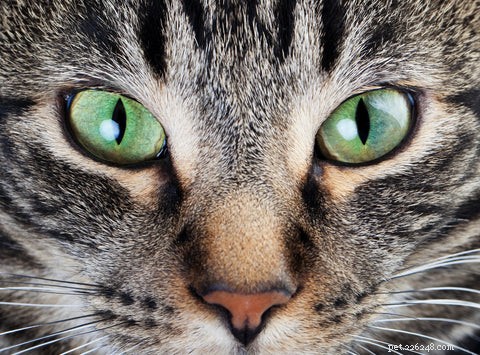
Cat eyes and human eyes are similar, but have some design differences that mean we don’t look at a laser pointer in exactly the same way.
Both species’ eyes have a retina, a structure at the back of the eye that takes in light and sends information to the brain through the optic nerve. Cats and humans both have two kinds of special light-sensitive cells in our retinas: rods and cones. Cones are responsible for seeing color and fine detail. Rods help us see under low light and sense movement.[6]
Humans have more cones than cats, and cats have more rods than we do. That means, for one thing, that while we see a bright-red, laser-pointer dot, cats probably see something that is more white or yellow.
But their extra rods make cats uber-sensitive to movement, which makes the laser-pointer toy especially exciting.
(As a side note, the extra rods also make them better dusk/dawn predators, because cats are crepuscular. For more information about a cat’s crepuscular nature, click here.)
Should I play with a laser pointer with my cat?
If ever there were a controversy in the cat world, it is this: to laser point, or not to laser point. There are good arguments on both sides. Let’s discuss.
Laser pointers are bad for cats
Yes, the movement of the laser pointer is super exciting for a cat. And then what? The cat hunts, and hunts and hunts but never catches the little red dot. Some cat-lovers (and veterinarians and behaviorists) think that might be “psychologically taxing” on a cat, possibly leading to neurotic behaviors.[7] This is because hunting a laser-pointer dot does not complete the “prey sequence.” The prey sequence is the order of actions that a cat takes in the course of hunting prey. The prey sequence is 1) stare, 2) stalk/chase, 3) pounce/grab, and 4) kill bite.[8] In chasing a laser-pointer dot the cat can complete steps one and two, but might become frustrated by never being able to execute the third and fourth steps. Theoretically, chronic frustration could lead to neurotic behaviors like excessive grooming.Laser pointers are good for cats
Nonsense, counters the pro-laser-pointer caucus. Cats play-hunt their toys all the time but never get to “kill” them because they’re not alive in the first place. The bigger concern is that indoor cats don’t get enough exercise or stimulation. Wild and feral cats climb trees, stalk insects, clamber over rocks, and hunt for their own dinner. While they may be at risk for other dangers, they get ample exercise and are probably rarely bored. Our house cats, by contrast, are often unfit or obese and don’t get the intellectual stimulation they really need. Cats who love a laser pointer really love a laser pointer. It makes for fun exercise and allows a cat to express at least some natural hunting behaviors. Plus, cat mom or dad can play with their cat without ever leaving the sofa. It might be worth evaluating your own cat. Is she just having fun with the laser toy, or is she becoming obsessed? If you think your cat is in the latter category, you should probably limit her exposure to laser pointers. If you’re concerned about your cat becoming frustrated with the laser pointer, consider starting out a play session with the red dot, but switching to a physical toy so that your cat can participate in the “pounce/grab” phase of the prey sequence. Oh, and let him win this one.
Are laser pointers dangerous?
Don’t point the laser in your own eye or your cat’s eyes. Laser pointers can damage eyes. Only use laser pointers designed for pets (with a red-colored light which has less power than those with green lights).
Most made-in-the-USA laser pointers should have a “safe for pets” stamp on them somewhere, meaning that you probably don’t have to worry if the little red dot should quickly graze an eye. But you still shouldn’t deliberately point one at the eye of any living thing. Your guess is as good as mine about the safety of a laser pointer manufactured elsewhere.
Overexerting your lap cat is a risk of using the laser pointer. Use your judgment. Let her build up a little steam if she’s enjoying herself, but don’t overdo it. Her drive to hunt might be keeping her going past the point of exhaustion.
Be careful where you point the laser. Don’t aim it at high shelves or dangerous surfaces. This activity is supposed to be fun for you and your cat, and not end in injury.
Interested in how cats see the world? Read, "Can cats see in the dark?"
- Pet Behavior
- Pet Breeds
- Pet Names
- Pet Adoption
- Pet Training
- Cat Stories
- Pet Health
- Adorable Pets
- Cats
- The Science Behind Cats’ Fascination with Laser Pointers
- Why Do Cats Love Plastic Bags? Discover the Surprising Reasons
- Why Do Cats Love the Cat Dancer Toy? Unveiling Their Obsession
- Why Some Cats Are Drawn to Plastic Bags: The Role of Smell
- Why Do Cats Love Laundry Baskets? Uncovering the Curious Behavior
- What Drives Cats to Chase Laser Pointers: Insights & Safety Tips
- The Science Behind Why Cats Are Obsessed with Laser Pointers