

Keeping Your Indoor Cat Happy in Small Apartments: Proven Tips & Tricks
Having moved a bunch of different times with my husband and our pet cat, Avery, I’ve learned a thing or two, not just about making moves easy on cats, but also about how to make do and keep kitties happy in small spaces.
If living in tight quarters with a cat is something you’re worried about as it’s not something you’ve done before – don’t worry it’s actually not as bad as you might think, even if you’re in a studio apartment like we are.
There are some things you should always be mindful of, plenty of tips and tricks you can implement to keep a house cat happy and entertained, but all in all, while it may be a tad more difficult to keep an indoor cat happy inside a smaller living space – it’s completely doable with some planning and not much effort besides.
If you’re already living in a small apartment and just want to make life all the better for your house cat, you’re definitely in the right place, too!
I’ve broken this article down into different sections to make it easier for you to browse. Some things you probably already do or had in mind, but I’m hoping you find at least a few new ideas you can implement to help make your kitty’s apartment life happier.
Okay, so here we go!
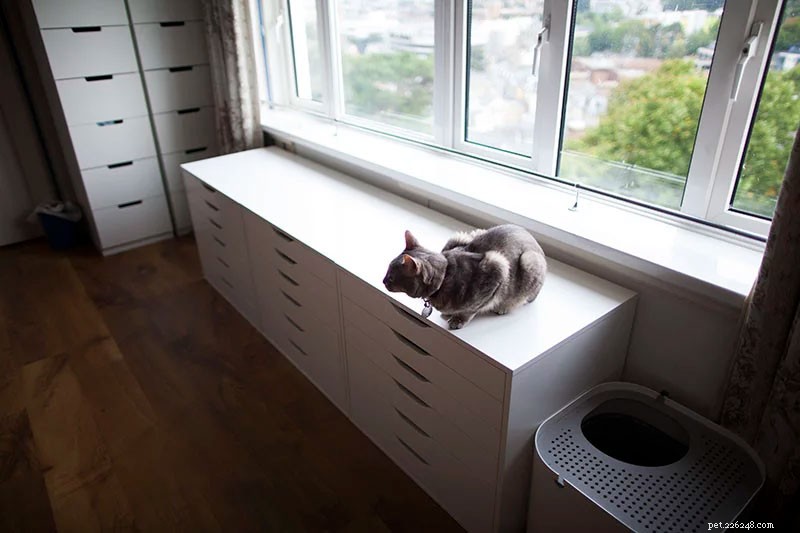 Picture from post Home Tour: Our Flat is Practically an Ikea Showroom
Part I: How to Keep Cats Safe & Healthy in Apartments
1. Make sure it’s not easy for your cat to jump out the window.
Back in Canada, this was an easy issue to ignore seeing as how we never really had to deal with it.
All windows for the most part have insect screens on them, and my cat is the type to never really scratch or push past the screens considering we discouraged that behaviour early on, just after adopting him.
Here in the UK, and in many countries in Europe things are a lot tougher. Insect screens on windows are extremely uncommon – I personally haven’t seen one home that’s got one in my years living here, and so we’ve had to be much more careful.
Luckily for us, we ended up in a flat that has small windows along the top with tall windows lined at the bottom (hard to describe without a visual: you can see what I mean here), and so when we need to let in some air, we only open the top ones a crack – those that are not easily within our cat’s reach.
We were worried Avery would try to climb up to sit atop of the window ledge, but considering we discourage him from putting his paws on the windows at all, this hasn’t happened.
There are cat screens available on the market, but none we found looked truly cat-proof, and many seemed to have the potential to damage the windows, so no viable options in that regard for us.
If you’ve found a good product that remedies this issue, please do leave a comment down below telling me what it is; if you DIY-ed a solution, I’d love to know how you did it. Would be greatly appreciated!
2. Make sure to sweep &/or vacuum often.
There’s nothing like a large living space to spread out the insane volume of cat hair shed to the point where you barely notice it. Not true of a small apartment/flat.
If you’ve got carpeting in your flat/apartment, cat hair is not likely to be as much of an issue for you as it would be if you had hardwood or laminate flooring. Carpeting leads cat hair to stick to the floor and almost disappear, until it’s time to vacuum that is.
Also vents – the central air vents in Canada I feel swallowed up a tonne of cat hair.
Here in the UK where central air isn’t common, I find that I have to sweep much more often, even in a similar sized space.
I end up seeing tufts of fur dancing around the flat like tumbleweed even after a single day. If this is allowed to collect for too long, kitty’s going to be ingesting a lot more of the fluffy stuff, which could lead to a lot more hairballs.
Assume when you move into a small space with a cat that you’ll need to be sweeping/vacuuming much more often.
You can also regularly brush your cat with a deshedding tool or get hold of a pet hair remover glove and pat down your cat frequently.
While using deshedding and hair removal tools like these won’t replace all the vacuuming/sweeping you’ll have to do, it really can help lessen the frequency you’ll have to sweep or vacuum overall, especially if you manage to find a little bit of downtime you can do this daily, or manage to schedule a few minutes of grooming into your daily routine.
3. Make sure there’s plenty for your cat to scratch on.
This is an issue that every cat owner will have to deal with, not just we small-space dwellers.
What exactly can you do to ensure your cat has plenty to scratch on without breaking the bank? Try investing in inexpensive cat trees or cardboard cat scratchers.
Hate seeing ugly cat products clustered around your small apartment, but really want to increase the scratching surfaces for your cat? PetFusion’s Ultimate Cat Scratcher Lounge and other beautiful, modern cat scratchers like it are really great options for situations like these.
Need something more heavy/sturdy, but just as pretty/sleek? A real wood cat tree or scratching post may do the trick here.
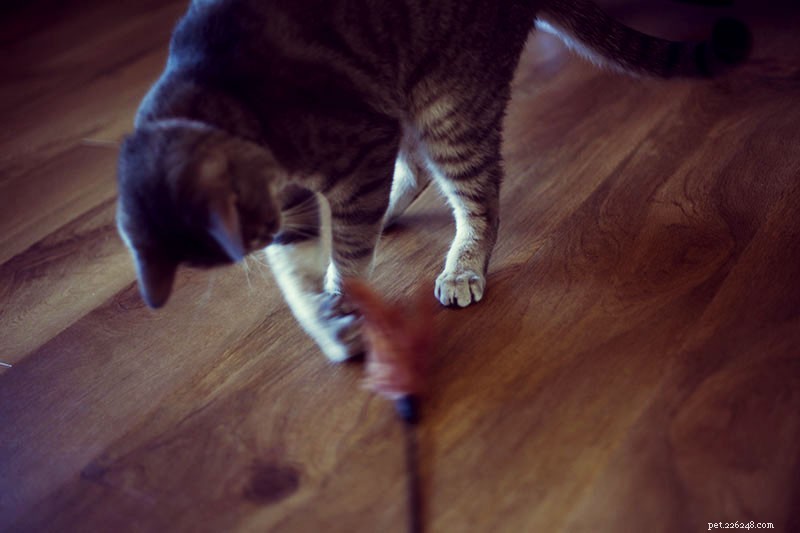 Interpet Pet Love Kat Tikkler Feather Wand Cat Toy – Amazon / eBay
Part II: How to Keep Your Cat Mentally & Physically Stimulated
4. Make sure kitty gets quality playtime once or twice daily.
Since cats are hunting animals and have a high prey drive, it’s very important that at least once or twice a day, they are able to get their hunting game on and actively engage in play.
The best toys for this type of thing? Exercise cat toys like the Cat Dancer 101 that require pretty high-energy output.
It can be really hard to engage some cats, however. I should know, I have what feels like one of the laziest cats around. But playtime still has to happen, no matter how difficult it can be to get started.
Need some help making daily playtime happen without too much fuss? Try using some of these tips for encouraging your cat to play with you.
5. Make sure your cat can play by him or herself if he or she wants.
While most cat toys on the market are ones you’ll need to actively move, throw, or engage with in some way for your cat to play with, there’s huge benefit to finding at least a few toys your cat fancies that he or she can play with by themselves.
I’m not actually talking about most automatic cat toys here, as these you still have to press a button on to activate. Instead, I’m talking about toys your cat can use even when no human is around.
Some examples? Cat springs, bouncy balls, and sisal mice – though there are plenty others that will do the trick. These types of cat toys can really help keep your cat happy, especially if you need to be at work for long hours.
You never know when a feline’s mythical burst of energy will happen to strike, and if there’s no one around to help relieve that prey drive, at least there’ll be some of these toys around to do so.
Need more recommendations? Check out my article on the best toys cats can play with by themselves.
6. Implement a few techniques to keep kitty entertained passively.
This is important for every house cat owner to do, but especially important for those of us who live in small spaces, seeing as how there’s likely to be a lot less for kitty to get up to in a smaller home (less bugs to hunt, less windows to switch back and forth peering out from, all that jazz).
A couple of my favourite tricks to keep cats passively entertained even if you’re out: suction bird feeders that stick to the outside of your window, kept stocked regularly with some wild bird food, as well as a closed aquarium so that your cat always has something interesting besides birds to watch.
Considering this post would go on for way too long if I included all my tips/suggestions for keeping indoor/house cats entertained, if you’re interested in reading through more of my ideas on the topic, please check out this article here: Bored Kitty? Hands-Off Ways to Keep an Indoor Cat Entertained.
7. Cat still not getting enough mental & physical stimulation? Implement a daily routine.
As I’ve already stated, my cat is exceptionally lazy, and this usually meant I spend a lot of my time fretting about the fact that that he may not be getting enough physical or mental stimulation into his day.
The easiest fix? Taking some of my own cat exercise tricks as well as some ideas I had for keeping Avery mentally stimulated during the day and implementing them in a daily routine I started up for him.
Consider doing the same if it’ll put your mind about your cat’s well being at ease.
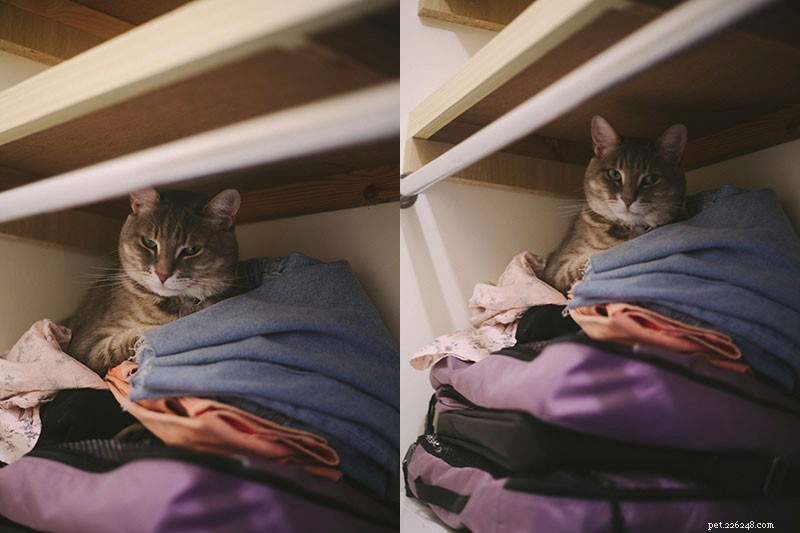 Picture from post Closet Kitty
Part III: How to Make Your Apartment Feel Bigger to Cats
8. Arrange furniture so kitty can easily jump from one piece to the next.
Not every piece of furniture in your home has to be kitty approved, but if you’re fine with your cat jumping onto a specific dresser or two, re-arrange so it’s easy for your cat to take advantage!
Doing this is easy: simply arrange cat-approved that’s shorter next to taller and taller pieces.
Essentially your goal is to arrange furniture so kitty can jump from one short piece to the next, like from an end table to the back of the sofa, to a dresser, to the top of a bookshelf.
Cats don’t care whether the space they have is horizontal or vertical. Sure, humans care: we can’t jump onto mantelpieces to hang out for a while; but cats can.
If you make it easy for your cat to climb high into enough spots throughout your apartment, your cat will be happy in even the smallest of apartment spaces.
9. Make a number of kitty-sized nooks and crannies for your cat to nap in.
Small cat-sized spaces interspersed throughout the apartment can really help prevent kitty from getting bored and feeling life has gotten to be a bit too redundant. How can you make these nooks? Try leaving the bottom of a bookshelf empty for kitty to squeeze into for naps, or making space in a corer of your closet.
Want a quick and easy temporary tent to keep your cat entertained while you’re out for part of the day? Drape a blanket over a chair before you leave so that your cat can use the bottom section for a cat nap.
The novelty of the temporary tent is almost guaranteed to strike a feline’s fancy.
If you think about your apartment long and hard enough, finding spots like this should be pretty easy, especially considering how little cats are.
Napping nooks don’t have to be permanent; in fact switching in and out spots will help keep things interesting for your cat.
Want to be able to move around cat nap nooks in the blink of an eye? Grab a cat cube or two and move these around to different spots in your apartment – like beneath the dining room table, under your office desk, even on the top of a cupboard – every week or so.
Trixie actually makes a wonderful little folding cat tower with a hammock that would be perfect for this use. Easy to put away to rotate in and out as well.
The options are endless, and the more cat-friendly spots you have in the house, the more content your cat will be. Your apartment may feel small to a human, but it will feel much bigger to a cat.
10. Invest in small, affordable cat furniture to increase spaces kitty can spend time in.
Just the same way you can use a cat cube to create an instant spot for your cat to sleep and hang out in, you can also use a variety of different cat furniture to do the same.
Take for instance a cat perch/window seat. What cat wouldn’t love the interesting view it got from this kind of vantage point? Once your cat seems to be getting bored of it, you can move it around, changing it to another height on the same window, or to another window altogether.
You can also grab a self-warming cat bed like the Petmate Aspen Round Bed and move it to different spots in the same way you could do with a window seat. There are many small cat trees you can do this with as well – some with perches, hammocks, even play places!
Options really open up with just a few small, simple pieces of cat furniture.
11. Invest in a narrow cat tree, jumping shelves, or cat climbers.
Now, this isn’t something that every apartment pet parent can do, I know, but if it’s possible for you to do in your flat, you might want to give it a try.
Have serious issues with space? Maybe a floor-to-ceiling cat tree is for you.
Don’t like the idea of drilling a cat tree into your ceiling? There are plenty of narrow, tall cat trees that can do the trick with no drilling necessary.
Have no problem drilling into walls, just want to maximize the space you have? Jumping shelves should do the trick.
Or if you can’t do any drilling, but want something along the same lines, try cat climber condos you can attach drill-free to your doors instead. Loads of options these days!
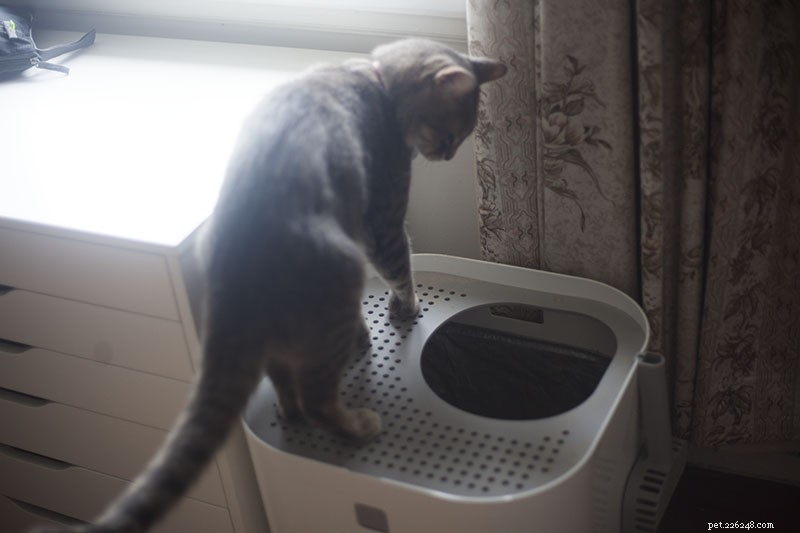 Modko Modkat Sleek Minimalist Top Entry Litter Box – Amazon / eBay
Part IV: How to Make Cat Cohabitation Easier on Humans
12. Train your cat to stop scratching human furniture.
It’s not so bad living in a huge house with plenty of furniture and having a cat slowly but surely destroy every piece with scratching. By the time kitty gets through all the furniture, it’ll be time for a new set anyway.
But when you’re in a flat and there isn’t much furniture to begin with, it can be pretty rough watching the one couch you loved enough to buy be completely destroyed by kitty claws.
There’s a fix. You can absolutely train your cat to stop scratching furniture. Here’s how.
There are also a lot of products on the market nowadays that can help you prevent and even cover up cat scratch damage on furniture.
For instance, if you’re currently in the process of training your cat to stop scratching, you can use see-thru plastic scratch guards to protect your sofas (or walls!) while your cats scratching habits change.
Cat claws already done some pretty brutal damage to a couch? Don’t replace your entire sofa! Grab a couch protector cover, or if the damage is only to the front part of the sofa where cats really love to scratch, hide the damage with a sleek and beautiful couch corner scratching post to make your furniture look new again.
Like the idea of training your cat to stop scratching human furniture and want to take the positive training a little bit further?
Try browsing through these training guides, to find other simple things you can teach your cat to do – keeping off counters, which is a massive safety, hygiene, and quality-of-life improvement for both the humans and felines in your home.
13. Reduce and prevent cat litter smells.
No one likes living in a smelly house, and while you may think this is something you’d have to live with having a house cat in a small apartment, that’s just plain untrue.
There are a tonne of things you can do to both reduce and prevent terrible smells wafting out of your cat’s litter box. The easiest of which is changing your cat litter.
Can’t stand the smell of cat pee? Try World’s Best Cat Litter. I’ve been using it myself for years, and considering it lasts so long with me (a 6kg bag lasts me about a month with my single cat), I don’t feel its too expensive. If you’d like, you can read my thoughts about World’s Best here.
Can’t stand the smell of #2s? Try a walnut based cat litter. They’re excellent for reducing tracking as well, so you won’t end up with too much mess to clean up after each and every kitty loo visit.
The walnut litter I used back in Canada was Blue Buffalo’s Naturally Fresh. It was amazing, but I couldn’t get a hold of Blue Buffalo products affordably here in the UK, which is why I made the switch.
I think I slightly prefer World’s Best better now, since it clumps so well, but I’m not completely certain. Either way, they’re closely tied for me at the #1 & #2 spots.
Don’t have the ability to get rid of scooped litter quickly because you don’t feel comfortable flushing litter down the toilet, and your apartment doesn’t let you throw litter down the chute?
Don’t let litter stink up your garbage bins, grab a litter dispenser system like the Litter Genie Plus to lock in litter odours until it’s ready to be taken out.
Trying to tackle lingering odour smells that are subtle but just don’t seem to go away? Try large charcoal room deodorizers, they should really help in this respect.
Need more tips related to this topic? Check out all my advice on reducing cat litter smells here.
14. Switch to a better litter box.
Some cat litter boxes are one heck of a lot more suited to apartment life than others.
In my opinion, these are currently some of the best, though realistically, any top entry litter box, hidden litter box, or automatic self-cleaning litter box is typically better than your run-of-the-mill litter pan or covered litter box.
The why comes down to a lot of factors. These types of litter boxes are usually better for one or more of the following reasons: they track less, they don’t require you to also have a litter mat, they aesthetically look a lot better, they take up less space, they reduce litter smells, they require you to have fewer litter boxes if you have multiple cats, and require a lot less maintenance. Yeah, I know – that’s a lot of reasons.
Obviously, you don’t need to switch litter boxes, but if you’re even remotely near interested in optimizing that aspect of indoor cat ownership life, know that it doesn’t have to be expensive to do.
This gorgeous top entry cat litter box by IRIS, for example, hardly breaks the bank, but it can save you one heck of a lot of runaway cat litter mess, can reduce litter smells (because more litter can be placed in it, cats can hide their washroom visits deeper in litter), removes the need for a separate litter mat, and can therefore take up less space overall than what you’ve currently got.
Curious about the potential of switching litter boxes, but want to make sure you get one that’s right for you? Check out my small apartment litter box recommendations article.
15. Reduce tracking with a better litter mat.
Not interested in changing litter boxes? Chosen an ideal litter box that still needs a litter mat beside it?
If you need help reducing litter tracking, you could switch the litter you have itself (walnut litter like Blue Buffalo’s Naturally Fresh, as I’ve already stated, is very good for that) or you could switch up the litter mat you’re using.
Can the specific mat you use really make that big of a difference?
Absolutely. In case you’re thinking of making a switch, based on reviews I’ve read, these seem to be some the best litter mats for tracking reduction currently available.
Thoughts on Cohabiting With House Cats in Apartments?
Have you ever lived with an indoor cat or two in a small apartment before? What was it like? Did you struggle or was it much easier than most probably expect?
Have any suggestions for other pet owners who are about to move into a small apartment with their pet, or about to adopt a pet while living in a small apartment? Share your tips with us in the comments section down below!
- Pet Behavior
- Pet Breeds
- Pet Names
- Pet Adoption
- Pet Training
- Cat Stories
- Pet Health
- Adorable Pets
- Cats
- How to Keep Your Indoor Cat Thriving: Proven Tips for Happiness and Health
- How to Keep Your Cat Happy at Home: Expert Tips & Signs
- 8 Proven Ways to Keep Your Indoor Cat Healthy, Happy, and Active
- The Ultimate Guide to Keeping Your Cat Happy and Healthy
- Keep Your Indoor Cat Cool During Hot Weather: Easy Tips & Tricks
- Top Cat Essentials: Products That Keep Indoor Cats Happy and Healthy
- How to Keep Your Indoor Cat Happy: Expert Tips & Tricks