

Cat Barbering Explained: Why Your Cat Over‑Grooms and How to Stop It
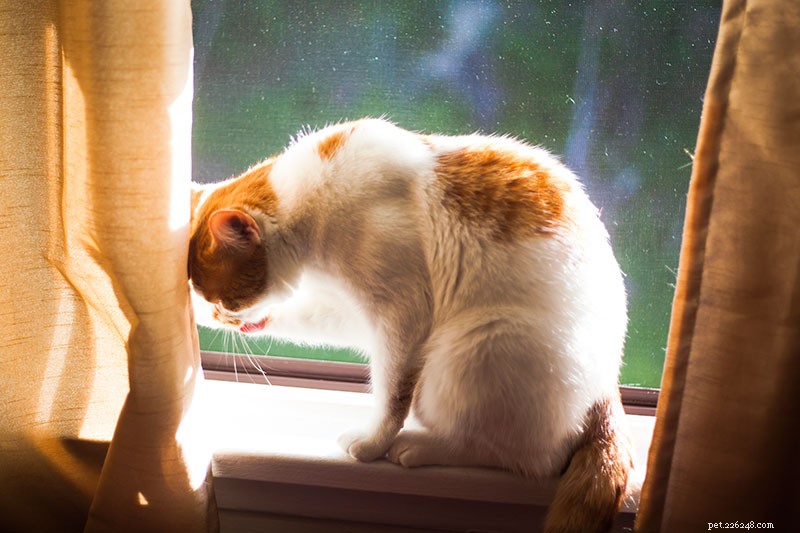
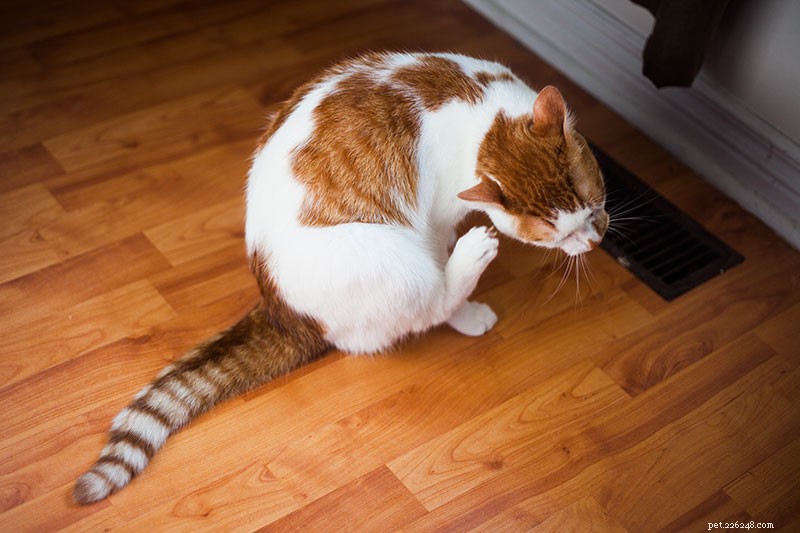
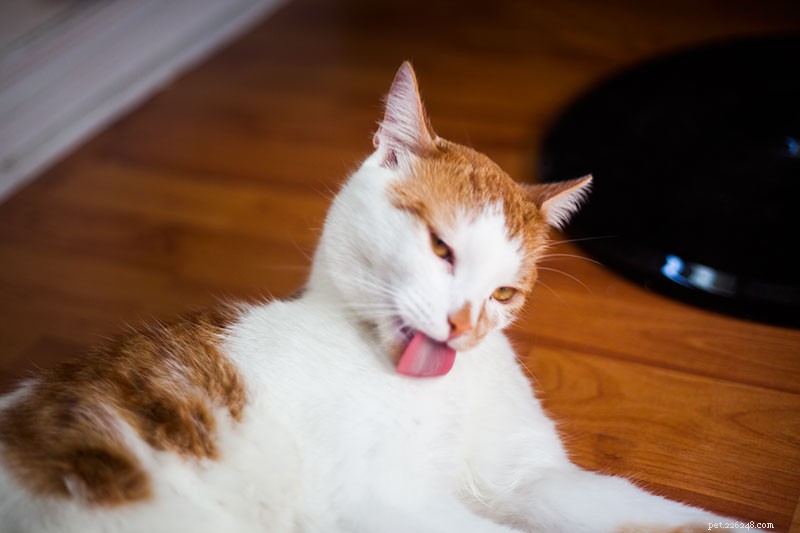
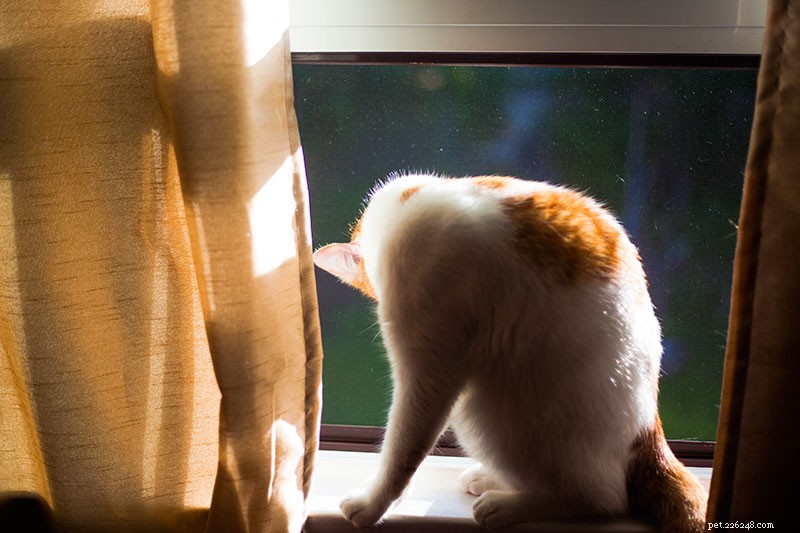
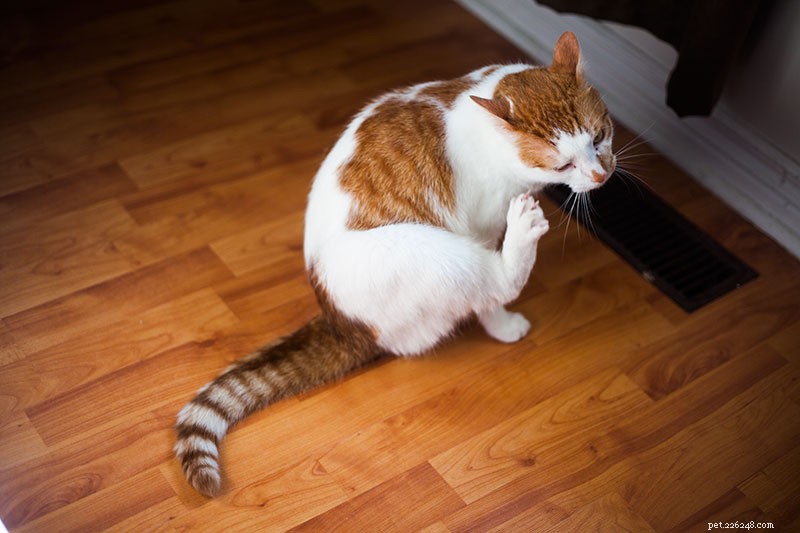
Here’s a frustrating behaviour to witness as a pet parent if I ever saw one: cat barbering. It’s when your cat bites, licks, sucks, or scratches – basically excessively over-grooming to the point where he or she will begin to lose hair, end up with bald spots, or even worse, have little scabs on his or her skin due to the compulsive behaviour.
It’s a frustrating behaviour my fellow pet blogger Crystal from Crystal and Daisy Mae’s Photo-Blogging Site has watched her cat perform for months. This post is for her.
Crystal first posted a comment about Daisy Mae’s behaviour on my article about why cats bite then lick published way back in February:
I quickly gave her a relevant link and said I would do my best to look into it for her, but completely forgot to research the topic for a full post (so sorry about that, by the way, Crystal!). Months later, on my post about personality changes after cats have been sick and cured from their illness, Crystal mentioned Daisy Mae’s problem again, asking for advice on what she should do since she’d been to the vet, but the vet couldn’t find a way to help her:
Based on my research, the causes behind this problem are either medical or behavioural in nature – either a cat is sick or has a parasite and this is a symptom, or this is a psychological/behavioural issue and not a symptom of an underlying medical cause.
Please note that I’m not a vet or a pet healthcare expert at all. I’ve done my best to compile the research I’ve done on this topic into a single post, but if I get things wrong, do correct me and I’ll do my best to update this post with the accurate information as quickly as possible. Obviously, use this article as a loose guide on what to look for and to double check for, but if your cat is barbering please oh please go to a vet to get him or her checked out. A lot of times barbering isn’t just nothing. It’s important to go.
I’ve done my best to list each and every potential explanation behind cat barbering I could find on the net, in case you wanted concrete options to take to your vet when you go visit them or wanted to double check to make sure the vet tried looking for every possible related physical illness. There is a point after which you may need to conclude your cat has a behavioural issue (psychogenic alopecia), rather than a medical one. But of course it’s ever so important to rule out all the medical issues it could possibly be first.
If I’ve missed mentioning any possible causes behind the behaviour of cat barbering, if you have personal experience on the matter, or if you can think of any practical advice for pet parents like Crystal who have a cat like Daisy Mae who barbers, please do share in the comments down below! You could really be helping a pet parent out a lot, even if it’s just in helping them feel they’re not alone in their frustration. Let’s start with the medical reasons that could be causing barbering as a symptom.
Medical Reasons That Could Cause Cat Barbering as a Symptom
1. Parasites
Chances are this is the first thing that came to mind when you first saw your kitty cat itch, and if it was, you’re on the right track, because a lot of the times, parasites are the cause behind cat barbering and over-grooming.
Have an indoor cat? Convinced Fluffy couldn’t possibly have a parasite since your furry feline never steps foot outdoors?
It’s actually entirely within the realm of possibility that an indoor cat could have ended up with fleas, ticks, worms, mites, or another parasite. Don’t get me wrong – it’s very uncommon and highly unlikely, but it’s possible, so it’s a good idea to double check anyway. Here are 10 ways indoor cats can get parasites in case you’re curious about how it’s possible. A few of those are impossible to prevent circumstances, like a flea or tick hitching a ride on a human’s pant to get indoors, or jumping into your house through a crack under a door or a window – so don’t feel bad if this freak occurrence happened to you. Sometimes the incredibly unlikely just happens!
The most common parasite to cause this kind of symptom? Fleas. So be sure to check for fleas in particular quite thoroughly. Less common amongst indoor cats, but still a possibility causing over-grooming, are skin mites and fungus caused by ringworm. Get a full parasite check at your vet to be thorough.
2. Allergies
Ever had an allergy before? Even in humans, a very common symptom of an allergy is itching – and for cats, this is just as true.
What could be causing an allergy that would then cause your cat to excessively lick, bite, scratch, and over-groom?
Quite a lot of things actually, so there’s a lot of ground to cover in terms of things you could test out.
In terms of the most common environmental allergies amongst cats, Catster has a short and sweet list of five published here –
- Pollen (which can travel up to 100 miles)
- Mold spores
- Dust mites
- Animal dander
- Grass
A helpful tool to combat these types of allergies? A HEPA filter air purifier. (As an unrelated tangent – air purifiers also do a kickass job at creating calming white noise if ever there’s loud construction, obnoxious neighbourhood parties, or any other anxiety-inducing noises that stress out your cat. Simply place kitty in a small room with one of these on, and your cat will be grateful for the instant peace and quiet. I used to use mine religiously for drowning out noise that may cause Avery anxiety; definitely need to get my hands on another now that we’ve moved.)
A few household related environmental allergies to top that list off that I can think of off the top of my head: cleaning products, perfumes, scented anything (including litter!) which could also cause irritation, basically just double check anything you suspect it might be.
Just like humans, cats can also have food allergies. So especially if your cat began itching and scratching viciously around the time a diet change or a recipe change in your cat’s food happened, you may want to give switching cat foods a try.
(Edit – just worked my way down and finished writing this article, and one study – referenced in the Psychogenic Alopecia section – found food allergies to be the cause of barbering in 57% of cases – so be sure to double, triple check with your vet to make sure your cat doesn’t have an undiagnosed food allergy!)
Obviously, be sure to inform your vet of any and all suspicions you have about potential allergies you think your feline may have, but there’s plenty to explore within the realm of this potential issue, so don’t give up on finding a solution!
3. Skin Conditions & Infections
Cats can get a bacterial skin infection known as Pyoderma that can cause these symptoms (sourced from PetMD):
Sound a lot like the results of barbering? I think so.
Cats can also have something called a eosinophilic granuloma complex, which includes three distinct syndromes, the symptoms of which are as follows (sourced from PetMD):
Again, sounds a lot like the results of barbering and over-grooming to me.
What this means is – while you may have noticed skin lacerations and lesions and assumed your cat’s itching and scratching was the cause, your cat may have an underlying bacterial skin infection or syndrome that actually caused the lesions, red skin, discharge, or even hair loss as well as being the root of the itchiness you’re witnessing.
Any cat breed can have a skin infection or have eosinophilic granuloma complex, and while these conditions are not all that common, you should still check to make sure they are ruled out. Vet didn’t find anything, but you strongly suspect a skin condition is the issue? Do your best to search for a veterinary dermatologist to run further tests.
4. Unrelated Illnesses
Unrelated illnesses, including but not limited to hyperthyroidism, arthritis, bladder infection – literally anything! – could cause a cat to over-groom because grooming itself is a stress-relieving activity. Thus, as Lisa Maciorakowski, DVM points out, “Since any illness may be a source of stress to a kitty and thereby lead to over-grooming, it is important to evaluate the general health of the cat. If the focus of the over-grooming is on one particular body part, the underlying areas should be evaluated for possible discomfort such as a joint with arthritis or a bladder infection.”
Mental & Behavioural Reasons That Could Explain Why Your Cat Is Barbering
1. Stress
We just spoke about stress being a potential cause for cat barbering, and while medical conditions may be the cause of the stress, they don’t necessarily have to be. Many things can cause a cat to be stressed out – from increased noise levels due to construction or loud neighbours, to a cat not being able to cope with other cats in the house, to not getting enough mental stimulation or physical exercise.
As with any and all stress related problems, run through the list of possible problems:
- Your cat could be sick.
- Your cat could need more play/need more exercise.
- Your cat may be hurt/injured.
- Your cat may dislike a change in his or her environment.
- Your cat might be bored.
The solutions?
- Take your cat to the vet to have a full work up done.
- Do a full weekend playing with your cat as often as he or she will engage, especially making use of these high-energy exercise toys to see if more exercise will result in less barbering.
- Double check your cat’s body for cuts or bruises (yes, you probably have already done this, but it’s good to know where these are so you can tell your vet when you go in for a check up, and to let him or her know to do a test to see whether or not these cuts or bruises are infected and thus causing pain – antibiotics may be necessary).
- Try “resetting” by placing your cat in a single room with everything he or she needs (food, litter, water, scratching post, toys, things to jump on, spots to sleep in), and a good view outside a quiet window with no cars, people, or commotion, away from other cats and noise (again, an air purifier would come in handy for this), be sure to come spend time with kitty regularly, and see if your cat lets up a little on the barbering. If he or she does, something about his or her environment is likely causing stress. Not doing the trick? Try changing litters or foods, since maybe that could be the problem. Do as much testing as you can to make kitty as comfortable as possible so you can rule out environmental stress as the culprit.
- Entertain kitty as much as possible for a weekend to see if this could be the issue. If your cat starts to over-groom when he or she is not stimulated, do your best to implement as many of these boredom-fighting measures as possible, and grab as many of these toys cats can play with by themselves to scatter around the house in case your cat wants to play when you’re not available.
Nothing work to fix the problem completely, but some of the stress-reliving activities helped a little? The last ditch diagnosis is…
2. Psychogenic Alopecia
Psychogenic alopecia is essentially a last-ditch diagnosis that labels a cat as having an obsessive compulsive disorder where he or she cannot stop over-grooming, excessively licking, chewing, biting, or doing all of the above to the point of balding, or self-mutilating to an extent.
The perfect summary of this condition is one again by Lisa Maciorakowski:
It’s important to note that if your cat has psychogenic alopecia, the issue is at it’s root stress, and over-grooming is the coping mechanism your cat happens to use to deal with and relieve the stress he or she feels. Finding the root of the stress, however difficult it may be, and remedying it, should help the issue to over time go away, but this is a big task considering so many things can cause a cat stress.
It’s also, however, important to note that the vast majority of cats likely do have an issue besides psychogenic alopecia and stress causing them to barber. In her article titled “Beware the Diagnosis of Psychogenic Alopecia: When Psychogenic Alopecia is the Wrong Diagnosis” Dr. Jennifer Coates mentions that “failing to run a complete diagnostic work-up on a cat that is pulling her hair out is an invitation for a misdiagnosis.” She cites a study called “Underlying medical conditions in cats with presumptive psychogenic alopecia.” by Waisglass SE that attempted to identify underlying causes of cat barbering to determine how many cats actually had psychogenic alopecia versus something else. The results were as follows:
The moral of the story from my perspective? Keep looking for an answer – and definitely start with looking for a food allergy, as a remedy may be more simple and straightforward to diagnose than you think.
Your Experiences with Cat Barbering?
Have you ever had a cat who barbered, excessively licked, over-groomed? Did he or she bald? Which spots on his or her body were most commonly over-groomed? Did you ever find a cause for this problem?
Have you ever had a cat diagnosed with Psychogenic Alopecia? Do you feel this was a correct diagnosis? Did you ever find a way to lessen the stress of your cat to a point where over-grooming was no longer an issue?
Please share any and all thoughts and advice you have down in the comments below. Again, I’m sure every pet parent who’s currently in this boat would really appreciate it!
- Pet Behavior
- Pet Breeds
- Pet Names
- Pet Adoption
- Pet Training
- Cat Stories
- Pet Health
- Adorable Pets
- Cats
- Why Cats Chatter: Decoding Their Mysterious Chirps
- Why Do Cats Have Barbed Tongues? Understanding the Science Behind Their Scratchy Texture
- Why Cats Hide When Sick: Signs, Causes, and How to Respond
- Understanding Why Your Cat Licks You: The Science Behind Their Behavior
- Decoding Your Cat’s Growl: Understanding Their Signals
- Why Does Your Cat Keep Licking You? Understanding Their Love and Grooming Behaviors
- What Your Cat's Licking Means: A Guide to Feline Affection