

How to Tell if Your Cats Are Playing or Fighting – A Quick Guide
It’s not always easy to tell if your cats are playing or fighting because the two can look very similar. Cats chasing each other, cats batting at each other, and cats jumping on one another is normal behavior when they’re playing—but can also be seen when fighting. Additionally, cats are known to play a bit aggressively, which might make you think they’re not having a happy interaction. The good news is, this guide is going to teach you how to tell if cats are playing or fighting. Here’s what you need to know!
Cats often play in the same ways they fight
Mock fighting or play aggression is normal behavior for cats. But it isn’t always easy to tell the difference between these and real aggression. There are ways to determine if they’re playing or fighting, such as body language and observing the nature of the fight. Here are the signs to look out for to spot the difference between playing and fighting.
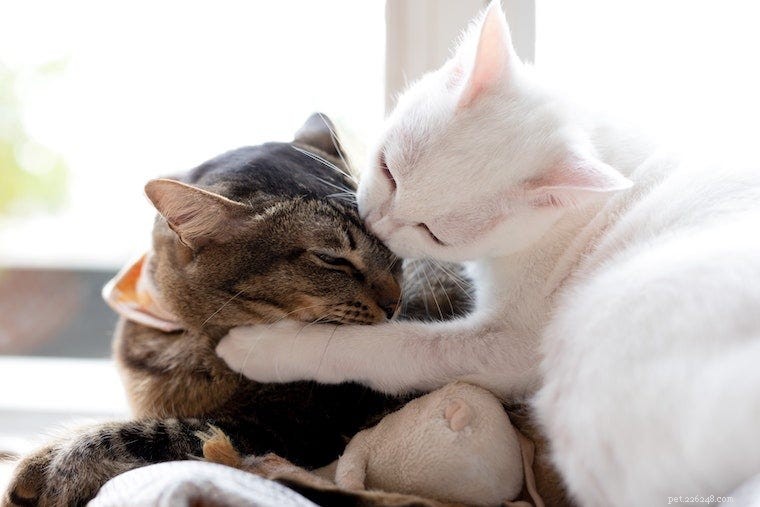
Cat Hug GIFfrom Cat GIFs
Observe their body language
Body language is one of the easiest ways to tell if cats are playing or fighting. When cats are playing, you’ll notice their bodies are relaxed and they take breaks during play. They also take turns during play, letting one be dominant and then switching roles.
On the other hand, do cats growl when playing? Not usually: Growling is often a sign of fighting behavior. Additionally, cats’ ears will be pinned back and their fur or tails will be puffed during aggressive interactions.
What about hissing? Hissing can be harmless in some cases. While hissing is usually thought of as a sign of being annoyed or threatened, it’s also a way cats communicate. Hissing can also be a warning sign of pain, annoyance, or stress, or an indication the play is too rough.
Signs of friendly play
- Biting without causing injury
- Chasing
- Claws are sheathed or retracted
- Relaxed body language with ears pointed up
Signs of aggressive play
- Thrashing their tails back and forth
- Ears pinned to the tip of their head
- Dilated pupils
- Whiskers out to the side
Signs of real fighting
- Puffing up the fur or tail
- Defensive postures
- Hissing with bared teeth while leaning away from each other
- Ears flattened or held back
What to do if your cat is playing too rough
If you’re concerned about your cat playing too rough with you or other cats, training can help redirect the unwanted behaviors. Be patient and loving with your cats and understand that punishments will not help. Cats don’t understand punishment, so breaking out the spray bottle or yelling at them can make the behavior worse. Even if you simply pull away from an aggressive cat, it can trigger their hunting instincts.
Give them individual space
Cats need space to claim their own territory. Set up shelves, a cat pyramid, or a cat tower in multiple rooms so they have a space to relax and be alone. This will also give your cat a place for activities to help work out any nervous energy.
Offer catnip
Catnip can be a good solution to help put your feline at ease and tame aggressive behaviors. It’s important, however, that you only offer catnip if you know your cat responds well to it. Catnip doesn’t affect every cat the same way, and can make some cats more aggressive.
Redirect their attention
When you start noticing things getting a bit tense between cats, try to redirect their attention and offer stimulation away from other cats. You never want to step in between aggressive cats. Instead, use a laser pointer or feather wand to redirect their attention.
Pheromone plugins
Cat diffusers such as Feliway can be useful tools to signal to your cat that everything is safe, calm, and secure. These diffusers emit an odorless, drug-free scent that mimics a cat’s pheromones to help calm an aggressive cat. When there’s tension between cats, the pheromones will induce a calming and happy atmosphere.
Reintroduce cats
If all else fails and you can’t redirect their attention with other activities, you may need to reintroduce your cats to one another. To do that, you’ll need to keep them in separate rooms, swap their scents, and feed them on opposite sides of a closed door. This helps them learn to stay calm while sensing each other. Next, start giving them supervised and limited visits to teach them the other isn’t a threat.
- Pet Behavior
- Pet Breeds
- Pet Names
- Pet Adoption
- Pet Training
- Cat Stories
- Pet Health
- Adorable Pets
- Cats
- How to Tell if Your Cats Are Playful or Aggressive
- Do Cats Show Territorial Instincts? Understanding Their Space and Social Dynamics
- How to Distinguish Playful Cats from Aggressive Ones: 3 Simple Signs
- How to Tell When Cats Are Playing or Fighting – Key Signs for a Peaceful Home
- Are Cats Nocturnal? Unveiling Their Nighttime Habits
- Do Cats Prefer the Night? Insights into Their Activity Patterns
- Understanding Your Cats' Behavior: How to Tell Play from Conflict