

Why Is My Cat So Hyper? Effective Ways to Calm a Hyperactive Feline
Ah the hyper kitty cat. There’s nothing more entertaining and amusing to watch – yet have the hyperactivity go on long enough, throw in a little attack session to your poor fingers or toes, a lot of mid-night wake up calls by way of kitty cat war cries, meowing and darting around the house like a wilderbeast, and this charming behaviour really does begin to lose its shine.
Trying to figure out why on earth is your cat so hyper? Wish you knew if all cats were this way, or if your cat is just a little bit unhinged?
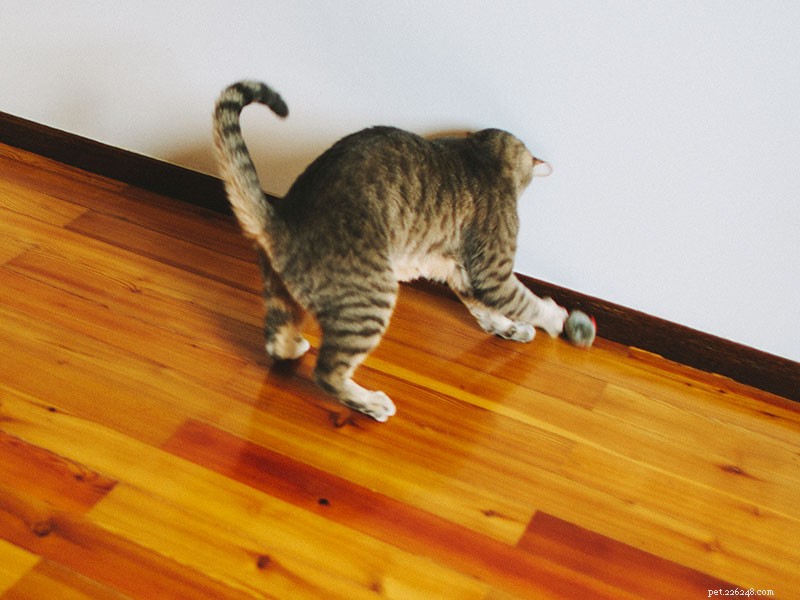
More importantly – if your cat is a hyperactive little beast, is it possible to calm your cat down? How exactly would you go about doing that?
Is there a way to prevent the madness from taking over life with your furry friend? A way to tone things down when that practically possessed look of utter chaos glistens in your fluffy’s eyes?
Is there hope or any kind of relief for we poor feline servants who are just trying to keep our cats happy, but also want to be able to live without fear of having our toes attacked under the covers repeatedly each night in our own homes?
If you have a hyperactive kitty cat – will you ever be able to have a good night’s sleep again?
The answer to all these questions is one heck of a lot more positive than you might imagine.
I promise you, if your cat is regularly displaying hyperactive behaviour, there are plenty of things you can do to help make the situation a lot better for you and your cat. Let’s start at the very beginning…
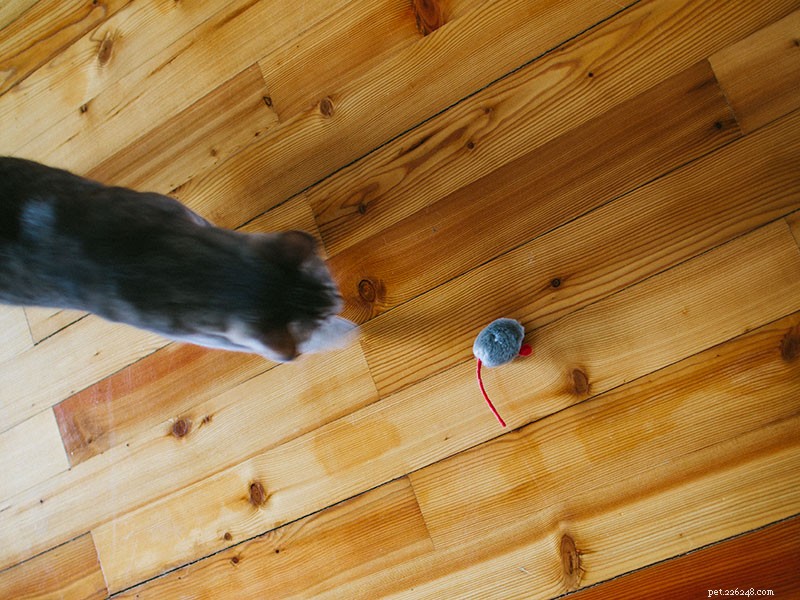 Toy Mouse with Microchip Squeak and Catnip – ZooPlus.co.uk / eBay
Why Is My Cat so Hyper?
To explain this one away, I’m going to need to call on your memory of nature documentaries that feature lions, as well as your memories of Disney’s The Lion King.
Remember watching these large cats hunt, stalk, and catch their prey? They run real fast, jump ever so high, and when they pounce, there’s no denying they mean to catch what they’re chasing after.
Cats use a lot of energy when they hunt. They don’t half-ass the hunting process one bit, and that’s part of why they’re so very good at catching their prey.
How can an animal in their sights possibly outrun, out jump, or squirm free of their grip? They can try, but it’d be really hard, because cats are such powerful animals when they’re in hunting mode.
In case you’re ever wondering why cats sleep so much during the day (up to 18 hours!) and seem really, really lazy most of the time, this has a lot to do with why.
They can’t be high energy all the time. They can’t even be medium energy most of the time, then have such huge bursts.
Instead, they conserve their energy, keeping things real low key, so that when it’s time to hunt, BOOM.. they kick into action, going from 0 to 100, and are crazy difficult to fend off if you happen to be their prey, because who can compete with that level of burst?
Which brings us back to the hyperactivity of your particular cat… because honestly it’s not anything like being hyper as a human.
It’s not about wanting to play to have fun per say, instead it’s about that crazy high feline prey drive, and to us humans the actions that result looks a lot like a hyperactive sugar-loaded homosapien child. But it’s different, and more visceral, and more pressing for a cat.
It’s biologically ingrained in them to get out all that energy by hunting, stalking, and killing prey, sometimes they happen think that prey is your wiggly toe beneath the bed covers. But it’s not them being mischievous or naughty, really – they’re merely following their base instinct to hunt.
If they didn’t ever feel a visceral and pressing need to hunt, knowing cats, they would probably spend every minute of every day lazing around or napping all day.
Which means in the wild, they would never catch anything, never eat, and we all know what happens when you don’t eat enough – you plain can’t survive.
This hyperactivity has thus played a huge role in feline survival. So you can’t have a cat without that crazy look glistening in their eyes sometimes.
So are all cats this way?
Yes, absolutely all cats get hyperactive. It’s not just your cat that gets batty out of nowhere.
And since cats are either nocturnal (active mostly at night) or crepuscular (active mostly at sunrise and sunset), cat owners do often encounter problems with their cat crying at night or waking them up way too early in the morning because that’s when these bursts of energy happen to come.
Spoiler alert before you get too bummed out: your cat can adapt to be diurnal (active mostly during the day) just like you, and many cats actually do this on their own naturally after some time living with their humans, so if you know your cat is waking you up at night due to hyperactivity and wanting to play, and you’ve been really wishing they’d switch up to being hyperactive in the morning instead, there is absolutely hope yet for you and your fur ball.
Which takes us into the next section…
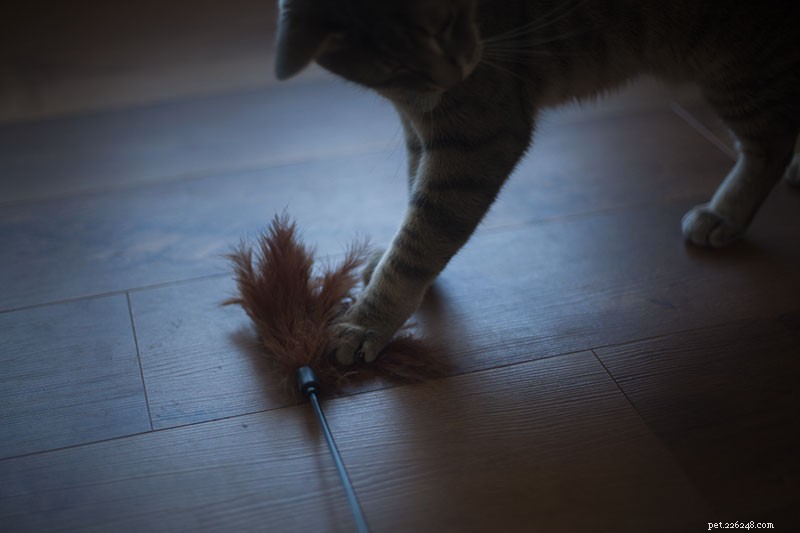 Interpet Pet Love Kat Tikkler Feather Wand Cat Toy – Amazon / eBay
How You Can Calm Your Hyper Cat Down
There are actually quite a lot of things you can do in order to calm a cat who’s frequently hyperactive down.
The tips generally revolve around a few very important points to note:
1 – Your cat will never stop being hyperactive all the time, so to make sure that your cat is calm during times you want him/her to be calm, you’re going to have to drain that energy away in short, energy intensive bursts of play sessions when you’ve got a spare moment to do so.
2 – If you want your cat to stop being hyperactive at night, you’re going to need to make sure that he or she is getting out all his or her energy during the day.
If all your cat’s needs are being met during the day, chances are real high he or she will sleep and relax throughout the entirety of the night. This is how many cats become diurnal (active mostly during the day) after some time living with humans.
When their needs (including exercise, a release of their prey drive, and meal times) are all met during the day, they’ll naturally begin to sleep and rest more during the night since they’ll be wiped out/exhausted from a long, fulfilling morning.
3 – You cannot and should not be fighting against your cat’s base needs and punishing a cat who wants to play. It’s not healthy for your cat, and it just plain won’t work out for you.
Instead, work with your cat to fulfill needs during morning, afternoon, and evening hours, so he or she is wiped out by nighttime. The cats and the humans in your household will all be happier and healthier for it.
Okay now time to get into the tips.
What I recommend: trying to do the most effective of these first.
I’m thus going to try starting with what I think are the most effective and work my way down to those that are, not ineffective, but definitely not as effective as the initial ones.
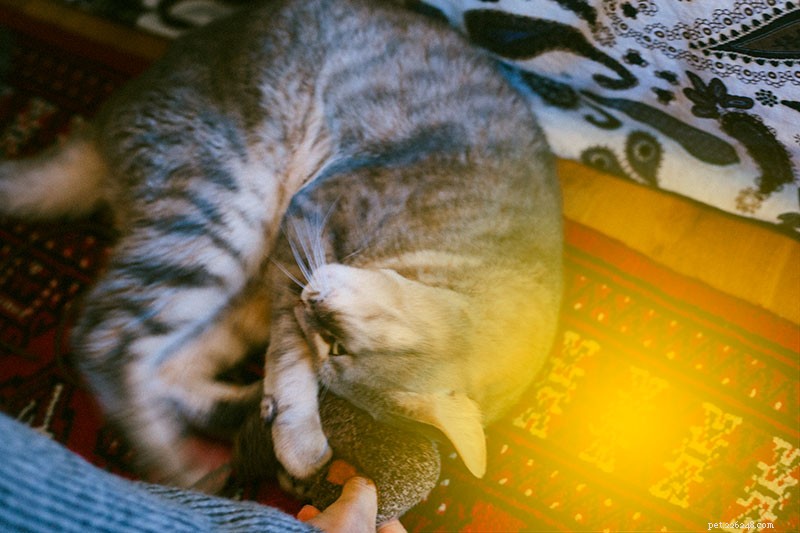 Petlinks Jeepers Creepers Catnip Rat Toy – Amazon / Chewy
1. Have regular, high energy playtime with your cat during the day.
Again, because of their prey drive, cats actually need play in their lives. Your cat should be having regular, daily playtime sessions that last around 20-30 minutes in total for each day.
You can break this 20-30 minutes into two or three sessions, or just have one long playtime until your cat is completely spent – it all depends on what works for you and/or your cat.
And yes, you can 100% “outsource” a lot of the work to automated cat toys that run on their own, like automatic laser pointers or button activated prey-under-rug types of games, but if these are just not all that interesting or engaging for your cat, you’ll need to step in and “do the dirty work” of playing with your kitty yourself.
If you already play with your cat regularly but find your cat’s still pretty darn hyperactive, you probably need to up the ante a little by switching to using high-energy, intensive exercise toys like Go-Cat Da Bird Feather Wand Toy that will really exhaust your cat to be playing with.
A lot of cat toys out there, like food puzzle toys, are great for stimulating cats mentally, but don’t excel at draining your cat of all his or her pent up energy, and really getting him/her to use their prey drive to the full hunting-mode extent, which is where those high energy cat toys really come in handy.
Kittens are obviously notorious for having lots of energy to spare, and that’s why these types of toys work out great for them, but some adult cats are a lot more high-energy than others.
For these, a bunch of high-energy cat toy options work out really well for releasing all that pent up energy and aggression on a toy instead of the furniture, the wall, or even you.
2. Add toys your cat can play with by him or her self to your cat’s environment.
Can you imagine a world where your hyperactive kitty would get that mythical burst of energy, and, rather than coming over to whine and complain or even attack you, waltzed over to a cat toy you had out, took a nice big whack at it, then chased it around the house to pounce and play with for as long as he or she wanted instead?
I doubt you’d have an issue with having a hyper, high-energy kitty if your furry was that proactive about playtime.
Thing is, unless you have a slew of toys cats can play with by themselves (many examples can be found here) already littered around your home in all the places your cat spends a good chunk of time, you can’t know if this picture of domestic bliss and life-with-cats perfection could indeed be your household.
Considering how inexpensive these types of cat toy usually are compared to electronic/automated varieties, honestly, you should not hold back giving a number varieties of them a go (again, for ideas on varieties of cat toys that are great for this see here).
Avery’s current favourite toys to play with by himself? Cat springs and a stuffed mouse that “squeaks” electronically if he pokes it.
Now that I know what he likes, I’m doing my best to buy him more varieties along the same lines… more toys he can swat at that will jump and bounce in funny ways, and more playthings that will squeak and chirp if he touches them.
Oh, and if you happen to be out of the house a lot, but want your cat to have the option of playing while you’re away?
These are the perfect types of toys to have lying around.
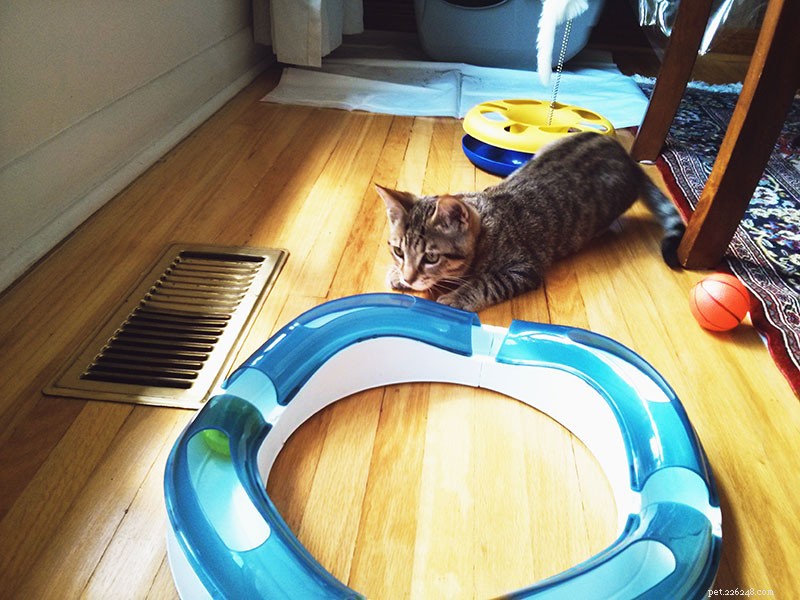 Catit Design Senses Play Circuit Light Up Ball Track Cat Toy – Amazon / Chewy
3. Make your cat’s environment more engaging.
This may absolutely suck for you as a cat owner to hear, but if your cat’s always hyperactive around you, your poor furry is probably – at least in part – bored stiff most of the day.
It doesn’t at all mean you’re a bad cat owner, and it doesn’t mean things are beyond hope, but sometimes, even if you’re doing your best to entertain your cat – well cats can be super picky about the things they’re interested in and just end up bored anyways.
I’m going to state the obvious here – boredom in cats happens a lot more frequently if they’re indoor-only.
That does not at all mean it’s bad to have an indoor only cat, I do not believe that in the least.
In fact, I have an indoor-only cat, so do my brother, my mother, and many of my friends, and so do a slew of other pet owners who have no issues keeping their cats at home entertained.
There are a tonne of ways you can make your indoor-only cat’s life incredibly engaging, here are a slew of the ideas I came up with to fight feline boredom passively, and if you do enough in this department, you may actually end up with an even more enriched and engaging environment than (in my opinion) many outdoor cats have.
You just have to work a little harder than an outdoor cat owner would to keep your cat mentally stimulated, and you have to understand the types of things that appeal to cats (and your cat in particular), then enrich your cat’s space with a plethora of varieties of the types of things that appeal.
If you’re currently living in an apartment or a small house, you may also want to check out my article about how to keep indoor cats happy in small spaces because it’s also got plenty of relevant tips for making your cat’s environment better overall.
4. Stop free-feeding your cat; feed meals instead.
Cats are supposed to get bursts of energy right before they eat. In my experience, my own cat Avery seems to get bursts of energy about an hour after his main meal for the day.
He’ll have a good cat nap after he eats ’til his belly is full then come nag me with those “I’m wild!” eyes that’s an obvious indication to em that he’s ready to play.
I feel the rule of thumb should be something like, make sure your cat eats meals roughly one or two hours before you sleep or a one or two hours after you wake up.
That way, if your cat wants to play before or after he or she eats, you’ll be home and you’ll be up and able to help him or her get that energy out.
If your cat gets really hungry at night and you’re happy to leave some kibble out for him or her, I’d recommend leaving some kibble out in a slow feeder bowl or a puzzle feeder cat toy (like the Catit Senses Food Maze I happen to love so much) so it takes a while to eat and isn’t all scarfed down in one go.
I’d recommend the main, big meal at the very least to be, again, either one or two hours before you sleep or one or two hours after you wake up.
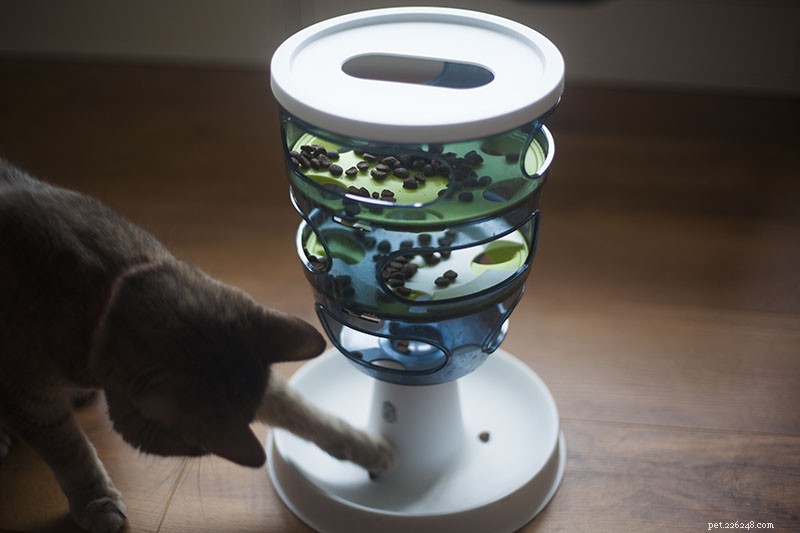 Catit Design Senses Food Maze – Amazon / Chewy
Your Thoughts on Hyper Cats?
Now it’s your turn to let me know about any thoughts, experiences, or advice you have on the topic of hyper kitty cats.
Have you ever had a hyper feline on your hands? Was it just a kitten thing that your cat grew out of when he or she matured into an adult?
Did your cat used to do things like wake you up at night or early in the morning, or attack your toes under bed sheets?
Did you resolve this by changing up something you were doing?
I feel like there are a million and one questions I could ask about this topic, but really, just anything that comes to mind or that you have to say related to hyperactive kitty cats, please leave in a comment down below.
The few minutes of your time it takes to leave that comment could really help another pet parent out!
- Pet Behavior
- Pet Breeds
- Pet Names
- Pet Adoption
- Pet Training
- Cat Stories
- Pet Health
- Adorable Pets
- Cats
- Understanding Cat Hiccups: Causes, Signs, and Relief
- Calm Your Cat During Car Rides: Expert Tips for a Stress‑Free Journey
- Why Cats Love to Bite: 4 Key Reasons & How to Respond
- Understanding Ferret Hissing: 5 Causes & Calm Techniques for Owners
- Calming a Stressed Cat: Proven Strategies to Reduce Anxiety
- 9 Proven Ways to Calm a Hyper Dog
- How to Calm an Aggressive Cat: Proven Techniques for a Peaceful Home