

Inside the Humane Society Fund: Empowering Animal Shelters & Rescues
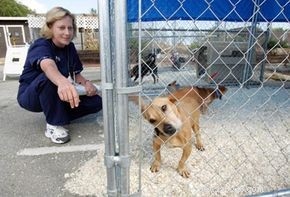 Dr. Linda Janowitz checks on some of the dogs at the Peninsula Humane Society & SPCA in San Mateo, California. See more pictures of pets.
When most people think of the Humane Society, they imagine rows and rows of caged dogs and cats waiting for someone to adopt them and take them home. While the Humane Society of the United States (HSUS) does work to support local animal shelters -- and dogs and cats -- its work encompasses much more than that. The motto of the HSUS is "Celebrating Animals, Confronting Cruelty," four simple words that illustrate a complex organization.
Pets Image Gallery
There are thousands of animal species all over the world, and the HSUS works directly or indirectly to save, protect or rescue just about all of them. And it works globally, not just in the United States, including with animals found in the depths of the oceans. Some of the animals the HSUS provides help for are involved in rodeos, racing, circuses, zoos, research, hunting, food, fashion, puppy mills and aquariums. And that's not even close to a complete list.
The HSUS also works with domestic pets and provides support to local animal shelters and animal-control professionals. The organization is constantly presenting pieces of legislation -- locally and nationally -- to outlaw cruelty to animals. In the event of a natural disaster like Hurricane Katrina or the 2004 tsunami in Southeast Asia, the HSUS has a disaster team ready to travel to the area and help rescue animals. It even has a program in place for homeowners to learn to coexist with backyard neighbors like squirrels, raccoons and mice.
So are there programs successful? What has the HSUS accomplished in its relatively short existence? How did this nonprofit organization get started, and how does it stay in business?
The History of the Humane Society
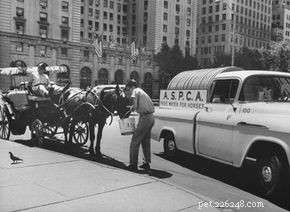 July 1963: A horse that gives tourists rides through Central Park is being fed by an ASPCA and Humane Society worker during a summer heat wave.
The Humane Society wasn't the first organization to work toward helping animals. The Society for the Prevention of Cruelty to Animals was founded in 1866. It was the first organization of its kind in the United States, but it wasn't the last -- over the next decade, several similar organizations came into existence [source: Learning to Give]. In 1877, delegates from 27 of these humane organizations across 10 states banded together to form the American Humane Association (AHA). Its main priority was to help farm animals and improve the conditions of their lives [source: American Humane Society].
The AHA worked for more than 65 years to help animals throughout the United States. But in 1954, a rift arose among its members. There was great debate about animals that were abandoned at animal shelters and had little to no hope of being adopted. Some members of the AHA wanted those animals turned over to laboratories for research. Others felt that was cruel and went against what they were fighting for -- those members broke off from the AHA and started the Humane Society of the United States. Robert J. Chenoweth was selected to lead the new organization, and Oliver M. Evans was chosen as its first director.
The primary goal of the HSUS was to eliminate all animal cruelty throughout the world, not just in particular areas. Its first fight was against legislation that would require shelters to turn over animals for scientific research. The next 50 years saw a myriad of accomplishments from the HSUS in several fields:
Today, the HSUS is based in Washington, D.C., with nine regional offices, eight affiliates and an international arm. There are 569 paid staff members -- including veterinarians, biologists, lawyers and behaviorists -- as well as the volunteers that work throughout the country. The Humane Society is a 501(c)(3) charitable organization, which keeps the business running the same way other nonprofits do: through donations and fundraising. It boasts nearly 10 million members and constituents and saw total revenue of more than $100 million in 2006, with more than $91 million coming directly from public support [source: HSUS].
While the Humane Society of the United States has done a lot to help animals in need in the past, it's up to some pretty cool activities right now. In the next section, we'll take a look at some of the HSUS' current programs.
Where's the Beef?In February 2008, the U.S. Department of Agriculture issued a recall of 143 million pounds of beef. This beef came from a California plant and was sent all over the country, with nearly half of it going to schools. The recall came because of an undercover investigation conducted by the Humane Society of the United States. In October 2007, an employee of the HSUS started working at the processing plant, and using an undercover camera, he recorded several acts of animal cruelty over the next few months [sources: Salon, CNN].
Humane Society Programs
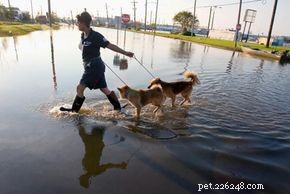 Racelle Carlson from the Arizona Humane Society leads two rescued dogs from a flooded neighborhood in New Orleans, La., to a processing area where the dogs will be examined, fed and evacuated to area shelters on September 6, 2005.
As we talked about in the last section, the HSUS has had many accomplishments over the years. In the 21 century, the organization has kept its momentum going. Here are two programs that have launched in the last few years:
Along with these new programs, the HSUS had some major achievements in 2007, in several areas of concern. To someone not well schooled in the animal cruelty trade, some of these areas may be surprising. These are some of the animal rights advances that took place because of HSUS programs and lobbying:
Humane Society International also persuaded the European Union to ban the trade of cat and dog fur and elephant ivory and continued to monitor seal hunts that take place in Canada.
 Humane Society International (HSI) spokesperson Nicola Beynon displays a toy cat purchased in Sydney, Australia whose face is made of real cat fur, at a press conference on July 10, 2003.
The HSUS works diligently to improve the welfare of animals around the globe, but it can't possibly be everywhere all at once. For this reason, the Humane Society teams up with other animal-rights groups and services to accomplish its mission. In the next section, we'll take a look at the HSUS' relationship with those other groups.
And the Award Goes To ...The HSUS rewards people who strive to make a difference in the animal community through a number of awards. Some of the awards the Humane Society presents are:
Read MoreThe Humane Society and Other Animal Groups
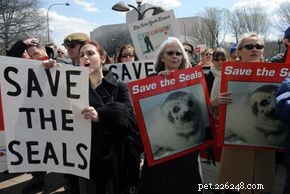
Demonstrators hold signs to protest against the slaughter of harp seals on March 15, 2006, in Washington, D.C. The Canadian commercial seal hunt is the largest marine mammal slaughter in the world.
The HSUS supports many animal rights groups. It's affiliated with eight specific organizations: the Humane Society Legislative Fund, the Doris Day Animal League, the Humane Society Youth, the Humane Society Veterinary Medical Association, the Humane Society University, The Fund for Animals, the Center for Respect of Life and Environment, and the Wildlife Land Trust.
You'll notice that none of these are animal shelters. While many people associate the Humane Society with local shelters, the two may not have anything to do with one another. The HSUS works to support local humane societies and has become their most important advocate. In 1960, local shelters began to affiliate with the HSUS, but they had to measure up to some very strict standards of operation [source: Funding Universe]. The HSUS wanted to ensure the organizations it was helping were truly looking out for the best welfare of animals. However, even if the HSUS is affiliated with a local shelter, that shelter remains an independent entity, with its own policies, rules and priorities.
Local humane societies that meet the standards of the HSUS receive some serious perks. The HSUS works to give its local shelters:
So although affiliation with the HSUS requires a shelter to meet rigid requirements, the shelter gets help and support that it wouldn't be able to find elsewhere. For more information on the Humane Society of the United States, local animal shelters and related topics, follow the links on the next page.
Colorado Controversy
In 2007, the Colorado Humane Society came under fire after an investigation revealed the shelter euthanized several animals and discarded their carcasses in the dumpster behind the building. Of the many guidelines the local shelters must follow to associate with the HSUS is that euthanized animals must be "disposed of by deep burial, incineration or other method in compliance with state and local laws."
The director of the shelter, Mary Warren, initially denied all of the accusations, but has since admitted the investigation was correct. The county, which had been funding the shelter, pulled all money from the program and closed its doors. The veterinarians and employees were all fired [source: The Denver Channel].
Read MoreRelated HowStuffWorks Articles
- Cane Corso: Italy’s Majestic Mastiff – History, Traits & Care
- Comprehensive Guide to Feline Glaucoma: Causes, Symptoms & Treatment
- Exotic Shorthair Cats: The Ultimate Owner’s Guide
- Nebelung Cats: A Comprehensive Guide to the Misty Breed
- American Curl Cats: Unique Ears, Warm Personality, and Essential Care Tips
- Understanding Canine Neutering: A Professional Guide to Dog Castration Surgery
- Discover the Tennessee Walking Horse: Comfort, Style, and Heritage