

Great Dane & German Shepherd Mix: Is This Large, Loyal Companion Right for You?
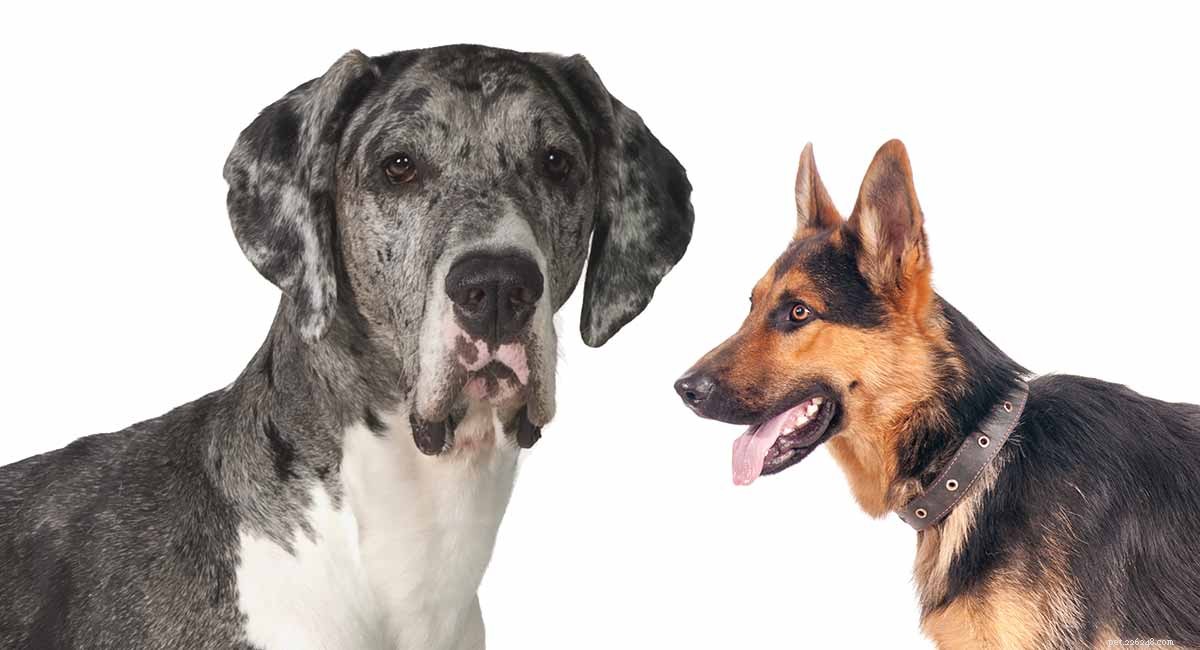
If you want to know whether the Great Dane German Shepherd mix would make a suitable pet, then this is the article for you!
Meet the Great Dane German Shepherd Mix
The Great Dane German Shepherd mix, often called the Great Shepherd, is the hybrid offspring of the Great Dane and the German Shepherd.
The Great Dane German Shepherd mix is one of the largest crossbreeds around.
So, what should you know before rushing out and getting yourself this colossal canine?
Let’s start by discussing the crossbreed controversy.
The Crossbreed Controversy
A crossbreed, hybrid, or designer dog is a mixed breed created by breeders with two specifically chosen purebred parents.
But why make a designer dog?
Actually, there are a number of reasons breeders choose to crossbreed, and in fact, this is a practice that has been going on since the beginning of the human and canine relationship.
Still, that doesn’t mean it’s a conflict-free practice.
Find out what happens when a German Shepherd is crossed with:
- Golden Retriever
- Labrador
- Siberian Husky
Some people insist that crossbreeds are nothing more than mutts. Others claim that mutts are different because they are “accidental” mixes with a widely unknown lineage.
To learn more about how mutts and crossbreeds may differ, click here.
And although many breeders claim that pedigree dogs are healthier than crossbreed dogs due to the care taken in their breeding, science is showing us otherwise.
Purebred dogs are more likely to suffer from genetic illnesses and general loss of fitness due to generations of overbreeding.
Crossbreed puppies are more likely to enjoy a biological phenomenon called hybrid vigor.
Hybrid vigor is when offspring of a wider gene pool survive longer, have less illness, and are more likely to reproduce.
To learn more about crossbreeding and the biological value of hybrid vigor, click here.
Otherwise, keep reading! It’s time to learn all about the Great Dane German Shepherd Mix!
How Did the Great Dane German Shepherd Mix Come About?
The first Great Dane German Shepherd mix is unknown.
But don’t worry. We may not be able to tell you exactly how he came to be, but we can still dive into the histories of his parent breeds.
Let’s begin with the Great Dane!
History of the Great Dane
The Great Dane is believed to come from Germany, although experts have long suspected he has a connection with Denmark. Just what that connection is, however, has historians stumped.
And while his Denmark heritage may be a mystery, experts have been able to determine that the Great Dane was originally bred as a wild boar hunter for German noblemen.
The powerful and massive Great Dane was also an incredible guard dog.
Despite being known by many enthusiasts as a “gentle giant,” the Great Dane was known for his loyal nature and incredible ability to guard his home and family.
The modern-day Great Dane is still just as loyal and loving, so it’s no surprise he sits at number 14 out of 194 on the American Kennel Club’s list of America’s most popular dog breeds!
History of the German Shepherd
A herding dog from Germany, most experts agree that the German Shepherd is a descendant of a small group of herding dogs from the 1800’s.
In fact, many historians claim that the German Shepherd is directly related to the five chief Italian herding breeds, including the Lupino del Gigante, the Bergamasco Shepherd, the Pastore d’Oropa, Cane da Pastore Della Lessinia e del Lagorai, and Cane Paratore.
A naturally protective breed, the German Shepherd made an excellent guard dog and shepherd dog, herding and protecting livestock in Germany for centuries.
However, it was the breed’s work ethic, loyal nature, and incredible intelligence that made him one of the top military and police canines around.
But the German Shepherd is adored by more than agriculturalists and law enforcement officials.
In fact, he makes for a favorite family dog, with an impressive seat at number two on the American Kennel Club’s list of America’s favorite dog breeds!
Great Dane German Shepherd Mix Temperament
What is the Great Dane German Shepherd mix temperament like?
Due to the fact that the Great Dane German Shepherd mix is a crossbreed, it’s important to keep in mind that he could inherit a number of different temperamental traits from his purebred parents.
To learn more, let’s go over the personalities of the Great Dane and the German Shepherd.
Great Dane Temperament
The Great Dane is famous for being the gentle giant of the dog world. He gets along well with children and other pets, including other dogs.
This is a well-mannered, patient, and calm breed who really just wants to lounge around and be with those he loves most.
However, experts do recommend keeping this large breed on a leash when walking him outside the home. While he may seem like a slow-poke mulling about inside, he is actually quite quick and can have a habit of wandering off after intriguing smells.
And while the Great Dane is gentle and does well with kiddos and other animals, it is important to note that this is a massive dog who takes up a lot of room.
Of course, early socialization and obedience training are a must with this large breed and will help to ensure he grows up to be well-rounded, anxiety-free, and happy.
German Shepherd Temperament
Much like the Great Dane, the German Shepherd is a powerful dog with a gentle touch. He does well with children and other household pets, but he can be standoffish with strangers.
Loyal to the end, the German Shepherd would willingly give up his life for his family and makes for an incredibly devoted and loving pet.
Patient, intelligent, and quite trainable, the German Shepherd is a wonderful dog for families of all ages.
However, it is very important to note that the German Shepherd is an intelligent, work-oriented breed and will be happy as long as he is being kept mentally and physically active.
So it’s fair to expect your Great Dane German Shepherd mix pup to a great family dog.
He’s likely to be patient and gentle, but he may also be uncertain around strangers. So good socialization from a young age will be key.
If he inherits the German Shepherd’s insatiable work ethic, you might also find he gets bored and impatient without jobs to do.
What Will My Great Dane German Shepherd Mix Look Like?
When it comes to physical appearance and size, remember that your Great Dane German Shepherd mix’s appearance could vary depending on genetics and chance.
With that in mind, let’s take a look at the defining characteristics of the Great Dane and the German Shepherd to get a better idea of what characteristics the Great Dane German Shepherd mix could inherit.
Great Dane Appearance
At a towering 28-32 inches tall and a whopping 110-175 pounds, the Great Dane is one of the largest dogs in the canine kingdom.
The Great Dane is born with long ears that may be clipped. He also has a long, lean body, a large head, a long tail, and a short, shiny coat that comes in six standard colors:
- Black
- Brindle
- Blue
- Mantle
- Harlequin
- Fawn
German Shepherd Appearance
The German Shepherd is a powerful breed, standing 22-24 inches tall and weighing between 50-90 pounds.
In theory this means a German Shepherd Great Dane mix could weigh anything from 50 to 175 pounds!
In reality, most pups will fall in the middle of this range, with a few outliers. But be prepared, and don’t make any assumptions based on their appearance as a puppy.
the GSD has a dense, double layer coat that can grow to medium length. He has large, erect ears, bright eyes, and an expressive face.
Much like the Great Dane, the German Shepherd also comes in six colors:
- Black and Tan
- Black
- Red and Black
- Sable
- Grey
- Black and Silver
Color inheritance is complicated, as is coat type. You probably won’t know exactly what kind of coat your Great Dane German Shepherd is going to have until he’s grown up.
How Do I Groom and Otherwise Care for a Great Dane German Shepherd Mix?
Grooming your Great Dane German Shepherd mix will depend mostly on the type of coat he inherits from his parents.
The Great Dane German Shepherd mix is going to shed and he will need an occasional brushing, with most experts agreeing that a brush down two or three times a week is best.
Other than that, your Great Dane German Shepherd mix should only need an occasional bath, unless of course he gets particularly messy.
Like all dogs, your Great Dane German Shepherd mix should have nails trimmed regularly to keep them from breaking or splitting.
He should also have his ears cleaned often to keep them free of debris, wax, moisture, and infection.
Health Issues and Lifespan of a Great Dane German Shepherd Mix
Like the majority of very large dogs, the Great Dane German Shepherd mix lifespan is unfortunately short, spanning on average between 7-10 years.
Also, since the Great Dane German Shepherd mix is a crossbreed, he could be susceptible to any of the genetic health issues of his purebred parents.
While early health screening is a great way to better predict what your pet may face in his future, you should also do some research on the Great Dane German Shepherd mix’s parent breeds.
Let’s start with the Great Dane.
Lifespan and Health Issues of the Great Dane
With a lifespan of 7-10 years, the big Great Dane can be prone to
- cardiac diseases
- eye issues
- autoimmune thyroiditis
- hip dysplasia
- hypothyroidism
- and bloat.
Bloat is the number one health threat to Great Danes worldwide.
It occurs when the stomach fills with air and twists back on itself. The only cure is immediate emergency surgery, so familiarize yourself with the symptoms before you bring home a Great Dane mix.
Bloat is often triggered by gulping food too quickly, so using a slow feeder bowl could help.
According to the Canine Health Information Center, Great Danes should be screened for the following disease before they breed:
- hip dysplasia
- eye disease
- heart disease
- autoimmune thyroiditis
Lifespan and Health Issues of the German Shepherd
Just like the Great Dane, the German Shepherd has a short lifespan of 7-10 years.
This means Great Dane German Shepherd mix puppies are likely to live 7-10 years too.
The most common health problems of German Shepherds are:
Elbow and hip dysplasia
One in five German Shepherd dogs will develop painful arthritis in their hips or elbows as a result of abnormal bone development at the joint.
To protect future generations, breeding Great Danes and German Shepherds should have their joints checked by a vet, who will issue a certificate rating their health.
Pancreatic Acinar Atrophy
This hereditary disorder affects around 1 in 5 German Shepherd dogs.
It prevents the small intestine absorbing fats properly, resulting in poor growth. Although we know it is a hereditary genetic disorder, there isn’t a test for carrier dogs yet.
Allergies
German Shepherd a more prone than the average dog to allergies. The most common allergies are dermatitis, inhalant allergies and food allergies.
Panosteitis
1 in 10 young German Shepherds experience intermittent lameness caused by panosteitis, which affects developing bones. Dogs grow out of the condition when their skeleton matures.
Bloat
Since this is a common illness of Great Danes and German Shepherds, you must be extra vigilant of the symptoms in their puppies.
Training and Exercising My Great Dane German Shepherd Mix
Once mature, your Great Dane German Shepherd mix is going to thrive on at least an hour of exercise a day.
However, be careful not to over-exercise your Great Dane German Shepherd mix, especially during puppyhood and adolescence.
Since the Great Dane German Shepherd mix grows large rapidly, his body is susceptible to injury.
However, by the age of two, your Great Shepherd dog should be physically mature enough for more vigorous walks, hikes, or jogs.
Training your Great Dane German Shepherd mix should be fun and easy. This is an intelligent dog who is eager to please and loves to learn.
Of course, positive reinforcement and lots of healthy treats during training always work best.
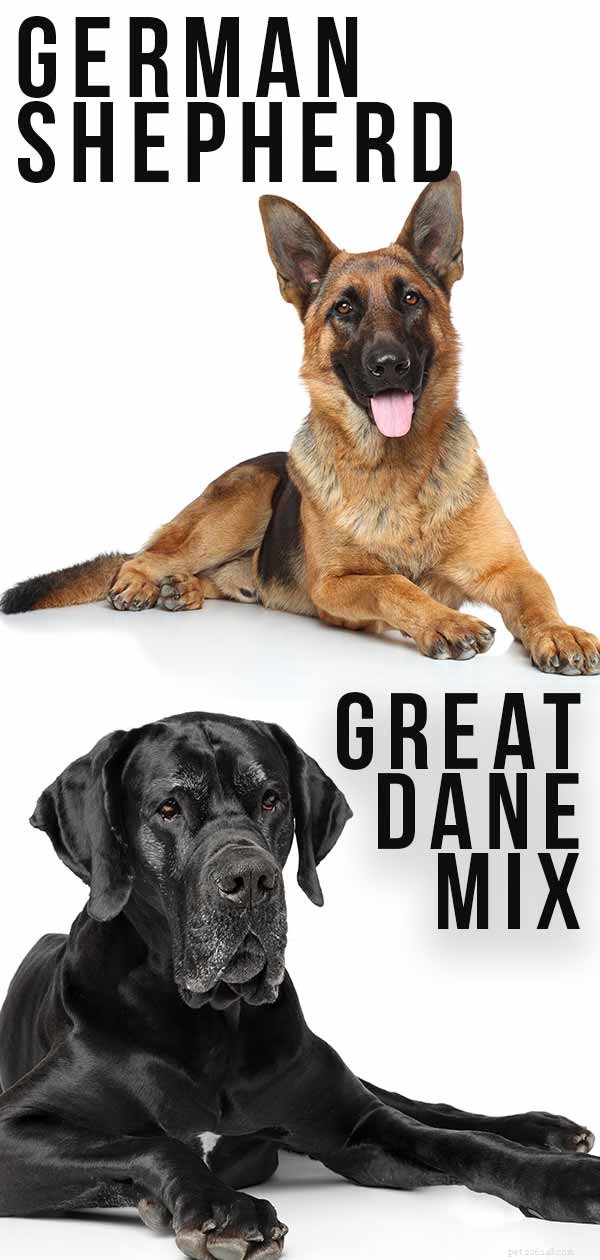
Is the Great Dane German Shepherd Mix the Right Dog for Me?
Life with a Great Dane German Shepherd mix may be fun, but it will also be a lot of work.
Remember, this is a dog who bonds closely with his people and will need lots of mental and physical stimulation to stay happy and healthy.

This crossbreed will also do best in homes with large, fenced in backyards where he can play freely, as well as space inside for him to lounge around.
He will also need an owner who has time to train and exercise him every day.
However, if you are ready for an intelligent, loyal, and patient dog the size of a small horse, then you may have found yourself a match made in crossbreed heaven!
Similar Breeds
If you’re not sure this hybrid is the best breed for you, there are plenty of others you can choose from.
Here are some other breeds with similar characteristics that might suit you a little better:
- German Shepherd Husky Mix
- Great Dane Pitbull Mix
Picking a Great Dane German Shepherd Mix Puppy
Looking to check out some Great Dane German Shepherd mix puppies?
Keep in mind that getting yourself a puppy from a reliable source is of the utmost importance.
Reputable breeders will have health screened their Great Dane German Shepherd puppies beforehand and will be able to offer you certificates to prove they are in good health before you purchase them.
Price
Speaking of purchasing Great Shepherd puppies, how much will they run you?
Typically, breeders can charge anywhere from $500 to over $1000.
If you’re looking to rescue, you’ll probably fork out much less. We’re talking around $50-$100 maximum.
Remember, when going through a shelter, finding the exact breed or crossbreed you want may be hit or miss.
You may wind up with a dog instead of a puppy, or even a Great Dane German Shepherd Lab mix instead of just simply a Great Dane German Shepherd mix.
However, there are a ton of benefits to rescuing, aside from just the price.
Don’t worry. We believe that as long as you prepare, do your research, and ask questions, you’ll find the perfect dog for you!
Best of luck!
References and Further Reading
Turcsan et al, Owner Perceived Differences Between Mixed-Breed and Purebred Dogs, PLOS ONE, 2017.
Howell et al , Puppy Parties and Beyond: the role of early age socialization practices on adult dog behavior, Veterinary Medicine Research and Reports, 2015.
Sutter and Ostrander, Dog Star Rising: The Canine Genetic System, Nature Reviews Genetics, 2004.
Ackerman, The Genetic Connection; a Guide to Health Problems in Purebred Dogs, Second Edition, 2011
Beuchat, The Myth of Hybrid Vigor in Dogs…Is A Myth, Institute of Canine Biology, 2014.
Cavanagh & Bell, Veterinary Medical Guide to Cat and Dog Breeds, CRC Press, 2012.
- Pet Behavior
- Pet Breeds
- Pet Names
- Pet Adoption
- Pet Training
- Pet Information
- Pet Health
- Adorable Pets
- Dogs
- German Shepherd‑Husky & Great Dane‑Husky Mixes: Traits, Care, and Comparison
- Boston Terrier – Small, Low-Maintenance Dog for City Living
- Australian Shepherd–Beagle Mix: The Ideal Family Dog for Active Lifestyles
- Pitbull-Beagle Mix: Traits, Care, and Suitability for You
- French Bulldog‑Pug Mix (Frugs): Find Out if This Hybrid Is Your Ideal Pet
- Great Dane–Golden Retriever Mix: The Ideal Big Family Companion?
- Havapoo: Is a Havanese‑Poodle Mix the Ideal Companion for You?