

Scientists Use Urine to Safeguard Africa’s Endangered Wild Dogs
Scientists Are Finding Innovative Ways to Save Africa’s Wild Dogs
Their scientific name is Lycoan pictus but they’re more commonly called the African Wild Dog, and they’re in trouble. Their numbers have been steadily declining over the past few decades, to a point where there’s only about 5,ooo left in total. Despite multiple efforts to protect them there’s been no noticeable difference.
These wild dogs are endangered – and with the growing population in Africa keeping them out of conflict with humans is becoming more difficult. But researchers from the Norwegian University of Science and Technology have a plan. They’ve come up with an innovative solution to keeping these dogs away from people, and it’s with artificial pee.
Though Protected, Their Numbers are Dwindling
African Wild Dogs are genetically separate from domesticated dog, though they are classified in the Canidae family.
Their situation in Africa is similar to that of the Wolf in the United States – they are considered endangered and protected – but people are still killing them. While Africa’s population grows it’s putting more strain on the enormous territory these wild dogs are used to roaming, much like bears in the United States. This has led to an increase in their conflicts with humans.
Wild dog’s encompass huge territories, often encompassing 100 miles, so keeping them safe has proven difficult with their ranges often crossing borders into unprotected territory. Fencing off areas for the dogs has been tried, but so far only the large scale fencing project in South Africa has seen much success.
Making their plight even worse is that African Wild Dogs are susceptible to the same infectious diseases as domesticated dogs. Most notably are rabies and distemper – which have both had devastating results on the remaining packs.
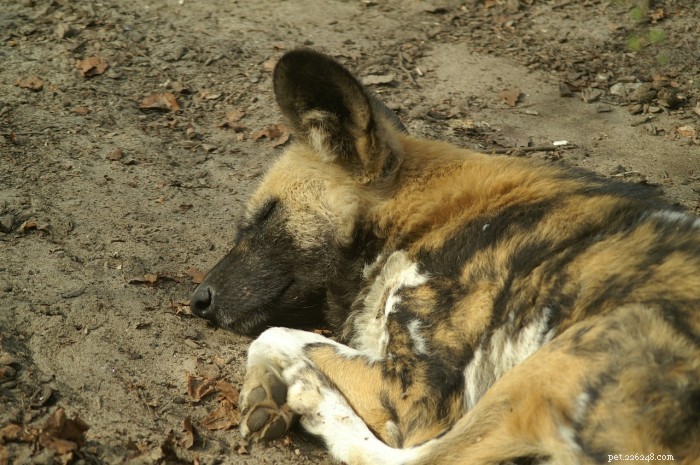
Africa’s Wild Dogs Have Had a Sharp Population Decrease
The wild dog was quite populous just a few decades ago – there were 500,000 of them in 39 countries. But they’ve had a sharp decline recently, and new estimates believe there are roughly between 3,000 & 5000 of them left.
The species has been completely lost in 25 of the 39 countries in which it was formerly recorded just 30 years ago.
Saving Africa’s Wild Dogs, With Urine?
Since artificial barriers such as fencing has proved mostly unsuccessful a new set of researchers has come up with a different plan to help save the African Wild Dog.
They’re trying biological barriers to keep the dogs contained in specific areas. Just like our dogs these wild dogs mark their territories with their own scent. They stick together with their own packs and don’t like to intrude into another packs territory.
So researchers collected sand that had been soaked with urine from wild dogs and moved it near other packs to keep them contained to certain areas, and so far it seems to be working. For now these scent markings left by scientists are keeping the dogs from moving into another packs perceived territory.
Although this method is promising the collection of large amounts of wild dog urine remains quite a challenge. Scientists are now working in labs, trying to create artificial wild dog urine.
- Pet Behavior
- Pet Breeds
- Pet Names
- Pet Adoption
- Pet Training
- Pet Information
- Pet Health
- Adorable Pets
- Dogs
- How Rottweilers Interact with Other Dogs: A Comprehensive Guide
- Golden Retrievers and Children: The Ideal Family Companion
- The Magic of Dogs: How Furry Friends Transform Lives
- How Dogs Reduce E. coli on Beaches and Protect Penguins
- Can Siamese Cats Coexist Peacefully with Dogs? A Guide to Successful Introductions
- Do Dogs See Color? Debunking the Myth of Complete Color Blindness
- 12 Floppy‑Eared Dogs That Will Capture Your Heart