

New Study Reveals Dogs Experience Jealousy Like Humans
When it comes to canine cognitive science we’ve come a long way. More and more we’re seeing what dog owners have felt all along – our dogs do have complex feelings & emotions. A new study suggests that our dogs exhibit jealousy just like us.
New Research Suggests Jealousy In Dogs is Just Like Humans
It’s long been assumed that jealousy is unique to humans due to the complex cognitive processes involved in such an emotion. Some studies have suggested that in order to feel jealous you need to be able to assess the perceived rival’s threat in relation to ones self and ones relationship.
Others believe jealousy might have emerged as a sibling to parent conflict where dependent siblings have to compete for paternal resources.
Researchers have seen for years what appears to be jealousy in dogs, wolves, and coyotes. But this is the first study that was held in a controlled environment that’s trying to prove it.
Dog owners know their animals can experience a wide range of emotion. For years we’ve known that dogs exhibit behaviors that look like jealousy but it’s hard to find out what animals are really thinking. A new study has found that dogs do seem to exhibit jealous behaviors.
Study Finds Dogs Exhibit Jealousy Like Humans
Researchers at Plos One released their findings today.
How the Jealousy Test Was Performed
The jealousy test is the same one given to 6 month old infants by researchers at the University of California. 36 dogs were individually videotaped while their owners ignored them and gave their attention to one of three objects – a plastic jack-o-lantern, pop up book that makes noise, and an animated stuffed dog.
The dog owners were instructed to ignore their dog and interact with one of the objects and treat it as if it were a dog.
When the owners interacted with the stuffed dog over three quarters of the dogs pushed or shoved their owners, many of these dogs also tried to push away the stuffed dog. Nearly one third of the dogs acted aggressively with the stuffed dog by snapping. Twenty percent of the dogs whined or barked at the stuffed dog.
When the owner moved onto the jack-o-lantern half of the dogs pushed their owners and one third of them pushed the object.
For the pop up book less than one third of the dogs pushed their owner and ten percent pushed the book. More dogs barked at the book than the jack-o-lantern.
The Results of the Test
When this test is given to infants we’re able to observe not only a negative effect but also heightened interest in the mother while she is interacting with what appears to be another infant. Dogs in this study behaved in much the same way.
The dogs were much more likely to try to break up the interaction between the owner and stuffed dog than the jack-o-lantern or book.
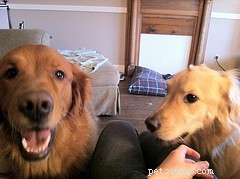
The researchers also found that the dogs might be perceiving the stuffed dog to be real. 86% of the dogs sniffed the stuffed dogs anus. The heightened aggressive responses to the stuffed dog versus other non-animal like objects also favor this theory.
How to Interpret the Results
If some of the dogs perceived the stuffed animal as real does it mean they have higher or lower cognitive function?
Were the dogs who didn’t think the stuffed dog was real unable to recognize the fact that it was a representation of a dog? Or perhaps they are more cognitively advanced because they weren’t fooled into believing it was real.
The study only included findings when the owner was with the dog. They failed to test how the dogs would react with just those objects alone.
The findings do however add additional support to the view that jealousy can arise in the absence of complex interpretations of the meaning of ones rival. The researchers hope that the study will inspire further research into the social emotions of animals.
The fact that most of the dogs were trying to push their owners away from the objects make it seem like they’re exhibiting something similar to human jealousy.
And If dogs can feel jealousy perhaps we’ve been underestimating them all along.
- Pet Behavior
- Pet Breeds
- Pet Names
- Pet Adoption
- Pet Training
- Pet Information
- Pet Health
- Adorable Pets
- Dogs
- Study Finds Dog Owners Experience Greater Happiness Than Cat Owners
- New Study Reveals Dogs Deceive Humans for Food—What It Means for Your Pet
- Do Dogs Truly Enjoy Hugs? Expert Insights and Misconceptions
- The Science Behind Why Dogs Behave Like Us
- What Makes Dogs Prefer Some People Over Others
- The Science Behind Dogs Sitting Like Humans
- Do Dogs Think Like Humans? Unveiling Scientific Insights