

Essential Dog Care Tips: Choose, Train, and Thrive with Your Furry Friend
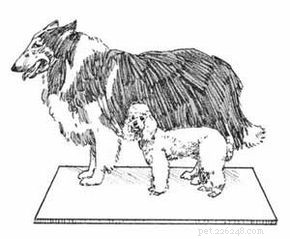 Choose the dog that's the right size for your home space. Check out these dog pictures.
Dogs are known as man's best friend for good reason: They're loyal, fun, and interesting. But dogs are complex creatures that thrive when under the care of a well-informed human being. In the following article, we offer a multitude of tips on caring for a dog.
Choosing a Dog
Once you've made the commitment to buy a dog, consider what kind of dog is going to fit into your life most satisfactorily. Ask yourself the following questions:
In the next section, we'll discuss four basic dog-care tasks: feeding, bathing, grooming, and exercise.
Feeding, Bathing, Grooming, and Exercise
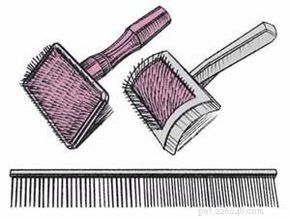 Long-haired dogs need bristle or wire brushes for their coats.
Owning a dog can be a lot of work. Among the main tasks involved in caring for your dog are feeding, bathing, grooming, and exercise.
You can minimize the soap residue that remains after a dog's shampoo by adding some vinegar to the bath's rinse water. Then rinse the dog's coat again thoroughly with plain water.
If your dog smells bad but there's no time to give it a bath, rub baking soda or cornstarch into its coat and brush it off.
If a skunk sprays your dog, wash the dog with tomato juice, then with shampoo and water.
Feeding Dogs
Bathing Your Dog
Grooming and Exercise
In the final section, we'll discuss some important health issues for dogs.
Health Issues
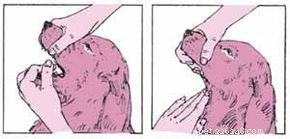 Giving a dog a pill requires a special technique.
In addition to daily care, dogs sometimes develop health issues that require the attention of you or a veterinarian. Here some important suggestions regarding the health of your dog:
Worming medications are dangerous if used incorrectly. Never worm your dog with any medication not prescribed by your vet.
If you have to give a dog liquid medication, have it stand on a towel or bath mat in the tub. Any medication that gets spilled will go in the tub and not on your carpet. Pull out the dog's lower lip at the corner to make a pouch, and use a dropper or a syringe to place the medication in the pouch, a little at a time. Rub its throat to stimulate swallowing.
To give a dog a pill, grasp its muzzle in one hand, then gently press the dog's lips over the upper teeth with your thumb on one side and your fingers on the other. Firm pressure will force the dog to open its mouth so that you can place the pill as far back in the mouth as possible with your free hand. Hold the dog's mouth closed, and rub its throat to stimulate swallowing.
If your dog won't take a pill readily, try disguising it in a piece of cream cheese, which most dogs will eat without complaint.
Don't worry about a young puppy's "garlic breath." This is normal and shows the presence of "good" bacteria in its mouth. The odor will disappear in a few months.
Keep puppies away from the droppings of other dogs. A disease known as parvovirus can be fatal to dogs who contract it. (Dogs under 6 months old are most susceptible.) Most puppies contract it through contact with infected feces. See your veterinarian about vaccinations to protect your dog from parvovirus.
As you've seen in this article, dogs require regular work and care. But the rewards make it all seem worthwhile.
- Pet Behavior
- Pet Breeds
- Pet Names
- Pet Adoption
- Pet Training
- Pet Information
- Pet Health
- Adorable Pets
- Dogs
- Expert Dog-Sitting Tips: Build Trust & Earn Extra Income
- Landseer Dog: The Gentle, Loyal Guardian for Families
- Safe Thanksgiving for Dogs: Essential Pet Food Safety Tips
- 10 Essential Tips Every Dog Owner Should Know
- Stop Your Dog From Digging: 7 Proven Tips
- 13 Pro Tips for Visiting Bend Dog Parks
- Expert Guide: Successfully Introducing a New Dog to Your Pack