

Why Your Dog Follows You Everywhere—and Why It's a Positive Bond
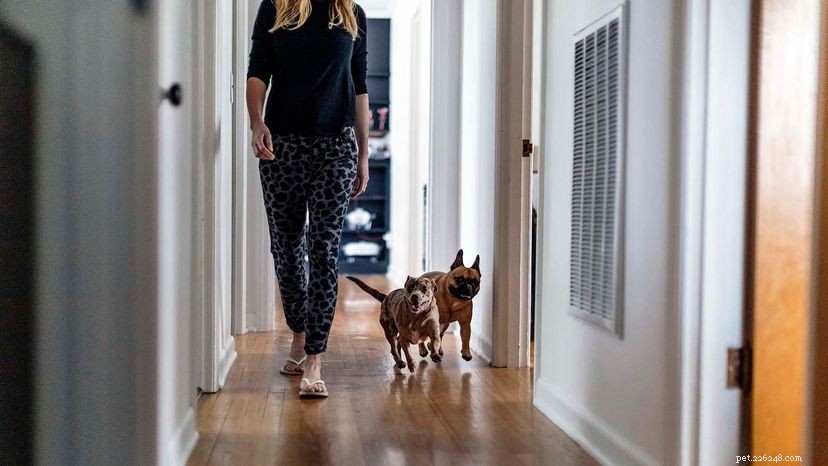 Dog owners know the routine. You come home from being gone (even for five minutes), and your dogs become your shadow.
 Dogs are, as any dog owner will attest, the best. The absolute best. Cat people won't agree. And those poor unfortunate, unfulfilled souls who choose not to share their lives with a companion pet won't, either.
But dogs ... c'mon. They meet you at the door like they've been thinking about you all day, even if you've been gone only a minute. Want to play? They're up for it. Any time. A snooze on the couch? Done. Heck, they've perfected that.
Are you happy? They're happy, too. A little down? They feel you. Really, they do.
Dogs are cool, even when they're goofy. They're unabashedly upfront, even when they're gnawing on your best pair of sneakers. They're fiercely protective of their humans, unless there's a ferocious-looking feline or some dude with fireworks is making a lot of noise. True, they may not be the smartest animals in the world. But they're a heck of a lot easier to have around than, say, a dolphin. Try walking a dolphin. See how that works out for you.
Dogs, who have shared human spaces for more than 10,000 years — they're thought to be the first domesticated animals — do it all, as researchers Monique Udell and Clive D.L. Wynne wrote in 2008:
Dogs play an astonishing range of roles in human society. Many individuals put their faith in rescue dogs when stranded in the wilderness or capsized in cold water. Others rely on guide dogs to get them safely to multiple destinations on a daily basis. Drug dogs, de-mining dogs, police dogs, termite- and even cancer-detecting dogs are trained and utilized as substance detectors even in the face of competition from the latest technology. There are herding dogs, hunting dogs, sled dogs, and various other specializations that are crucial to the livelihoods of many individuals, not to mention the role dogs play in entertainment and the pleasures of individual dog ownership ...The best part about dogs, though, hands down, is simply that they're there for you. Always. Sometimes even when you might not want them to be.
When you come home. When you walk into the kitchen. Even when you take a bathroom break.
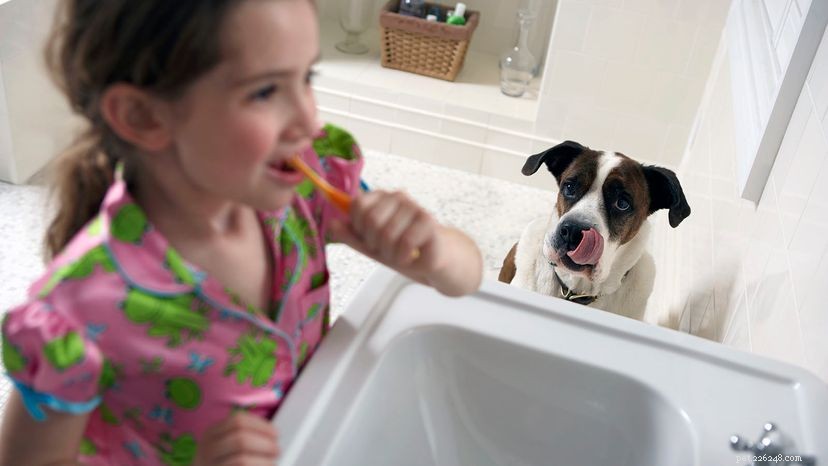 Uh, maybe you can just wait outside for a sec, Bud?
Scientific research on the bond between canines and humans, which only in the past few decades has begun to turn especially rigorous, reaffirms several aspects of the relationship that we've always suspected. Among the findings:
Wynne and Udell even go so far as to suggest that banking on the two species' 10,000-year cohabitation, dogs and humans have evolved together and are maybe closer, evolutionarily speaking, than humans are to primates.
This all leads to one other recent theory, by Wynne, which if not strictly scientific, is at least difficult to discount.
Dogs will follow you everywhere, privacy be damned. They'd rather hang out with you, as brain scans on dogs have shown, than eat, if forced to make a choice. They pick up on your mood like no other animal on the planet. They crave your praise. They cringe when you're mad with them.
It sounds an awful lot like ... is this love?
"I think our dogs have an unbelievable, quite exceptional drive to form strong emotional attachments with us, just like we see in our own children," Wynne — author of the 2019 book "Dog Is Love: Why and How Your Dog Loves You" — told BYUradio host Julie Rose in 2020. "Our dogs are driven ... They really do love us."
Try getting that from a cat.
Now That's InterestingThe "Dog Project" at Emory University in Atlanta began in 2012, aimed at discovering how dogs' brains work. Dogs are trained to sit still, without any sedation or restraint, in magnetic resonance imaging machines. The current project is mapping the "perceptual and decision systems" of the brain to predict how well the subjects may perform as guide dogs or service dogs.
- Pet Behavior
- Pet Breeds
- Pet Names
- Pet Adoption
- Pet Training
- Pet Information
- Pet Health
- Adorable Pets
- Dogs
- Why Does My Dog Follow Me Everywhere? 5 Key Reasons Explained
- Understanding Why Dogs Eat Grass and How to Stop It
- Why Your Dog Keeps Following You—and What It Means
- Why Does Your Dog Follow You? 6 Key Reasons
- 9 Proven Health Benefits of Salmon Oil for Dogs You Should Know
- Understanding Dog Humping: Causes, Signs, and How to Manage It
- The Complete Guide to Probiotics, Prebiotics, and Postbiotics for Dogs: Why All Three Matter