

Unveiling How Dogs Learn: Training Secrets Explained
A dog's ability to learn all kinds of tricks and behaviors is never in question. They know the sound of your wheels on your driveway when you're coming home. They know the sound of food being added to their bowl. They obviously remember, because they never forget where their food bowl is! They know all the commands you taught them, like sit, stay, and come. But how do dogs learn?
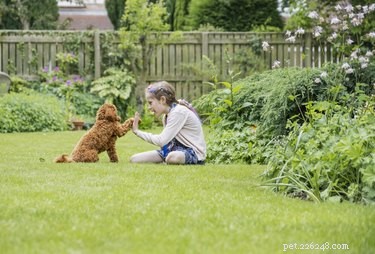
Dog owners everywhere know that dogs are smart, but when you're training your dog, what is it that really gets them to put two and two together and figure out that when you say "stay" you want them to stay where they are? It appears that dogs learn through a combination of observation or social cues, visual cues, and verbal cues. But even though researchers are looking at what dogs can do, figuring out how they know what they know is still a mystery.
How do dogs learn?
The Canine Cognition Center at Yale University involves dogs with games to help understand how they think and solve problems. One of the things they do is show dogs a series of events, called "looking measures," that include something unexpected. When dogs see the unexpected thing, they look measurably longer at that "scene."
Their research also involves how dogs understand human social cues. Dogs often know what to do when they see humans pointing, for instance, pointing to a hidden cache of treats. These are called social cues. When it comes to language, research shows that dogs do understand the sound of human speech, and are able to make connections quickly between the word and an object, such as the name of their favorite toy.
Types of learning for a dog
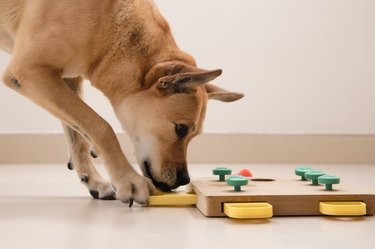
Social learning for dogs involves observations and memory. For instance, if a dog is within a fenced yard and he sees a human (or another dog) go around the yard to get to a gate in the fence, the dog will likely learn that the gate is where to get out of the fence. Or, the dog may be in a crate and want to get out, and may be able to figure out how to manipulate the lock so he can get out. This is a type of problem solving, as VCA Hospitals says, that dogs are pretty good at on their own.
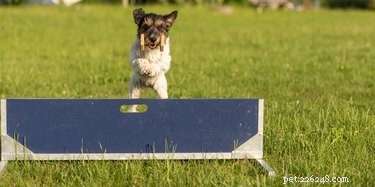
A dog's physical learning might be tested by putting them through an obstacle course that changes, for instance. It may take a while before they finish the course, but they eventually will. This indicates that dogs have a basic understanding of their environment, which they need to be able to do basic navigation such as finding their food bowls.

Visual cues come about through your pet's unique ability to cooperate with humans. In the late 1990s, researcher Brian Hare noted that the chimpanzees he was working with couldn't follow a human's pointing gesture to find food, which dogs can do. This was notable because chimpanzees are the closest animal relative to humans, so why couldn't they understand our body language?
His research on dog and wolf pups and whether they would follow a human pointing toward food revealed that dog pups were more attracted to humans, understood human body language, and made more eye contact with humans than the wolf pups did. This research opened up a whole new field of research into how dogs learn that looks at how genetically selecting for certain characteristics and behaviors (for instance, hunting or herding) influences a dog's ability to learn, reason, communicate, remember, and solve problems. Hare concludes that a dog "might be bred to specialize in certain types of thinking."
Dog training and dog learning
The Golden Retriever Club of America explains that:
1. dogs are problem solvers,
2. dogs pet learns by trial and error,
3. Dogs don't keep repeating behavior if it doesn't get them what they want
4. dogs are situational, and
5. dogs perform correctly prior to learning a task.
When a dog is learning to problem solve, they'll quickly learn to avoid actions that don't work. For instance, going back to the example of a dog locked in a crate, since barking didn't solve the problem of the lock on the crate, the dog learned to skip barking and go to the next step in the trial and error problem solving process. Similarly, if a dog opens the gate on a crate by accident, they'll be likely to keep trying the same thing that worked the first time. But if the lock on the gate changes, they'll have to start over (situational learning).
A big part of how dogs learn when it comes to dog training is consistency, and the way that you, as the dog owners, respond to their actions. For the best and quickest results in dog training, you should respond with some form of positive reinforcement when the dog does what you want her to do. Positive reinforcement is based on using a praising, happy tone of voice and following that up with a toy, treat or game that the dog enjoys.

In summary
Research shows that dogs learn through a combination of innate problem solving skills, trial and error, repeating the behaviors that work, and positive reinforcement that encourages certain behaviors. Dog training is most effective when it can take all those things into account. Your pet may be able to understand your body language, but a dog's ability to associate your body language with what you want it do requires consistent positive reinforcement.
A new field of study is looking at how the genetics of breeding for certain personalities and abilities, like herding or hunting, influence show dogs learn from a genetic standpoint. But overall, while there has been a lot of research into what dogs can do, figuring out how they know what they know is still a mystery.
- Pet Behavior
- Pet Breeds
- Pet Names
- Pet Adoption
- Pet Training
- Pet Information
- Pet Health
- Adorable Pets
- Dogs
- Understanding How Dogs Contract Whipworms: Prevention and Treatment
- How Dogs Learn and Respond to Human Words: The Science Behind Their Understanding
- Identifying Parasites on Dogs: A Practical Guide to Ticks, Mites, and Fleas
- Understanding Dog Neutering: Procedure, Benefits, and Care
- Understanding How Dogs Learn: Insights for Better Training
- Understanding Your Dog's Voice: Decoding Bark, Growl, and Whimper Signals
- Dogs Can’t Fly – How Their Limits Shape Pet Travel