

Build a Reliable Pause Table: Complete DIY Guide
Things You'll Need
One sheet 4-by-8 foot plywood
Eight 48-inch PVC pipe, 1 1/4-inch diameter
Eight 6-inch PVC pipe 1 1/4-inch diameter
Four U-shaped PVC joints
Four T-shaped PVC joints
Two four-way PVC points
Four long bolts
PVC glue
Power saw
Power drill
Paint
Warning
Do not use power tools within range of people or animals. Power tools can be very dangerous, so be sure you have a clear area to build in.
Tip
Use high-quality materials. Using cheap or defective parts to construct your pause table could result in injury to your dog.
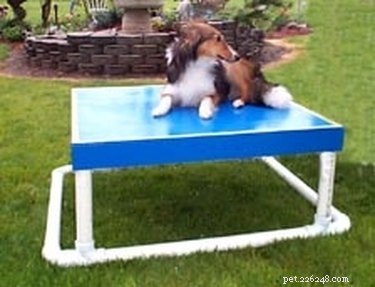 Build a Pause Table
The pause table is an essential obstacle on almost any agility course. It is used to show stability and control between dog and handler, and it is vital to success within the agility ring. The pause table is a fairly simple obstacle to construct and will help to ensure your dog's success as an agility competitor.
Step 1
Take one of your four-way joints and insert one of the 48-inch long PVC pieces into each of the holes in the joint. You can glue them in if you want your table base to be permanently secured together. Repeat this with the remaining four-way joint and 48-inch segments.
Step 2
Attach a U-joint to the ends of each 48-inch pipe on one section of your four-way joint assembly. Be sure the open end of the U faces downward. On the remaining four-way assembly piece, attach one of the T-joints to the ends of the 48-inch pipe, with an opening facing up and down from the main section.
Step 3
Place a 6-inch section of PVC pipe in each of the open ends of the U-joints, and connect them with the upper opening in each of the T-joints to connect both of the four-way assembly sections. You should now have one complete unit with openings still at the bottom of the T-joint sections.
Step 4
Insert your four remaining 6-inch PVC sections into the last openings in the bottom of your T-joints. These will form the legs of your pause table. Leave these sections unglued, so you can use longer or shorter pipes if necessary, depending on the height of your dog.
Step 5
Cut your 4-by-8 foot sheet of plywood in half, so that you have two 4-by-4 foot sections. Apply a thick layer of glue to the top of one of the sheets, and press the remaining sheet on top of the glue. Screw the sections together so that you have one solid 4-by-4 foot platform top.
Step 6
Paint your table top section. You can use a regular exterior paint for your top. Just be sure that you put at least two coats of paint on your top, to ensure it stays in good condition.
Step 7
Center your table top over your PVC base, and drill our holes through both the top and the PVC, one toward each corner of the table. Place one of the bolts in each hole, and tighten the bolts securely.
Step 8
Check over your top and PVC sections to be sure there are no rough or sharp edges, and be sure that all of your joints and bolts are secure. Once you've checked over your obstacle and have assured it's safe, you and your dog are ready to start training on your very own pause table.
- Pet Behavior
- Pet Breeds
- Pet Names
- Pet Adoption
- Pet Training
- Pet Information
- Pet Health
- Adorable Pets
- Dogs
- Build Your Own Dog Agility Course: A DIY Guide for Safe, Durable Equipment
- DIY PVC Dog Kennel: Build a Secure, Custom Indoor Home for Your Puppy
- Designing a Safe & Fun Backyard Jungle Gym for Your Dog
- Build a Durable Cable Dog Run: Step‑by‑Step Guide
- Step‑by‑Step Guide: Build a Safe Dog Pull Cart
- Build an Affordable Dog Kennel: Step‑by‑Step Guide for Outdoor Safety
- Build Your Own Dog Walk: A Complete DIY Agility Obstacle