

Is Your Dog Truly Trained? When Can You Call Training Finished?
Cooper is a good dog.
Cooper is a smart dog.
He knows all sorts of things, from the basic obedience cues like sit and stay and down to more complex cues like shutting cabinet doors and performing tricks. Based on what he knows at this point, anything else I teach him is just for fun. Games. Tricks. Nothing too useful but definitely entertaining.
Which means, of course, that I’ve become complacent in his obedience work. Can I consider him “done,” like a cake? Finished, like there’s no more training to do?
As far as obedience, anyway, there’s nothing much to do here. Wipe my hands. Move on.
Maybe…
But it wouldn’t do either one of us any good (and it might do him some long-term harm).
I recently encountered this statement in a Facebook group that went something like: “Well, my dog’s trained, so we don’t really work on XYZ. No point.”
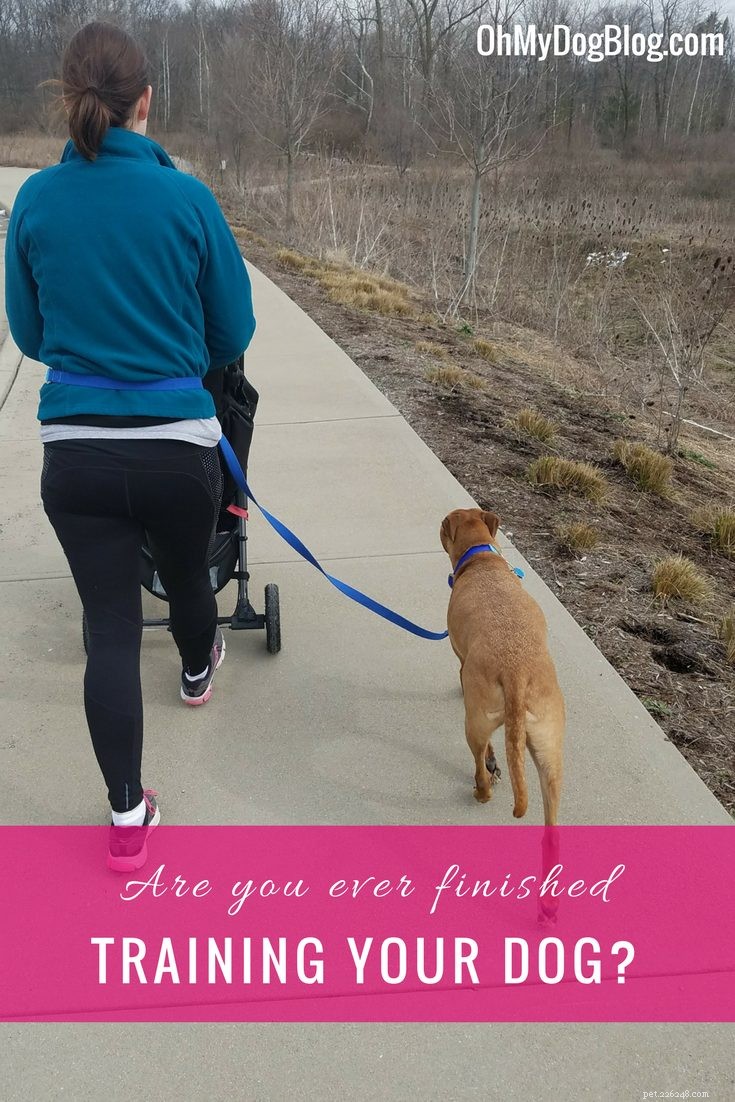
So, is your dog ever “trained”?
When I work with Cooper, I think of his “training” in two buckets: obedience, the stuff mentioned above that he’s mastered, and behavior, the stuff that’s harder to quantify like being scared of new objects or barking out the living room window because the wind blew the leaves in the tree funny.
The obedience stuff is important, especially in the early days of a new pup. It’s the house training, the basic manners, the useful parts of being a member of a family. There comes a time, though, when a dog has learned pretty much everything they need to… Anything else, like tricks or dog games or even sports like agility, well, that’s just icing on this cake.
Or is it?
The behavior stuff, on the other hand, has to be ongoing if you love a dog who’s anything but a happy goober. You know the kind of dog I’m talking about… No dog I’ve ever cared for has been a happy goober. 🙂 (Well, maybe Molly…)
This is the forever training, the ongoing stuff. The reinforcement and the conditioning. This is the training where one day you discover that your quirky pup is afraid of the new bird feeder you hung in your backyard, so you work on that. This is the training where you try to catch your dog every single time he, say, sees a person on a motorcycle while riding in the car by tossing treats from the bag you keep in your glove compartment.
This type of training, in my opinion, is never “done.” Unless, of course, you’re the person of a goober dog!
That said, I’ve discovered that the obedience training conditions Cooper to learn. If we’re working on a behavior issue, or if I’m simply trying to build up his confidence so that he can go to a new park without shaking like a little leaf (we’re not there yet), obedience training does the trick.
He gets into “work” mode.
He starts to focus.
His mindset shifts from “AHHHHHHOMG!!!!” to “hey, I know what to do!”
We had a great session recently when we went to the playground. We traded off pushing Violet on the little baby swing and having Cooper “work” on basic cues. On the other side of the playground, a small family played on the climbing rocks, and on the soccer fields behind us, a bunch of guys were playing a pick-up game. It was a super distracting environment, though it was a park he’s very comfortable with. And he nailed it. Of course, we thankfully didn’t see any other dogs–this would probably be a different story!–but it’s progress.
Cooper is a good dog. At home, or at my parents’ house, he’s nearly perfect.
But he’s nowhere near “trained” and we’re certainly not done training.
Even when he’s reached a happy old age, games and toys and trying new things–all pieces of “dog training”–will be part of his daily routine because it keeps his mind fit, just like research shows daily mental activity like completing sudoku or crossword puzzles helps stave off Alzheimer’s.
And so, my long, meandering post comes to an end with my conclusion being, of course, that a dog might know a lot of stuff, but training can keep him mentally engaged and mentally fit to help his aging process go smoother and to stave off boredom. He might know all his obedience cues, and we’re not working to turn him into an obedient little automaton, but training is a big, important piece to his overall wellness.
Currently, of course, we’re working on his mat work… and making great strides!
How about you and your pup? What do you think? Do you consider your dog “trained” or your training “done”? How do you work to keep your dog mentally fit and engaged? Leave a comment below, and let’s trade training notes!
- Pet Behavior
- Pet Breeds
- Pet Names
- Pet Adoption
- Pet Training
- Pet Information
- Pet Health
- Adorable Pets
- Dogs
- Master Dog Behavior with Clicker Training: A Proven, Positive Method
- How Your Dog Trains You: 3 Surprising Ways
- Mastering Dog Rewards: Effective Strategies for Positive Training
- Stop the Jump: Proven Training to Keep Your Dog Off You
- How to Train Your Dog to Run Beside You: A Step‑by‑Step Guide
- Dog Training: Group Classes vs. Solo Training – Which Works Best?
- Effective Crate Training: A Guide to Making Your Dog Feel Safe and Secure