

Rescuing a Red‑Eared Slider: Returning Her to the Lake
Last weekend, I came across a large turtle in my yard. It was a red eared slider and she was beautiful! I'm not sure what she was doing here, but we do live across the street from a park with a lake in it. She looked nice and healthy and I thought she might enjoy it if she were returned to a place where she could swim freely.
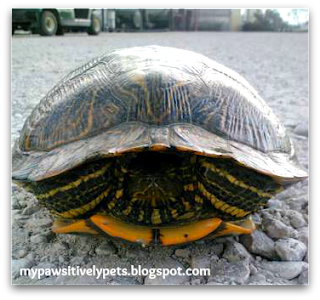 Here's a picture of the turtle we found.
My daughter and I decided to drive her over to the park and let her go in the lake over there. She quickly swam back into the water. I think she was happy to be back home! I took a video of the release which you can watch below. (I apologize for the quality of the video and the fact that it's sideways...)
Red eared sliders are a semi-aquatic turtle that are native to the Southern United States. They are probably one of the most popular turtles kept as pets. They get their names for the red markings around their ears. The name "slider" comes from the way they slide off of rocks or logs when threats approach them.
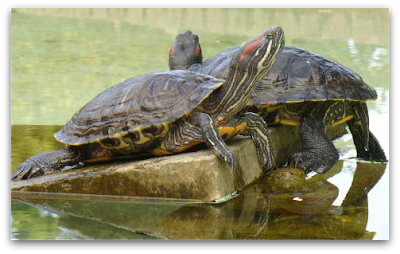 You can see the red markings on the side of this red eared slider's head.
Red eared sliders are actually found all over the world. Many populations of red eared sliders in places like Australia and England are an invasive species.
Sadly, they do not belong in these places. They were released there by people who kept them as pets. Because of this, there are many laws and regulations on the sale, trade, and import of red eared sliders around the world.
In America, the FDA bans the sale of red eared slider turtle eggs and turtles with a carapace that is less than 4 inches in diameter. Pet stores have found a loophole in this regulation though. There is an exception to the law that says that these turtles with a carapace less than 4 inches in diameter can be sold for scientific, exhibition, or educational purposes, other than use as pets.
Here's a picture of the turtle we found.
My daughter and I decided to drive her over to the park and let her go in the lake over there. She quickly swam back into the water. I think she was happy to be back home! I took a video of the release which you can watch below. (I apologize for the quality of the video and the fact that it's sideways...)
Red eared sliders are a semi-aquatic turtle that are native to the Southern United States. They are probably one of the most popular turtles kept as pets. They get their names for the red markings around their ears. The name "slider" comes from the way they slide off of rocks or logs when threats approach them.
You can see the red markings on the side of this red eared slider's head.
Red eared sliders are actually found all over the world. Many populations of red eared sliders in places like Australia and England are an invasive species.
Sadly, they do not belong in these places. They were released there by people who kept them as pets. Because of this, there are many laws and regulations on the sale, trade, and import of red eared sliders around the world.
In America, the FDA bans the sale of red eared slider turtle eggs and turtles with a carapace that is less than 4 inches in diameter. Pet stores have found a loophole in this regulation though. There is an exception to the law that says that these turtles with a carapace less than 4 inches in diameter can be sold for scientific, exhibition, or educational purposes, other than use as pets.
- How Long Can a Red‑Eared Slider Survive Without Water? Expert Guide
- Do Red‑Eared Slider Turtles Bite? Safe Handling & Care Tips
- What Do Red‑Eared Slider Turtles Eat? A Complete Feeding Guide
- How to Choose a Healthy Red‑Eared Slider: Expert Tips for Stress‑Free Acquisition
- Comprehensive Guide to Supplies for Red‑Eared Sliders & Similar Turtles
- Reeve’s Turtle (Mauremys reevesii): The Ideal Companion for Red‑Eared Slider Enthusiasts
- Swollen Eyes in Red‑Eared Sliders and Other Aquatic Turtles: Causes, Symptoms, and Prevention