

Boelen's Black Python: Discover the Majestic Constrictor
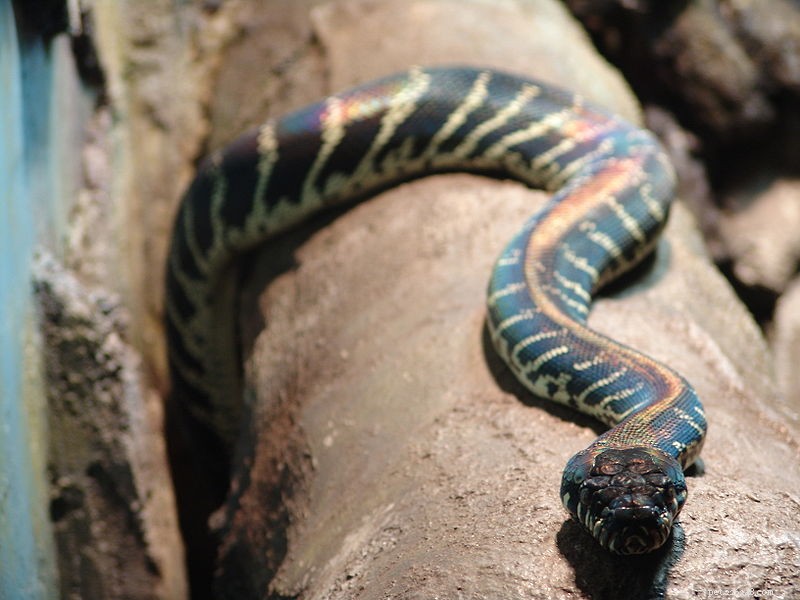 This article is one of a series in which I plan to provide a brief introduction to both popular and rarely-kept amphibians, reptiles and invertebrates. Detailed care articles will follow…until then, I would enjoy receiving your questions and comments. Today we’ll take a look at one of the world’s most stunning large constrictors, the Boelen’s or Black Python, Morelia boeleni.
Recently, while thumbing through my well-used copy of Dick Bartlett’s wonderful book In Search of Reptiles and Amphibians (E J Brill, 1987), I came across his account of one of the first Boelen’s Pythons to be exhibited in the USA. It put me in mind of my early experiences with these awe-inspiring snakes, and I decided to look into their current status. I was happy to see that some great work has been done in both the field and captivity…a fantastic summary of this, along with many photos, is posted on the website of the Boelen’s Python Group.
Arrival in the USA
I began working with Boelen’s Pythons at the Bronx Zoo in the late 1980’s, when a group of wild-caught adults was confiscated and sent to us for safe-keeping; not many had been imported prior to this. Their iridescent, jet black bodies, capped by a broad head boldly marked in bright yellow-white, were a sight to behold.
Just as impressive was their ferocity…and at 8-10 feet long, they were a force to be reckoned with. While some folks do manage to handle Boelen’s Pythons with ease, many report that young and old alike retain personalities reminiscent of their oft-ill tempered relative, the Amethystine Python, M. amethistina.
Health Problems and Stress
Those I cared for did not adjust well to captivity. Stress had worsened the effect of their parasite load, and some of the worms and other nasties they harbored were difficult to eradicate.
When cleared of parasites, they proved too high strung for public exhibits. Those unable to retreat to the tops of trees, well out of view, struck at the glass and injured their snouts. They also tended to poke about for escape routes, lodging substrate along their gums and cutting themselves up in the process (this is a common problem). Several refused to descend from the trees to drink…these were given water-injected rats for a time.
Diet
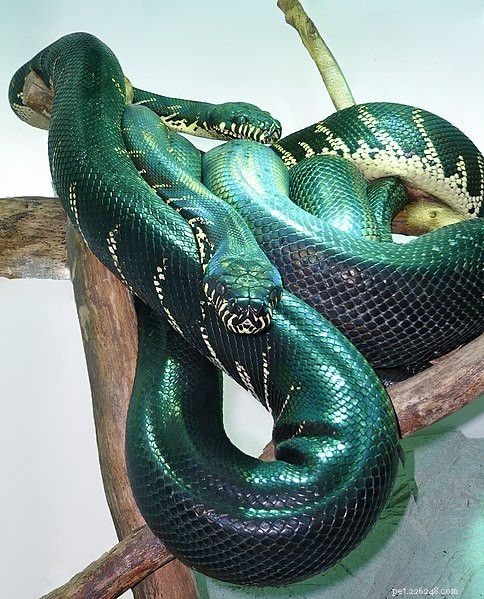 When it comes to feeding, wild-caught specimens often prove as fussy as the notoriously picky Green Anaconda (one Anaconda under my care took wild-caught but not lab rats, another refused all but Muskrats).
Bats, birds, lizards and marsupials such as phalangers and cuscus (please see photo) are taken by wild Boelen’s Pythons; captive bred rodents are often rejected. Some of mine favored guinea pigs; scenting rats with chickens and quails has also proven successful.
Natural History
Boelen’s Pythons, first described in 1952, are found only on New Guinea. They favor dense, humid rainforests, and are often associated with steep cliff faces. Arboreal activity has been reported, and captives certainly favor elevated resting sites, but subterranean retreats are also used (please see article below).
The Future
While some specimens have lived into their 20’s, captive breeding has been sporadic. That situation is changing, slowly, as we learn and experiment…please consider registering with the Boelen’s Python Group, and sharing your observations on this blog, if you are fortunate enough to work with these magnificent snakes.
- How Long Do Pythons Live? Lifespan Insights for Captive & Wild Species
- Seamless Cat Integration: The Proven Crate Method
- Introducing Your Dog to a Crate Safely: A Compassionate Guide (Video)
- Python vs Boa: Understanding the Key Differences for Prospective Owners
- Black Pastel Ball Python Morph: Rare Co-Dominant Color Variation
- Welcoming a New Cat to Your Home: A Guide to Smooth Integration
- Debunking the Black Cat Myth: Why These Cats Are Loving and Lucky Companions