

Key Lessons from 1960s Anole Keeping: A Historic Insight into Green Anole Care
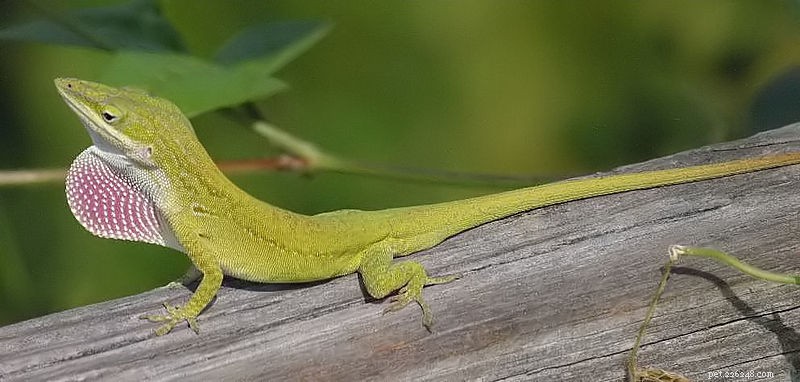 Green Anoles (Anolis carolinensis) were one of the first lizards to be widely available in the US pet trade. Although there were bright spots, our knowledge of their needs was severely lacking, and millions met untimely ends as a result (Horned Lizards, Phrynosoma spp., the other trade staple at the time, remain difficult captives still). Today we (and they!) fare better, but as my own experience indicates, the road has been rocky…
From Florida to Madison Square Garden
I acquired my first Green Anole as did millions of other NYC children of my generation – as a 25 cent purchase at Madison Square Garden, courtesy of Ringling Brothers, Barnum and Bailey Circus. The terrified “Chameleon” came in its own “traveling container” – a narrow, cellophane-paneled box that resembled (and most likely was!) designed to hold a tiny pie.
Thankfully, I realized that the pin with tiny chain, sold to anchor the lizard to one’s chest, was a bad (and, at $1.00, expensive) idea…not that strolling around my Bronx neighborhood decked out in such a manner was a good idea in any event!
The Basics: Sugar Water and Sun
The “instructions” printed on the box directed budding herpetologists to feed their charges “turtle food” (dried ant pupae, at the time) and “sugar water”. We now know that Green Anoles do lap at nectar, but a bowl of sugar water and dried pupae were, to say the least, not welcomed by the doomed lizards.
Fortunately, I lived near an animal importer, (whom I later worked for), who took pity on me and offered advice from time to time – “…sun, sun, sun” was how he summed up lizard care. He also told me that “straight sunlight” was needed – today we know that glass filters out UVB, but this was a real pearl of wisdom at the time. I already knew, from reading everything I could get my hands on (Clifford B. Moore’s 1937 classic, Wild Animal Pets, is still useful – check it out if you can) that anoles needed live food, so I assumed I was all set.
 I built a simple wood-framed screen cage and lodged it among the branches of an apple tree, so that it would be exposed to both sun and shade (this was before raccoons, which today would have trashed the cage, invaded NYC…in fact, I had a recording of a baby raccoon, made for hunters, that I played on visits to Long Island, in hopes of someday sighting one of the elusive beasts!).
Final Stop – a Bronx Apple Tree
In time, I judged the little creature’s sunbathing periods to be too short, and so removed him for a basking session on my arm. Outdoor life and a diet of moths and earwigs obviously agreed with him, and he was off my arm and onto a branch in a flash.
I knew not to grab for the tail, but not what else to do, and so hesitated…the anole did not, and off he went. My own considerable climbing skills were put to shame, and he sped into the tree’s canopy where, I assume, he enjoyed a sunny, but final, summer.
- Odin Stars as Bailey in 'A Dog's Journey': A Heartwarming Sequel to 'A Dog's Purpose'
- 5 Proven Dog Training Lessons I Learned the Hard Way
- Family Day at the San Antonio Zoo: A Spring Break Adventure
- Surviving a Snake Bite: One Vet's Personal Experience
- How Dog Training Teaches Kids Life Skills
- Training Dogs: 10 Life Lessons That Changed My World
- 15 Key Lessons My New Kitten, Hobbes, Has Taught Me