

Socotra Island Blue Baboon (Monocentropus balfouri) – Comprehensive Care Guide
Back when I first started keeping tarantulas in the mid 1990’s there was really only one tarantula in the hobby that might be considered as “blue” – the Cobalt Blue tarantula from Asia. Soon afterward came others, however, such as the stunning Greenbottle Blue and the Martinique Pinktoe. The Socotra Island Blue Baboon, however, was an unknown entity at the time.
Right now I consider Monocentropus balfouri to be one of the most exciting introductions into the hobby in recent years. These tarantulas not only have stunning bright blue legs, but they are also one of the few tarantulas can can be considered “communal” – that is to say that they can be kept together in groups with only a small risk of losses. Set up in a naturalistic vivarium these are a fantastic addition to your collection.
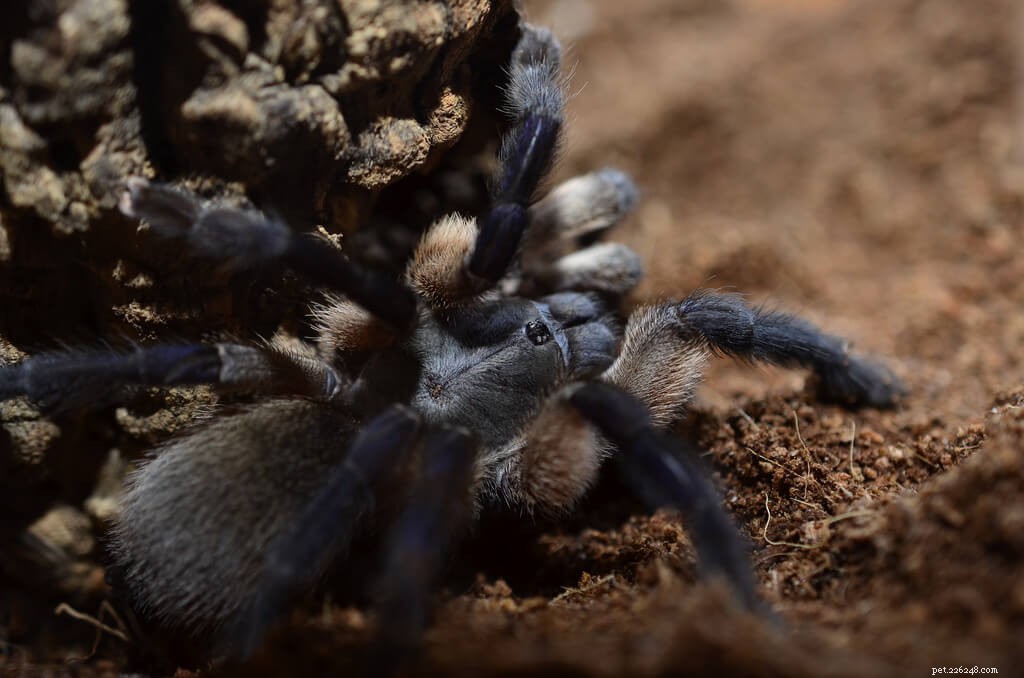
Before we jump into our Socotra Island Blue Baboon care sheet, however, a couple of warnings are necessary…
This is certainly not a suitable tarantula for beginners. These guys can move like lightning, and as with many other baboon tarantulas they are also quite aggressive. You’ll therefore need some experience if you’re not to end up with an angry and fiesty tarantula loose in your home.
In truth, like many other baboon spiders, this species will also spend the vast majority of its time in its burrow – the classic “pet hole”. If you’re looking for a “show tarantula” that you can enjoy seeing on a regular basis, this may not be the most suitable species – you may find that a Salmon Pink or a Mexican Red Knee suits you better.
For the more experienced keeper, however, these are a “must have” species in every serious collection. Read on to see what you need to know about keeping Monocentropus balfouri in captivity.
Contents
- 1 Wild Habitat of Monocentropus balfouri
- 2 Housing Socotra Island Blue Baboons
- 3 Heating & Temperature
- 4 Water & Humidity
- 5 Cage Furnishings
- 6 Feeding Monocentropus balfouri
- 7 Socotra Island Blue Baboon Handling
Wild Habitat of Monocentropus balfouri
As the common name of this tarantula reveals, this species is endemic to Socotra Island. That’s all well and good, but where actually is Socotra?!
The answer is that the island lies off the coast of Yemen, where other popular exotic pets such as the Yemen Chameleon (Chamaeleo calyptratus) can also be found. This means that Monocentropus balfouri is used to a hot and dry environment, with relatively low humidities throughout much of the year.
The Blue Baboon was first described as long ago as 1897, and is known locally as the “fitãneh spider“. Despite its long existence in the scientific literature, it really only started to enter the pet trade over the last few years. Socotra Island itself was designated a UNESCO World Heritage site in 2008 thanks to the wide range of unique and special wildlife to be found there.
Sadly, an illegal wildlife trade has also sprung up there, with many species being smuggled off the island and into the pet trade. As a result of this, it is crucial that we as tarantula keepers try to do our bit for conservation.
Firstly, try to make sure you’re purchasing captive bred specimens. Secondly, if you opt to keep the Socotra Island Blue Baboon then get involved in breeding programs. In this way we can help to ensure that the pet trade is being fed from a sustainable source, rather than from wild habitats being plundered.
One fascinating aspect of Monocentropus balfouri is that tarantula keepers have observed levels of maternal care that is very rare in other tarantulas. Keepers report that mothers may kill feeder insects and carry them into the burrow for youngsters to eat! If watching unique behaviour is your thing then this may be a great tarantula to consider. Read to find out how in my new care sheet…
Housing Socotra Island Blue Baboons
Selecting the right cage for your Monocentropus balfouri is crucial, and this is even more so if you plan to keep a small colony together. Considering how fast these spiders move, and how potent their venom is likely to be, you won’t want to be constantly fussing about in their cage. You’ll almost want to maintain it as a “closed system” to prevent escapees, only opening it occasionally to provide food or water.
Related: Do Tarantulas Eat Their Babies?Like the Greenbottle Blue or the Usambara Orange Baboon, this species of tarantula is a heavy webber. Within weeks of placing your new tarantula into their cage it will become filled with fine webbing.
In addition to this, the species is a strong burrower and will spend most of its life out of sight beneath the substrate. When kept communally, you will often find that different tarantulas build their own burrows closeby one another, rather than all living together in one hole.
All this means that you’re going to need a very secure cage of a suitable size to ensure that (a) your tarantulas can behave as they would in the wild and (b) if and when you need to open the cage you have a bit of “advance warning” if one of your specimens suddenly bolts up the side of the cage. You don’t want to be lugging furniture around your house trying to hunt down one of these bad boys!


Adult specimens are mid-sized tarantulas, typically reaching some 5-6” across the legs. For a single specimen I would suggest a floor area no less than 10” x 10” but remember that bigger is better. If you’re planning to purchase a small colony then you may want to be thinking about a tarantula tank some 60cm / 24” long, with a depth of a foot (30cm) or more.
When a suitable depth of substrate has been added this should allow your tarantulas to burrow out of sight and to live a reasonably normal lifestyle.
Any standard tarantula-style tank will be suitable. It should be made of glass or plastic, and have plenty of ventilation. It is crucial that the humidity in your Monocentropus balfouri cage is not allowed to get too high (remember, these hail from arid areas). At the same time, however, be mindful not to make gaps so big that smaller specimens can squeeze through them.
The larger Exo Terras can work pretty well for this species. The front-opening doors mean that you don’t need to completely remove the lid for maintenance, the mesh lid ensures suitable ventilation and the glass lip at the front allows for a decent depth of substrate to be added.
Heating & Temperature
As with all tarantulas, the Blue Baboon should have a thermal gradient in its cage, with one area being much warmer than the rest. This allows your tarantula(s) to choose the area that suits them best.
Ambient temperatures tend to be quite hot in the Socotra Archipelago so the hot end should be 25-28’C. As this species likes to burrow, it is generally easiest to heat the cage by attaching a low-cost reptile heat mat to one side of the cage. Placing the cage directly on a heater when plenty of substrate is provided can result in overheating.


Water & Humidity
Humidity in Yemen tends to be quite low, so this isn’t a species that needs damp conditions. Generally speaking keep them nice and dry, with suitable ventilation. Many keepers like to give their Blue Baboons the odd spray with a houseplant spray gun.
While it is very rare to see this species actually drinking, it is a good policy to include a water bowl for juvenile and adult specimens so that they have access to fresh water if desired.
Related: Do All Tarantulas Have Urticating Hairs?Cage Furnishings
Once you have selected a suitable cage and heating setup there are a few other elements you’ll want to consider. Thanks to their burrowing mentality, and the copious amounts of web they produce, this probably isn’t a spider for whom you’ll want to build a detailed landscape. Most of your hard work will soon be torn apart or covered in web.
Instead, you’ll simply want to offer a nice deep substrate, and potentially a number of hides. Substrate-wise, coconut fibre tends to work well, though keepers have also experimented with other options such as potting compost or peat.


As mentioned, it can also be a nice idea to include a number of hides. Possibly the easiest and best option is to partially bury some suitably-sized cork bark tubes. Your Monocentropus balfouri may decide to use one of these instead of a burrow, or it may serve as a “starter burrow” that is extended by your pet over time.
The goal here, due to the speed with which this species moves, is you minimize your maintenance routine. Long forceps can come in handy for retrieving water bowls or excess feeder insects without putting your fingers in danger!
Feeding Monocentropus balfouri
The Socotra Island Blue Baboon seems to grow quite rapidly, with some specimens going from spiderling to mature adult in little more than two years. Unsurprisingly, they tend to have an appetite that meets this growth rate, and Monocentropus balfouri will tuck into most standard insects – such as locusts, roaches or black and brown crickets.
Pay special attention to any time that your Blue Baboon webs themselves fully into their burrow. This is likely to be an indication that they are in the process of moulting, and so won’t eat anyway.
Feeding should be particularly generous if you opt to try keeping this species in a communal setup. Note that this is still quite a risky prospect, as all tarantulas can be cannibalistic. D
on’t say I didn’t warn you if you decide to keep 5-10 Blue Baboons together, but find that numbers start to dwindle over time! One way to minimize any loss is to ensure that suitable insects are regularly provided; full tummies will make their cage mates look far less appetizing.
Socotra Island Blue Baboon Handling
Are you mad? All joking aside, while the Blue Baboon tarantula is not as aggressive as some other species, it is important to remember that it is still a baboon spider. That means attitude.
This aside, of course, Monocentropus balfouri can move like greased lightning, so are totally unsuitable for handling.
Even moving spiders from one cage to another can be problematic, so this certainly isn’t a beginner tarantula or a suitable species for people looking to hold their spider regularly.

Photo by B a y L e e ‘ s 8 Legged Art 
- Pterinopelma sazimai: Comprehensive Care Guide for the Brazilian Blue Tarantula
- Harpactira pulchripes (Golden Blue Leg Baboon) – Comprehensive Care Guide
- Togo Starburst Baboon (Heteroscodra maculata) Care Guide: Expert Tips & Habitat
- Expert Care Guide for the Greenbottle Blue Tarantula (Chromatopelma cyaneopubescens)
- Singapore Blue Tarantula (Omothymus violaceopes): Expert Care & Maintenance Guide
- Comprehensive Care Guide for King Baboon Tarantulas (Pelinobius muticus)
- Comprehensive Guide to Caring for Blue Tongue Skinks