

Unlocking Canine Communication: How Talking Dog Buttons Work
The following content may contain Chewy links. PetMD is operated by Chewy.
Dogs already communicate through a rich mix of body language, facial expressions, and vocalizations. Adding a human language layer could make conversations with our four‑legged companions even more meaningful.
Talking dog buttons—also known as “dog talk boards”—offer a way for dogs to request what they need by pressing a button that speaks a pre‑recorded word or phrase. The idea has exploded in popularity thanks to social media stars like Bunny the TikTok dog, and many pet owners are curious whether their own dogs can learn to use them.
What Are Dog Talk Buttons?
These devices borrow from alternative and augmentative communication (AAC) systems used by people who cannot speak. Each board features circular or hexagonal buttons with a printed word. When a dog presses a button—by nose, paw, or even a gentle tap—an audio clip plays, telling the owner what the dog wants.
Typical buttons might read “Outside,” “Walk,” “Play,” “Food,” or “Poop.” The goal is to give the dog a tangible, repeatable way to signal their needs.
The Science Behind Talking Dog Buttons
Canines are surprisingly receptive to human language. Psychologist John W. Pilley famously taught his Border Collie, Chaser, over 1,000 toy names and simple sentences. Chaser could even parse sentences that included a prepositional object, verb, and direct object.
FluentPet’s system—used by Bunny—arranges hexagon tiles by the Fitzgerald Key, grouping words by category (subject, object, place, action, descriptor, social). This spatial organization is designed to reinforce learning.
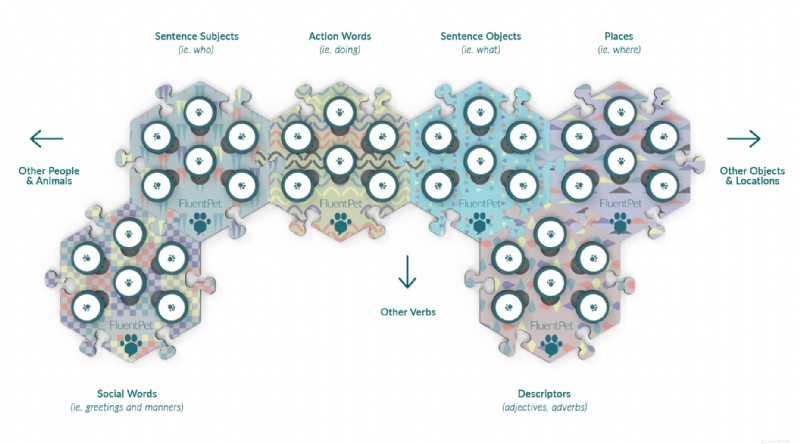
Common categories:
- Subjects: names of people or other dogs
- Objects: toys, food, treats
- Places: bed, couch, outside, yard
- Actions: potty, play, come
- Descriptors: good, later, all done
- Social: love you, hi, want
A research collaboration between FluentPet founder Leo Trottier and UC San Diego’s Comparative Cognition Lab (led by Dr. Federico Rossano) is currently evaluating how effectively dogs can express themselves through these devices. The open study—accessible at TheyCanTalk.org—has attracted more than 3,000 participants worldwide.
Even cats are starting to press buttons. Billi the Instagram‑famous cat has begun using a similar system to communicate with her owners.
Should You Use Dog Communicator Buttons?
Talking buttons can enrich the bond between you and your dog by giving the animal a clear way to signal needs that might otherwise go unnoticed—such as the need to go outside or to play. An audible cue like “Outside” can prevent missed bathroom trips and reduce frustration for both parties.
Artist and owner Alexis Devine reported that her Sheepadoodle, Bunny, was using the “Outside” button consistently within weeks of training. She was inspired by Christina Hunger, a speech‑language pathologist who trained her mixed‑breed dog Stella to use a button board.
Hunger authored How Stella Learned to Talk: The Groundbreaking Story of the World’s First Talking Dog, documenting the step‑by‑step process of teaching a dog to communicate through buttons.
Devine emphasizes that success hinges on patience, repetition, and attentive listening. By observing what the dog already says—through barks, whines, or body posture—you can choose the most relevant words for the board.
Can Any Dog Learn to Use Talking Buttons?
Most dogs can learn to press a button to signal a basic need. Training a dog to press the “Outside” button is essentially the same as teaching a bell‑ringing routine for potty time. Adding an “Play” button is also straightforward: each time you press the button, you immediately play with the dog, reinforcing the association.
As dogs mature, their button preferences can shift. Bunny’s favorite buttons evolved from “Outside,” “Play,” and “Poop” to “Love you,” and she now often combines several buttons to convey complex requests.
How to Train Your Dog to Use Talking Dog Buttons
Like children, dogs learn language by hearing it repeatedly. The most effective method is modeling: you press the button while simultaneously performing the desired action. For example, say “Food,” press the “Food” button, and then hand the dog its meal. Or say “Outside,” press the button, and immediately take the dog outside.
Repetition and a clear reward (e.g., going outside, a favorite toy, or a treat) solidify the connection between button and outcome.
Tips for Using Dog Talk Buttons
Here are practical guidelines to maximize success:
- Start slowly: Each dog’s pace varies; some may take weeks to show interest.
- Centralize the board: Place the board in a consistent, high‑traffic area where the dog spends time.
- Respect natural cues: Buttons add options, not replace body language or vocal signals.
- Never force button presses: Avoid physically placing the dog’s paw on the button.
- Keep training fun: Enjoy the process; if the dog isn’t engaged, it may simply not be the right fit.
Even without a button board, you already have a robust communication system. Introducing buttons can provide mental enrichment and deepen your relationship.
Products to try:
- Hunger for Words Talking Pet Button Mat
- Mighty Paw Smart Bell
References
- Hare B, Tomasillo M. “Human-like social skills in dogs?” Trends in Cognitive Sciences. 2005;9(2): 439-444.
- Pilley JW. “Border Collie comprehends sentences containing a prepositional object, verb and direct object,” Science Direct. 2013;4(4): 229-240.
- Kaminski J, Waller BM, Diogo R, Burrows AM. “Evolution of facial muscle anatomy in dogs.” PNAS. 2019;16(29):14677-14681.
- Wilson L. “From Clever Hans to Bunny the TikTok Dog: An Exploration into Animal-to-Human Communication.” The Macksey Journal. 2021(2): Article 148.
Resources:
Alexis Devine: Instagram: @whataboutbunny | TikTok: @whataboutbunny
Christina Hunger: Instagram: @hunger4words | www.hungerforwords.com

WRITTEN BY
Manette M. Kohler, DVM
Veterinarian
Dr. Manette Kohler graduated in 1991 from the University of Wisconsin School of Veterinary Medicine…
- Top Service Dog Schools Offering Adoption Programs – A Complete Guide
- German Wirehaired Pointer: Traits, Training, and Care Guide
- Short‑Legged Dog Breeds: Causes, Characteristics, and Care
- Positive Reinforcement Proven Effective: A Real-Life Success Story
- Shetland Sheepdog (Sheltie) – A Loyal, Energetic Companion for Active Families
- Master Dog House-Training in Winter: Proven Tips for Cold-Weather Success
- A Newfoundland’s Heart‑Wrenching Goodbye to Grandma Touches Hearts