

Effective Ringworm Treatment for Cats: A Trusted Veterinary Guide
Justine Lee, DVM, DACVECC, DABT
As a veterinarian, one of the most common fungal diseases that I see is ringworm in cats.
Years ago, I fostered a kitten that was brought in by a good samaritan. What I didn’t know when I was fostering her was that she would leave her infectious ringworm all over our house. This resulted in severe skin lesions on me, my husband, and my 13-year-old cat. It also contaminated our house with ringworm. Treatment was pretty intensive—not only did I have to shave all my cat’s fur off, but I had to give my poor cat a foul-smelling medical bath every 3 days. It also required about $1,500 of prescription oral antifungal medication, too.
So, what is ringworm in cats, and what do you need to know as a cat parent?
Ringworm, often called dermatophytosis, is a fungus that is a disease of the environment. The most common types of ringworm found include:
- Microsporum canis (commonly found on domestic animals)
- Microsporum gypseum (commonly found in the soil)
- Trychophyton m. (commonly found on rodents)
Cats can carry ringworm on their fur more frequently than dogs, and often don’t show any clinical signs from it—in other words, they may or may not be affected, but will likely shed it to their environment (including two-legged and four-legged pets, too!).
What are the signs of ringworm?
Signs of ringworm in cats include:
- Hairless regions on the face or body
- Broken hairs
- Red, raised, dry, circular patches on you or your family members
- Itchiness
- Scaling (e.g., white flakes on the fur)
- Crustiness on your cat
- Open, ulcerated bumps (e.g., nodules)
- Discolored areas of skin (especially in Devon Rex cats)
How do I know if my cat has ringworm?
Your veterinarian will have to do several tests to diagnose ringworm in cats; it can sometimes be diagnosed with a specialized light called a Wood’s lamp. More specific tests include a trichogram, fungal culture (submitted to a lab), a PCR test, or even a DTM test.
What is the treatment for ringworm in cats?
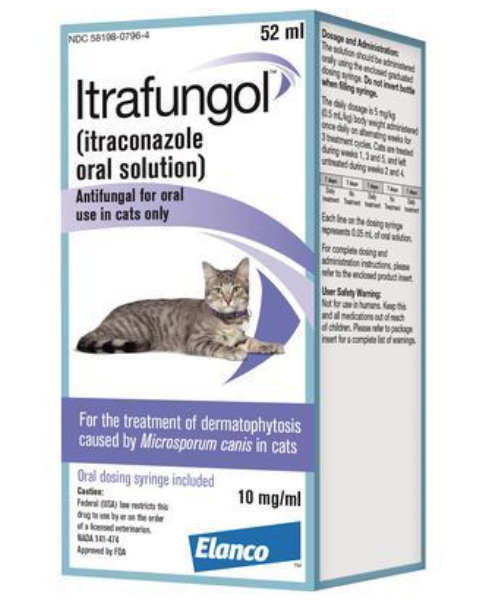
So, what’s the treatment? Ringworm needs to be tackled aggressively with topical lime sulfur baths, oral antifungal medication, environmental clean-up, and bathing.
Topical treatment includes bathing your cat with a medical lime sulfur dip twice a week. This typically comes as a concentrated form and must be diluted, or it can cause corrosive burns on the body. (It normally has to be diluted at 8 ounces of lime sulfur to one gallon of water). This needs to be done for 1-2 months or until your cat tests negative by skin culture for at least 2 tests in a row. I also found that shaving my cat down (to the skin) helped with bathing and minimizing shedding around the house. Other topical options may include antifungal/chlorhexidine combination shampoos.
- Pet Behavior
- Pet Breeds
- Pet Names
- Pet Adoption
- Pet Training
- Cat Stories
- Pet Health
- Adorable Pets
- Cats
- Vet-Approved Guide: How to Treat Ringworm in Cats
- Effective Tapeworm Treatment for Cats: Safe & Proven Methods
- Effective Ways to Relieve Cat Constipation: Home Care & Vet Tips
- Effective Treatments for Hyperthyroidism in Cats
- Treating Cat Diarrhea: Quick Home Remedies & Vet Guidance
- Effective Ringworm Treatment for Dogs and Cats: A Complete Guide
- Managing Your Cat's Seizures: Quick, Safe Care Tips