

Cat Dental Abscesses: Causes, Symptoms & Proven Treatments
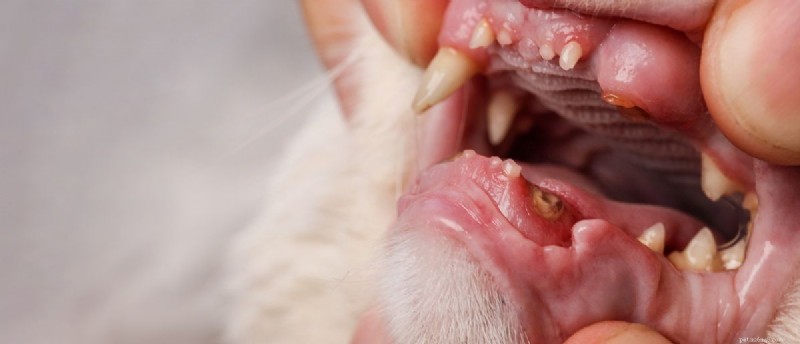
Fractured teeth like this cat’s canines allow infection to enter the inside of the tooth and is a common cause of dental abscesses. Riccio da favola / Shutterstock.com
A dental abscess, or tooth root abscess, is an infection that occurs at the very base, or root of a tooth. This is a painful condition that requires veterinary care. This article will explain how a dental abscess occurs in cats and how they are treated.
Quick Overview: Dental Abscesses in Cats
Other Names: Tooth root abscess
Common Symptoms: Dropping food, favoring one side of the mouth when chewing, teeth chattering, facial swelling, pawing at the face, swatting at food (a sign of frustration due to oral pain)
Requires Ongoing Medication: No
Vaccine Available: No
 Treatment Options: Oral antibiotics and pain medication provide temporary relief; an anesthetic dental procedure for a root canal or to remove the tooth provides a cure
 Home Treatment: After tooth removal, feed soft food for 10-14 days so that the tooth removal site can heal properly Warm compresses over swollen areas on the face can help reduce swelling Follow your vet’s instructions for medications and follow-ups Medical management can help or temporarily resolve signs of swelling or pain but the tooth or teeth affected must be addressed for full resolution
Causes of Dental Abscesses in Cats
A tooth root abscess most often occurs when a tooth has been fractured, allowing bacteria to enter the inside of the tooth.
A tooth has three layers. The outer enamel provides protection and acts as a barrier against bacteria. Dentin forms a majority of the solid portion of the tooth. It contains many small pores through which blood flows to provide nourishment to the tooth. The inner most part, the pulp cavity, contains soft tissue, blood vessels, and nerves.
If the crown of the tooth (the visible part) breaks off enough, the pulp cavity of the tooth will be exposed, making it susceptible to bacteria to get inside.
A couple teeth in cats are more susceptible to this occurring. This includes all four canine teeth, the upper fourth premolars and lower first molars. These last two are called the carnassial teeth and have a big role in chewing, while the canines are for biting. Being the most prominent teeth in the mouth, they are the most likely to become fractured.
Teeth can become fractured by chewing on something hard, through a blunt trauma event or fall, or through the act of chasing down and catching larger prey (or fighting).
Another way a dental abscess can occur is through periodontitis. Periodontitis first starts with gingivitis. This is where plaque which harbors bacteria develops into tartar and calculus. Tartar and calculus are harder substances that bacteria can attach to. As bacteria accumulates, it can work its way down deeper into the gum tissue and below where the gums connect with the teeth.
At this point, the immune system mounts a response to the bacteria, causing inflammation. If not addressed at this stage, bacteria and destructive enzymes they produce will continue to destroy deeper tissue that holds the tooth in place, including bone.
This process of periodontitis can lead to deep holes or pockets between gums/bone and the teeth. Abscesses can form within these pockets, eventually leading to tooth loss.
Symptoms of Dental Abscesses in Cats

One sign of a dental abscess can be favoring one side of the mouth when eating and/or dropping food. Oleg Opryshko / Shutterstock.com
Symptoms of a dental abscess may be visibly clear. But sometimes they will not be. Cats are very good at hiding discomfort.
Noticeable signs may include:
- Exceptionally foul mouth odor
- Visible pus or blood discharge around the gumline
- Facial swelling, often the side of the face under the eye, and usually only on one side
Other signs of a dental abscess may be more subtle, reflecting oral pain or discomfort:
- Hissing or swatting at food
- Chewing on one side of the mouth
- Dropping food
- Pawing at the face
- Rubbing the carpet or other objects (not to be confused with affection or scent rubbing)
Over time, dental pain may also lead to signs of lethargy, hiding, reduced activity, and weight loss.
Complications of Having a Dental Abscess
Dental infections in general do not just affect the mouth. Studies have shown that pets with dental disease are at a much higher risk for heart and kidney disease.
Cats especially are at a higher risk for chronic kidney disease if they have ongoing periodontal disease present that goes unaddressed.
How does this occur? When bacteria break past the gumline causing gingivitis and periodontitis, they are also able to get into the bloodstream. Consider that may go on for years and years in many cats. It’s one of several theories for why chronic kidney disease is very common in cats.
Diagnosis of Dental Abscesses in Cats
A veterinarian may suspect a dental abscess based on historical information and physical exam findings. A cat that is pawing at their face or dropping food who has localized facial swelling and a visibly gnarly tooth may very well have a tooth abscess.
But the only way to truly confirm a dental abscess is with a dental x-ray. Dental x-ray is considered a standard of care when performing anesthetic dental cleaning procedures or COHATs (comprehensive oral health assessment and treatment).
With a dental x-ray you can see a detailed, close up view of the tooth and its attachments to the surrounding jaw bone. An abscess will appear as a dark hole around the root of the tooth, showing that the surrounding bone has been replaced with a pocket of infection.
Treatments for Dental Abscesses in Cats
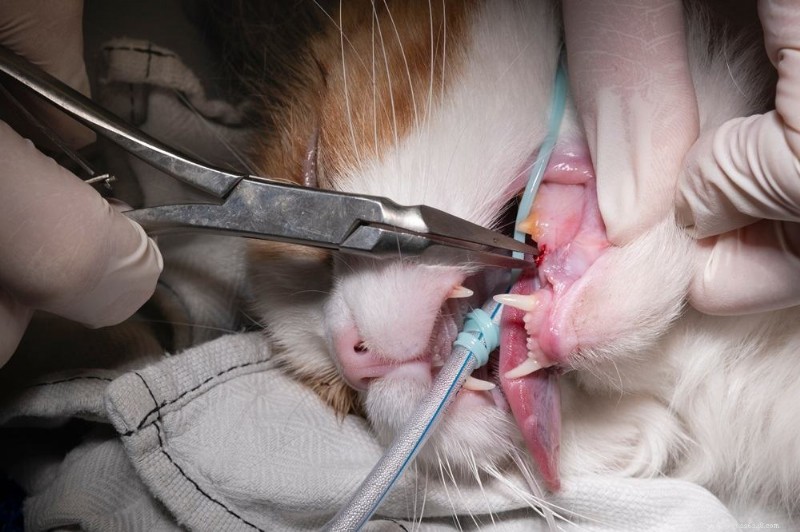
Removal of a diseased tooth under anesthesia is the most common way to fully resolve a tooth root abscess. Henk Vrieselaar / Shutterstock.com
There are three treatment approaches to dental abscesses in cats.
1. Medical approach
The medical approach involves only using medications to address the infection and associated discomfort. An antibiotic paired with an anti-inflammatory and/or additional pain medication can be used to kill bacteria and help with pain.
Some examples for commonly used antibiotics include:
- Convenia (this is the only non-oral medication and has the advantage of reducing the number of oral medications being given to a cat with a painful mouth)
- Clindamycin
- Clavamox
Onsior is a common non-steroidal anti-inflammatory (NSAID medication. Prednisolone, a steroid, may also be used. Meloxicam is an NSAID that may be used by some veterinarians, but carries significant precautions and risks in cats.
Buprenorphine and gabapentin are both pain medications that are commonly used.
The main disadvantage to this approach is that it can only help temporarily and will never provide a cure. Medications will typically always be started if a dental abscess is suspected, to help relieve pain and reduce swelling.
But the improvement will only last about as long as the medications are being given. A week or two after they are finished, any swelling and discomfort will return because the source of infection, the tooth itself, is still present. The tooth itself in this case acts as something called a nidus, which is a medical term for a structure or object that acts as a focus or source of infection.
In cats where an anesthetic procedure presents a high risk, some veterinarians may elect to do a cyclic course of antibiotics (such as giving antibiotics for one week, then taking a break for 3 weeks, then repeating that whole cycle again each month). This can help reduce recurrence of dental abscess swelling and infection but does increase risk for antibiotic resistance.
2. Root canal
A root canal in a cat follows the same principle as in a person. The pulp cavity of the tooth is removed and replaced with synthetic dental material. This process sterilizes the tooth, removing bacteria. The crown of the tooth is then sealed to protect it against further infection. After this process, the tooth is no longer “alive” but can continue to provide structure to the mouth for the life of the cat.
A root canal can only be performed under certain conditions. The most common is when a tooth is fractured and the pulp cavity is at risk for infection or may be infected already. The surrounding bone must otherwise be of good integrity. Teeth affected by deep pocketing or significant abscesses where bone has been removed by infection cannot be treated with a root canal.
While any licensed veterinarian can perform a root canal, this procedure is considered highly specialized and most veterinarians do not have sufficient training to perform it. Most root canals are performed by board certified veterinary dental specialists, veterinarians who specialize only in more advanced dental procedures.
3. Surgical extraction
Removal of a tooth through surgical extraction is the most common approach to providing a resolution to a tooth root abscess. It is also the only solution if the bone surrounding a tooth root is diseased as well.
To perform a tooth removal, the gums surrounding the tooth must be cut and reflected back to expose the surrounding jaw bone. A drill with very small burrs is used to carefully remove the periodontal ligament and a little of the surrounding bone that holds the tooth in place. In some cases, the bone is already diseased and very little additional bone tissue must be removed to get the tooth out.
Once the tooth is removed, the socket is flushed out to remove infected tissue and debris. The gum tissue is then sutured back down to cover the hole that remains from the missing tooth.
While surgical extraction is more invasive and involved, veterinarians are trained in veterinary school to perform tooth removal, making this service available at many general practices.
Cat Care Tips
- If your cat has a dental abscess, make sure to follow your veterinarian’s instructions. This may be giving prescribed antibiotics, pain medications, diet changes, and follow-up visits.
- Soft food can be helpful while your cat is being treated for any painful mouth swelling. The same is true after surgical tooth removal, to help things heal.
- If your cat usually only eats dry food, you can try softening it with low sodium chicken broth.
- Facial swelling may be aided with warm compresses. A warm washcloth in a ziploc bag and applying it for 5-10 minutes can help. Repeat two to three times a day.
- It’s important to remember a dental abscess will never truly resolve until the affected tooth is removed.
Prevention of Dental Abscesses in Cats
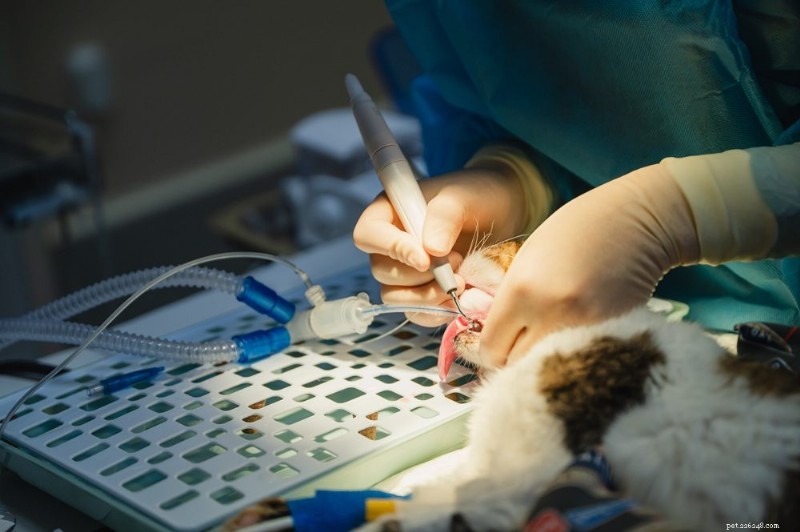
A dental cleaning procedure to address gingivitis and build up of disease on the teeth is one way dental abscesses can be prevented. Gonzalo Infiesta / Shutterstock.com
Preventing a dental abscess in a cat requires two approaches. The first is recognizing and responding to a broken tooth as soon as possible. Any fractured tooth is at risk for infection.
The second is regular dental care to prevent gingivitis and periodontal disease. This starts at home and needs to start as young as possible to build good habits. It’s very hard to make a cat comfortable with teeth brushing after reaching adulthood. Training your cat as a kitten to be comfortable with their mouth being handled is just as important as nail trims and brushing/grooming their coat.
Even so, not all cats will be amenable to teeth brushing, which should be done at least 3 times a week to make an impact. There are other products, like dental treats, water additives, rinses, and diets, that are proven to reduce tartar build-up and prolong dental health. See the Veterinary Oral Health Council’s (VOHC) approved products list for cats to view options.
Just like in humans, professional dental cleanings are also important. No matter how much we brush at home, we still need our teeth to be scaled, scraped, picked, and polished. We need x-rays of our mouth to see what things look like under the gumline and the surrounding bone. This is the same for pets. The main difference is that pets cannot tolerate the invasiveness of having their mouths worked on without full anesthesia. Even heavy sedation carries risks of a pet reacting and being in pain during a procedure.
Professional dental cleanings can also be comparably expensive. But as with many approaches to preventive health care, dental cleanings can be budgeted for. To understand a general picture of your cat’s dental health and when a cleaning may be needed, make sure to keep up annual visits with your veterinarian.
-
Hunter, T., Hiscox, L., & Bellows, J. (n.d.). Tooth Root Abscess in Cats. VCA.
-
Cornell University College of Veterinary Medicine. (2017, June). Feline Dental Disease. Cornell Feline Health Center.
-
Famuyiro, K. (2025, July 30). How Your Pet’s Dental Health Affects Their Heart and Kidneys. LA Times.
-
Trevejo, R. T., Lefebvre, S. L., Yang, M., Rhoads, C., Goldstein, G., & Lund, E. M. (2018). Survival analysis to evaluate associations between periodontal disease and the risk of development of chronic azotemic kidney disease in cats evaluated at primary care veterinary hospitals. Journal of the American Veterinary Medical Association, 252(6), 710–720. https://doi.org/10.2460/javma.252.6.710
-
Weir, M., Hiscox, L., & Bellows, J. (n.d.). Does My Cat Need a Root Canal? VCA.
-
VOHC Approved Products for Cats. (2025, March). Veterinary Oral Health Council.
-
Barnes, C., Weir, M., & Gollakner, R. (n.d.). Antibiotic-Resistant Bacterial Infections in Cats. VCA.
- Pet Behavior
- Pet Breeds
- Pet Names
- Pet Adoption
- Pet Training
- Cat Stories
- Pet Health
- Adorable Pets
- Cats
- How a Bearded Collie Helped Her Human Overcome Depression After 9/11
- Understanding Cherry Eye in Dogs: Causes, Symptoms, and Treatment
- Understanding Attack Dogs: Roles, Training, and Responsibilities
- Choosing the Right Companion: Adopt a Cat or Buy a Kitten?
- The Taiwan Dog: Loyal, Energetic Companion & Hunting Heritage
- Do All Dogs Swim? Discover Which Breeds Excel in Water
- Help Your Dog Regain Appetite: Proven Strategies When They Won’t Eat