

How Well Do Chickens See in the Dark? Understanding Their Night Vision
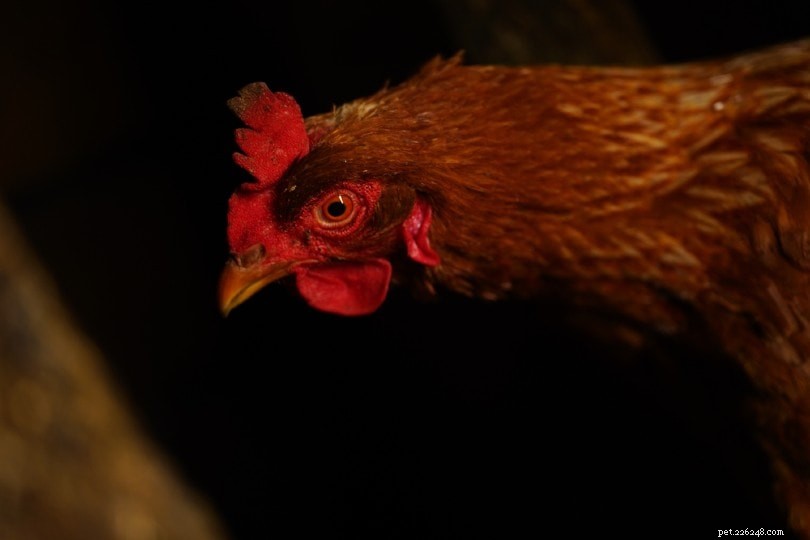
Sight is the most developed sense in chickens, as is also the case with many birds. With its eyes placed on either side of the head, the chicken has predominantly monocular vision, except for a small area in front of the beak, which is binocular and allows it to perceive relief and distance with great precision.
But despite everything, the vision of chickens is not perfect: they see extremely poorly in the dark! Let’s see the reasons for this poor night vision and some other interesting facts about the sense of sight of chickens.
Why Do Chickens See Badly in the Dark?
The retina of vertebrates, such as birds and mammals, contains photoreceptor cells called cones and rods: these are responsible for day and night vision, respectively. Thus, the rods are necessary for night vision and do not detect colors. As for them, the cones make it possible to distinguish the colors and to perceive the details of the objects.
Cones make up 5% of all photoreceptors in humans and only 3% in mice, but cones outnumber rods in bird species, such as chickens. This explains why chickens can’t see well in the dark: they don’t have enough rods.
Scientists believe that an ancestor of mammals had developed an advanced visual system but that this faculty was lost during part of mammalian evolution, possibly during a period when mammals were primarily nocturnal. They believe that nocturnal behavior suppressed the evolving need for better color perception and visual acuity, ultimately leading to the loss of cones.
But, in the case of birds, like chickens, their vision has evolved differently.
Indeed, chickens never had a nocturnal ancestor because they evolved after the time of the dinosaurs. They went straight from dinosaurs to chickens and never needed good night vision to escape predators.
In short, our nocturnal ancestors mainly exploited the sensitivity of the rods to the detriment of color vision. The evolution of chickens has done the opposite.
Do All Birds Have Poor Night Vision?
Most birds have poor night vision, except for owls, nightjars, and woodcock, as well as some hawks and other birds of prey. Besides, most mammals dangerous to chickens have at least good or even excellent night vision. Therefore, chickens are at a considerable disadvantage when the sun goes down, hence the importance of not letting your chickens roam free overnight in your backyard!
Can Chickens See in Color?
The chicken has four types of cones in the retina of the eye instead of three in humans. Because of this, the chicken is said to be tetrachromatic, while humans are trichromatic. But, most of all, it means that chickens see colors differently.
So, just like humans, chickens have in their eyes the three types of cones needed to form colors: red, yellow, and blue. These are the three primary colors: you get all the colors you can imagine by mixing them.
But chickens also have cones sensitive to ultraviolet light. Thus, the light that reaches the retina of the chickens also passes through colored micro-droplets of oil. They further increase the number of colors the chickens can distinguish by acting as filters for the corresponding colors.
For example, a hen can use UV vision to see which of her chicks are the healthiest: growing feathers reflect UV better, so they know which chicks are the most vigorous and will therefore take care of them as a priority.
How Does the Vision of Chickens Compare to That of Humans?
The retinas of chickens and humans are both rich in cones, demonstrating the importance of color vision in both species. But in chickens, this manifests as a ratio of three cones to two rods, whereas the human retina exhibits a cone-to-rod ratio of one cone to 20 rods, which is why we have better night vision than chickens.
In addition, the chicken’s eyes are protected by two horizontal lids, just like those of humans. However, they have a thin and almost transparent third eyelid, called the nictitating membrane. This slides back and forth, protecting the eye and distributing tear secretions.
Fun fact: If you’ve ever watched chickens walk, you’ve probably noticed that their gait is a bit peculiar, and their heads swing in a pendulum motion. In fact, to see well, the chicken must keep its head fixed as long as possible when moving: the head remains fixed while the body moves forward, then it throws itself forward while the body does not move, then stays fixed while the body moves forward, etc. This is called the optokinetic reflex: the immobility of the gaze compensates for the blur associated with movement.
Finally, the chick has very sensitive deep-brain photoreceptors that constantly analyze the photoperiod’s duration and play an essential role in triggering physiological cycles, such as laying, molting, and brooding.
Final Thoughts
Chickens see colors better than we do, but they haven’t been spoiled for their night vision. Their evolution from the time of the dinosaurs meant that they never needed to see well in the dark, making them easy prey for their nocturnal predators. Therefore, they need their human caretakers to protect them after dark!
- Do Guinea Pigs See in the Dark? Understanding Their Vision
- Do Mice Roam at Night? Discover Their Vision and Nocturnal Habits
- Chinchillas at Night: Their Nocturnal Nature and Vision Explained
- Do Dogs Truly See in the Dark? Exploring Their Night Vision Capabilities
- How Well Do Cats See in the Dark? Exploring Their Night Vision
- Do Dogs Truly See Well in the Dark? Exploring Their Night Vision
- How Well Do Dogs See in the Dark? Insights into Canine Night Vision