

Finn: From Heirloom Collie to Mountain Search & Rescue Champion
Finn was free, though not in the “free to good home” sense. As a puppy, he was deliberately donated to become a search dog for a mountain rescue team. Finn logged several years of service and was called to go on many search and rescue missions, but everything began when he was just 6 weeks old and barely weaned.
Even at that tender age, Finn’s breeder (Pat Howarth of CownBred Collies in Lanchashire, Great Britain) knew he showed exceptional promise. Basically, he had a lot of career options: to become a winning show dog, a topnotch companion, or even a quality working dog.
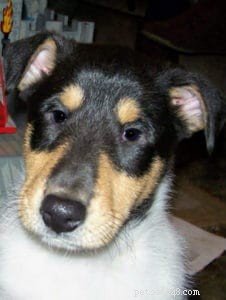
Table of Contents
The Offer
Here’s how it happened, according to Pat:
The letter basically said:
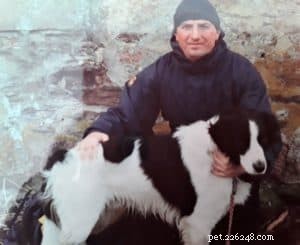
In a case of serendipity, Pat’s timing was just right for Stephen Garofalo (“Gruff” to his friends). Stephen had to retire his second search dog, a Border Collie named Roy, and was in need of a replacement partner. He said, “I’d heard of Smooth Collies but never thought of owning one until Pat offered me one. We did some research on the breed and decided that they have potential.”
The Chosen One
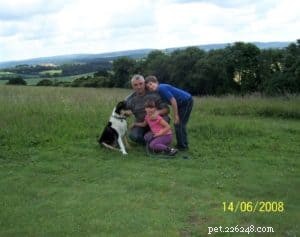
So Pat got a phone call telling her “what a lovely gesture” her offer of a puppy was, and two days later Stephen brought his family to meet the litter – all of whom were boy puppies. From what Stephen had said he looked for in a dog, Pat suspected Finlay would be his choice. He stood out from his brothers, being, in Pat’s words, “a big, very handsome, cool, laid-back dog.” If Pat had kept a Smooth Collie puppy, Finn would have been her pick of the litter.
Stephen said he usually relies on his instincts when selecting a search dog. He explained that fearfulness is really the main thing to look for, and if a dog is not fearful, “You can usually shape them to what you need.” But on that November day of 2007, Pat helped them choose.
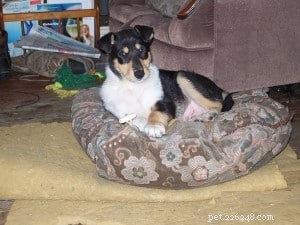
Pat had just had the puppies’ eyes tested for inherited eye defects (best practice due to the prevalence of Collie Eye Anomaly), so when Stephen asked if they could take Finn home with them that day, she agreed. In her opinion, “The sooner the pup gets to know his new owner, the better.” Stephen is of a similar mindset.
The Rescuers
It takes a massive amount of work before a human and canine are ready to go rescue people, so I’ll give background on what it took for Stephen and Finn to enter the ranks of the elite ones who perform this life-saving service. Before the stories of their search and rescue missions can be fully appreciated, it helps to know how they prepared before they could be sent out as a dog/handler team. (If you aren’t interested in dog training or the making of S & R team, feel free to skip down toward the end for specific mission info.)
SARDA (Search and Rescue Dog Association)
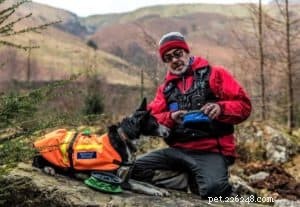
Finlay had some big pawprints to fill, but he had a competent handler and mountaineer to instruct him. Stephen had first had to become a member of a mountain rescue team to be eligible to become a search dog handler. Then he had gone through years of volunteering and extensive training to reach the level of graded (full) handler with the charity known as SARDA, whose “principle purpose is to train mountain rescue team members and their dogs to be competent search units.”
No one, not even the higher ups, receive wages. Their work is entirely funded by supporters and charitable donations, and all money received goes strictly into training and supplies.
In a previous article on search dogs posted on the RPMRT website, Stephen wrote:
MRT (Mountain Rescue Teams)
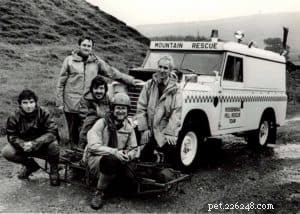
It should not be supposed that the rescuers’ status as volunteers make them less professional. In fact, they are often the true “firsts” of the first responders, working in tandem with police and ambulance units. They may even be called out to assist in situations where a helicopter cannot fly due to poor weather conditions.
The Rossendale and Pendle Mountain Rescue Team (RPMRT) is an official, free emergency service providing a specialist team of trained volunteers 24 hours a day, year-round. Their website states, “We train every week and most weekends in our core skills of medical, rope rescue, navigation, communications, and stretcher work – along with water rescue.” It is clearly not for the faint of heart or the person with a passing interest, and it was this group that Stephen joined.
Many is the hiker, jogger, or photographer who has gone out into the hills and had a hard fall or taken a tumble down a ravine, leaving them with a broken bone or a head injury. The mountain rescuers are adept at looking after themselves while extracting victims from the situations they have found themselves in.
Sometimes people suffering from dementia or Alzheimer’s wander off and become lost, while others set out for a nature walk and simply lose their bearings. Less commonly, children go missing. When a missing person is reported, that is usually when the search dogs like Finn are brought in.
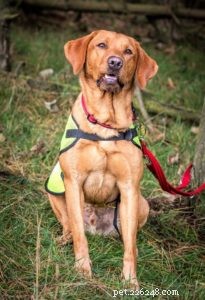
Stephen's Training
Stephen joined his first mountain rescue team in 1982, when he was just 19. Before he could train as a search dog handler, he had to become a “body” (or dogsbody) at the young age of 22. As he said, “The road to becoming a dog handler is a long one.”
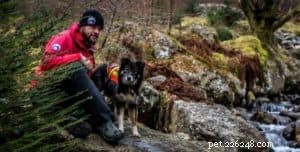
The “Body”
A “body,” in search and rescue speak, is someone who hides out in the hills so the dogs can find them and hone their skills. Stephen referred to the bodies as “a very important arm of the association” who “perform an invaluable service and make a massive contribution to the training of search dogs.” Though many bodies are MR (mountain rescue) team members or prospective dog handlers, a person needn’t be either to act as a body.
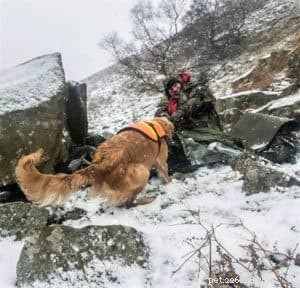
Stephen’s time bodying allowed him to observe how the graded handlers trained their dogs, contribute to their training himself, meet MR team members from across the country, and practice dealing with the dangers of a hostile environment. Having to follow instructions and “lie out on the British moors and mountains all year round in all weather” was a test of commitment for those considering joining SARDA.
The association requires prospective dog handlers to volunteer as a body for at least 6 months, but Stephen bodied for 2 1/2 years before he started training his first dog. To this day, he says, he never forgets to thank the dogsbodies.
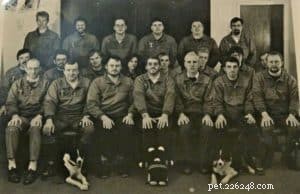
The Trainee Handler
When it comes to trainee handlers, Stephen commented that “many are called but few are chosen.” When he started, up to two-thirds of potential dog handlers didn’t make the grade. Some found it was more time-consuming than they had anticipated, while others, Stephen noted, “did not have the ability to train a working dog to a set standard.”
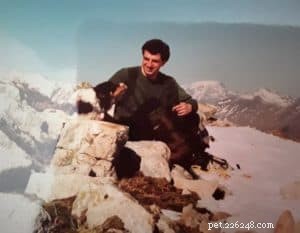
The techniques of dog training can be learned, and skill can be gained through experience. But in Stephen’s words, “There is also a deeper element in that some people just seem able to communicate their wishes to animals better than others. Much depends upon body language and attitude…”
Conversely, Stephen pointed out, “Many people out there could train a search dog, but they are not mountaineers.” To become a qualified search dog handler, a person has to be both dog-savvy and hill-savvy. After all, the handlers of SARDA are part of a specialized fraternity within the mountain rescue group.
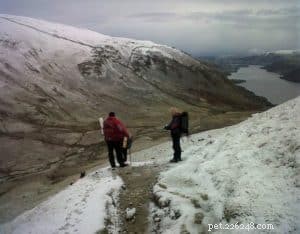
Emphasis is often placed on canine temperaments, but in regards to the handlers’ temperaments, Stephen said:
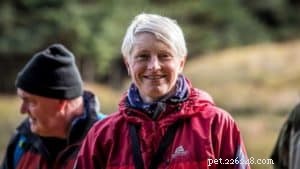
Throughout Stephen’s training, the SARDA evaluators were also watching to see if he had the necessary character traits of self-honesty and integrity. He explained that “liars and people who constantly overestimate their skills will not give accurate information during a debriefing and will make poor ambassadors for their teams.”
Stephen's Dogs
Skye
In 1987, when Stephen was 24 years old, he started training his beginner dog, a female Border Collie named Skye, daughter of a great search dog called Roscoe. All that time “interning” and making connections paid off, because she was descended from a whole lineage of search dogs who had belonged to previous dog handlers.
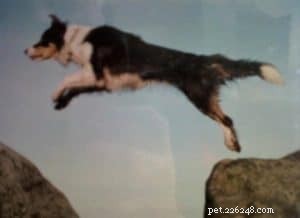
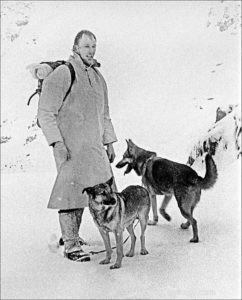
In Stephen’s estimation, “Broadly speaking, the best dog to start with is a Border Collie bitch. They are highly trainable, mature quickly, and have long working lives.” Skye became a certified search dog (making Stephen an accredited dog handler) in 1990, fully seven years after he had originally become a full team member. She lived from 1987 to 2000.
Roy
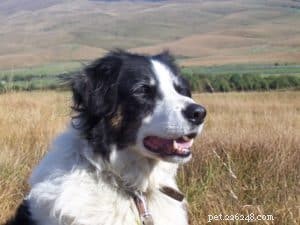
Stephen’s second dog, Rob Roy, was Roscoe’s grandson and thus related to Skye. Roy stayed healthy and worked well into his old age, living from June 1995 until July 2008. In that year, Finn was picked to become his successor, and Roy had some small part in the early education of Finn.
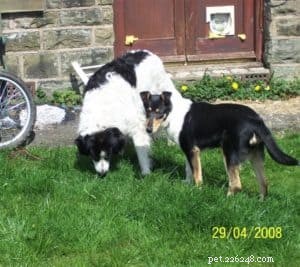
Finn
A Smooth Collie like Finn is not the typical choice for a search and rescue dog. Border Collies (the not-so-distant cousins of Smooth and Rough Collies) are by far the most popular breed to use, and are just more popular in general. Pat Howarth, who has been breeding Collies for nearly 60 years, said that on average, only about 70 Smooths are registered each year with the Kennel Club in the United Kingdom. (Maybe if Lassie had been a Smooth instead of a Rough Collie, things would be different.)
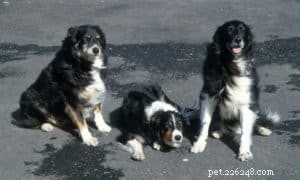

Arlene Harris’s daughter Lizzie volunteered on the rescue team with Stephen. When Arlene mentioned that she was considering getting a Smooth Collie, Lizzie said, “Oh, I think that’s what Steve has just got: I’ll ask him.” Arlene thought that would be too coincidental, since Smooths are now uncommon in Britain and she’d never even seen one in person. But Stephen brought Finn by to meet Arlene, and that’s how she ended up taking home Finn’s littermate Jack, and later also adopting the brothers’ grandmother, Tally.
Arlene said she had wanted a smart dog, one that could be off-leash trained without worry of it chasing livestock, and not as high-strung as Border Collies can sometimes be. She said:
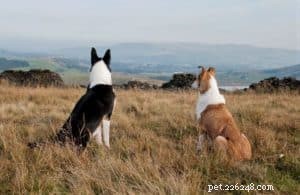
Because Smooth Collies are a working breed, Finn did meet Stephen’s requirements to be “free-moving, hardy, and trainable.” Stephen emphasized how crucial it is for a dog to be tractable, since an overly stubborn dog could make extra work for the handler and possibly fail the final SARDA field test. (For example, cats may be more clever than dogs, but most of us have little to no success getting one to cooperate.)
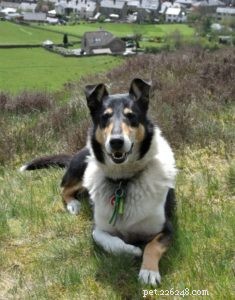
Finn was also an appropriate size: a tiny dog would have trouble quickly covering large tracts of rugged terrain, while a giant dog would be difficult to maneuver into a helicopter. Other good-sized working (primarily hunting and herding) breeds that have made successful search dogs include German Shepherds, Hovawarts, German Shorthaired Pointers, German Wirehaired Pointers, Golden Retrievers, Labrador Retrievers, Siberian Huskies, Springer Spaniels, and various mixed breeds.
Finn's Training
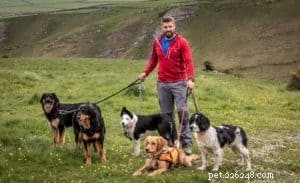
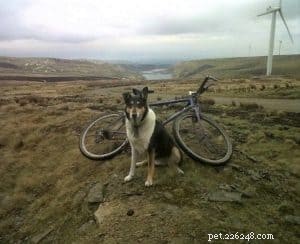
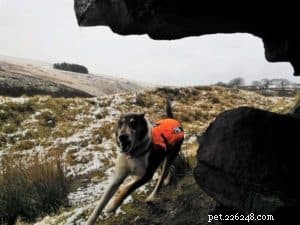
The first thing was to make a mountain dog out of Finn. This took time, as Stephen was mindful not to strain Finn’s developing joints in his first year of life. But Stephen regularly took him out on hikes, gradually increasing the distance of their mountain rambles and thus Finn’s endurance. Stephen explained, “Taking your dog onto the fells is as important as the rest of its training, so that it can acquire field skills, learn to recognise hazards, and build up its fitness at a steady and sensible rate.”
Stock Test: Wooly Mammals
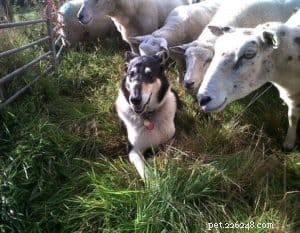
Roaming the countryside also gave Finn a chance to get around some wooly livestock. “Much of Britain’s open land is farmland, and much of Britain’s upland is grazed by sheep,” Stephen explained. “Therefore, our dogs have to be safe to work around and through sheep.”
To progress through search dog training, Finn first had to pass a stock test to prove he was trustworthy around livestock. In search and rescue work, dogs are off-leash much of the time, often ranging far from their handler. They cannot be distracted and must not chase or otherwise harry grazing sheep. The farmers who allow rescue teams to train or search on their land are trusting them to ensure their animals come to no harm.
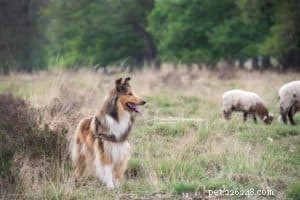
As you can imagine, not chasing sheep can go very much against the instincts of herding breeds like Border Collies and Smooth Collies. But that same innate desire can be a helpful thing when properly channeled. Stock training started young for all Stephen’s dogs, and it “largely consisted of redirecting the dogs’ chasing instinct away from animals, onto an inanimate object like a ball, and then from the ball onto people acting as casualties.”
In practice, the stock test is simple. Stephen said, “a flock of sheep will be encouraged to mill around your dog, and its behaviour will be monitored.” Finn passed, which meant he could then go on to the introductory assessment, a test of obedience.
Introductory Assessment: Obedience Test
Here is Stephen’s description of what Finn had to master to ace the obedience portion of his training:
Stephen commented, “The standard is not very high.” Perhaps not, from the standpoint of an actual obedience competition; but as your average pet owner, I beg to differ. Precisely none of my three dogs would hold a stay with me out of sight, nor would they throw themselves to the ground mid-run! Which probably just goes to show the correctness of Stephen’s assertion that “Often, the hardest part of training a dog is training the handler.”
Stage One: Find Sequence
Once Finn had the obedience basics down, he was ready to progress to stage one training. Knowing how to find people is obviously the most important thing a search and rescue dog can learn. When I asked Stephen about the sequence of events, he explained it like this:
Yes, the process does sound similar to the famous scene culminating in the much-repeated phrase, “What’s that, Lassie? Timmy is in the well?!” But it’s not that simple. Lassie, you see, had some background information to go on. But a dog encountering yet another human scent doesn’t know that stranger is metaphorically “in a well.”
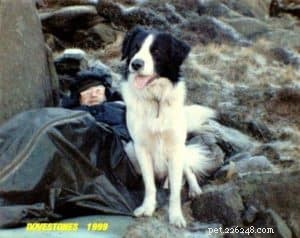
So Finn, as a prospective search dog, had to be taught to find people in stages, individually learning each step in a series of actions. Here’s how Stephen explained it:
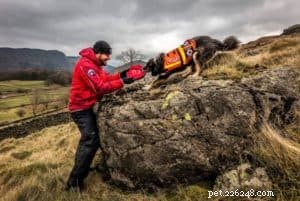
In this way, playful Finn learned that once he had successfully united Stephen and a body, he would be rewarded with a favored dog toy, and not by Stephen alone. “This all takes a considerable amount of input from the body, and ideally only a dog handler or a body who is good with dogs and enthusiastic should be used,” Stephen said.
Rather than track with his nose to the ground to find people, Finn had to be trained to use airborne scent. Stephen (and helpers) accomplished it this way:
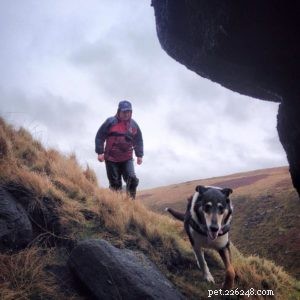
To keep Finn from getting bored, his training was done “in short, sharp bursts, with a strong emphasis on play, and with regular changes of bodies and terrain.” But searches for missing people can be the equivalent of very long work shifts, sometimes over the course of days, so the next challenge was to get Finn to the point he could “maintain his performance for hours.” Once he demonstrated a mastery of the find sequence, Finn was ready for stage two training.
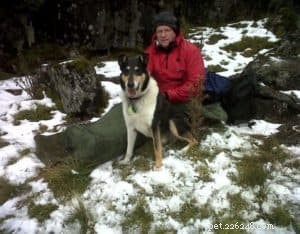
Stage Two: Fine Tuning
This phase of Finn’s training was really about smoothing out the wrinkles. Stephen said most people’s stay in stage two was very short. To level up, as it were, Finn had to cover larger areas and learn how to hunt using his instincts, with less prompting and input from the bodies and Stephen.
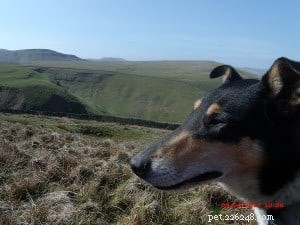
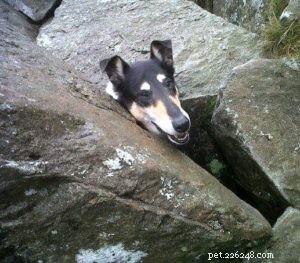
The strategy was not to head straight for a body’s location, but to the Smooth Collie a chance to smell the wind and follow the scent back to the hidden body himself. Stephen had to be patient and let Finn work his sniffing magic. The more successful finds Finn experienced, the more his confidence grew.
Stage Three: Crab Dancing
Since Finn had the find sequence down and the motivation to keep going, he entered his last “mini assessment” before the big, final test. Stephen and Finn couldn’t just show up at the final assessment and ask to be tested. Along with everyone else, they had to prove as a team that they were worthy to be invited.
Phase three is possibly more a challenge for the handler than the dog. Stephen said, “This stage often sorts out the mountain rescue people from the rescue people, because the areas get more rugged and the final months of consolidation take place in the winter season.”
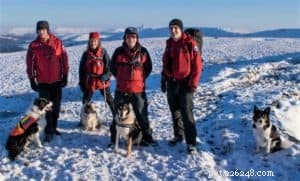
Throughout stage three, the search areas became progressively larger, and Stephen had no foreknowledge of the bodies’ hiding place. Absent that advantage, he was truly hunting as much as Finn. But it wasn’t an aimless meander, as Stephen still guided the search. He said, “Working areas is theoretically easy: you have a box with some obstructions in it such as streams, crags, and gullies. So, all you have to do is take your air-scenting dog to the upwind end and start working.” In actuality, it becomes much more difficult.
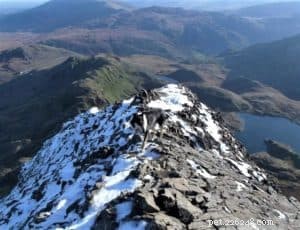
The methodical way Stephen learned to maneuver his dogs through search areas, zigzagging “down from the top boundary in a series of large sweeps,” is given the fun term “crab walking.” It’s essentially the same way bird hunters like my dad teach gun dogs to quarter in the field.
As a team, Stephen and Finn “put on a good show in the closing months of the year” and received an invitation to attend the annual course. The invite was a vote of confidence, indicating they had been evaluated and thought likely to pass – though that was not a guarantee.
The Annual Course: Pass or Fail
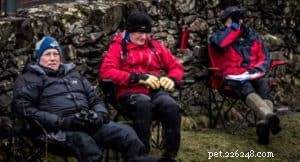
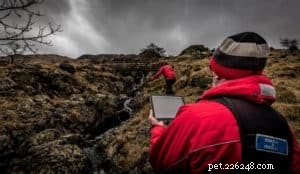
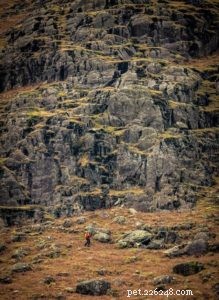
It wasn’t enough for Finn, Stephen, and the others being tested to find all the bodies hidden in their search areas. The dogs would be penalized if they did not inform their handlers of a found body or if they attacked sheep, and the teams could be heavily faulted, even failed, for performing with general inconsistency (less than 90% success rate) or not covering their areas thoroughly.
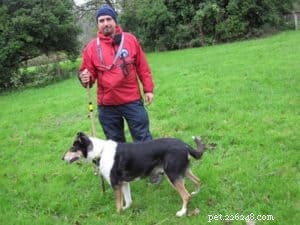
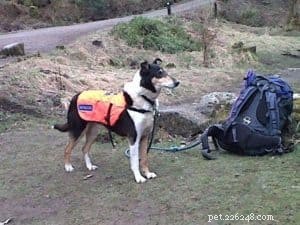
In January of 2011, “after three days of winter weather, slipping and sliding, depression and exhilaration,” Stephen and Finn had cleared their areas, found their bodies, and passed the test. They “qualified to join one of the most exclusive dog clubs in the world” and were rewarded with “a plastic dog tag, a couple of dog jackets, and a waterproof coat – the total value of which did not cover a fraction of the cost of training.” Clearly, for the volunteers involved in this work, the rewards are not material.
The Missions
While each member of a MR team has a part to play, a search dog handler’s role within their team is highly specialized. Still, Stephen said handlers “don’t expect too much adulation” upon passing the final assessment.

The Teamwork
Though not all the team members would fully realize everything Stephen and Finn had gone through to achieve the status of a qualified S & R handler/dog team, that didn’t mean Stephen lacked respect and appreciation for them. He pointed out that “dog handlers cannot act in isolation. We are only truly useful with the backup of a team to provide coordination, communication, sophisticated casualty care, and ultimately casualty evacuation.”
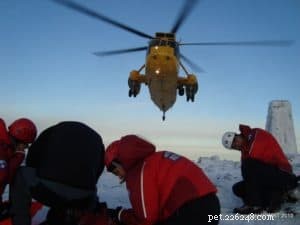
But Finn and his fellow search dogs became adept at working fairly independently. “Once an experienced dog is rolling, it hardly needs its handler,” Stephen said. “The weakest link in a dog team is the handler…” In fact, the canines consistently outperform their human counterparts.
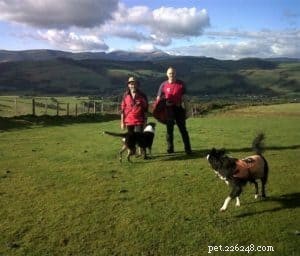
This is not surprising, given a dog’s natural equipment. Dogs may not see color the way we humans do, but their eyeset gives them a stereoscopic view of the world and their night vision is much better than ours. And they don’t have to lick a finger and hold it up to detect the wind direction. That’s what their whiskers are for. Plus, they have immensely superior senses of hearing and smell. According to the Calder Valley Search and Rescue Team, “It is not unusual for a dog to pick up a scent from a missing person 500 metres (547 yards) or more away.”
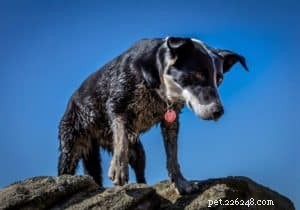
“In an ideal world,” Stephen asserted, “dogs would be the first resource deployed on searches… in the hope of providing a fast conclusion. In reality, this seldom happens.” Issues arise with transportation, bureaucracy, and sometimes, as Stephen bluntly said, “deranged team leaders who want to make sure their boys get the glory.”
Usually, dog handlers work alone. “This takes a strong mindset… It also requires good hill skills, because you will often not be on familiar terrain,” Stephen said. Sometimes dog teams work in small groups. “In large spaces like fell sides and open moorland,” said Stephen, “we can form a sweep line. At other times, we work in pairs to clear opposite banks of a river or sides of a ridge.”
Many searches take place in urban outskirts, which means dealing with manmade obstacles as well as the rugged countryside. For such difficult areas, Stephen prefers to join and strengthen a search party. Though Stephen and Collie Finn were technically assigned to the RPMRT, they could expect to be called out to assist in searches with another MR team in any part of the country.
Stephen told me he has been on at least 400 missing people searches with his 3 dogs (that’s an average of 133 searches per dog)! But he said, “I’ve never kept count of the number of team callouts for injured people with a known location that I have been out to rescue.” The majority of their calls are for just such assistance, and they really are more rescue than search.
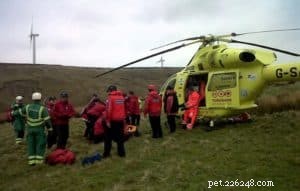
Stephen was understandably hesitant to discuss memorable missions he went on with Finn. As he said, “the missing people and their relatives may still be alive.” However, he directed me to some incident reports that are public access. While I can share some highlights of Stephen and Finn’s exploits, I must be necessarily vague on the details to protect others’ privacy.
To keep in top form, they also continued their training days with SARDA and MR teammates nearly every weekend – when not on an active callout. It should be noted that, regardless of who found what missing person, the team got the credit. They were truly, admirably searching for people in need, not hunting for personal praise.
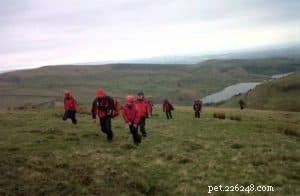
When Dogs Fly
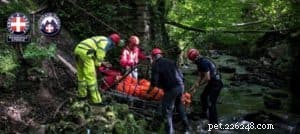
In preparation for being flown out to searches in remote, inaccessible locations, Stephen (Gruff) and Finn attended a helicopter training day with their teammates at RAF (Royal Air Force) Leconfield. This involved being winched up into a Sea King chopper by a 250-foot-long steel cable. According to the RPMRT report:
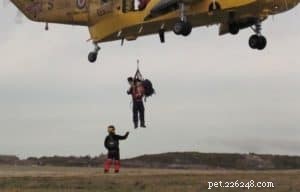
Stephen commented about how the smell permeated his team kit, requiring a thorough washing. (If you’ve not lived through a dog releasing his anal glands near you, count yourself fortunate.) Apparently it was being lowered down that Finn disliked. I don’t blame him; I have no love of heights and wouldn’t appreciate being shoved out of a hovering helicopter either.
When Avalanches Strike
But Finn did improve with practice. A good thing, because Stephen and Finn would later be asked by the RAF to assist in a search for avalanche victims in Scotland. Finn and Stephen were already in the area, as they had been participating in a nearby SARDA avalanche training course; but to get to the site at the Chalamain Gap, they were airlifted by a helpful wildlife group that was researching pine martens in the Cairngorm Mountains.
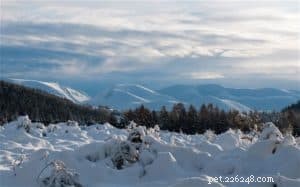
Finn had the ability to scent a person buried beneath more than 6 feet of snow, and he had been trained to begin digging on command once he had indicated his find. Of the 12 people who had been on the slope when the snowslide struck, 3 did not survive. Stephen said, “We are always hoping to find victims who are alive and uninjured, but sadly it’s not always the case.”
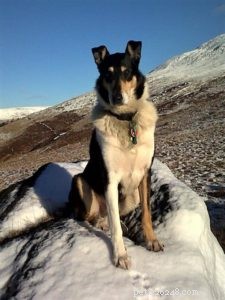
When it comes to snow rescue, dogs are once again more suited to this frigid job than humans. As wolf descendants, many breeds are still double-coated, Smooth Collies included. Finn, though the shorthaired version of a Collie, had a thick layer of fur to keep him warm. He occasionally wore SARDA-issued weather jackets, but they could get easily hung up on brush and hamper his movements.
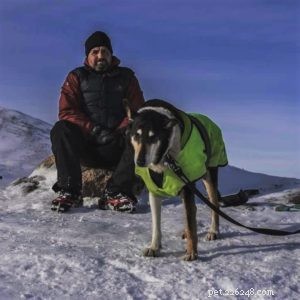
Structurally, dogs are also very cold-adapted, though the downside is this makes them much less heat-tolerant.
When People Are Lost
S & R work gets sensationalized, but often it is anything but. Sometimes, the team would be called out to help in another locality, search for several hours, clear their areas, and basically have to report to the authorities, “He’s not here; you’ll have to look elsewhere.” That may sound unhelpful, but it’s actually great for narrowing things down. (Rather like a room-by-room search for your missing car keys.) Here’s a sample report excerpt:
Here’s another sample of a fairly typical callout log:

While some search results were inconclusive (at least at the time), others were tragic. One of Stephen’s social media posts simply said, “Another search concluding with one less man in the world.” But if they didn’t locate someone in time to save them, they were still providing closure for that person’s loved ones. In some cases, they would be asked to find someone even when there was little chance they would still be alive.
The SARDA search dogs like Finn are by and large air-scenting dogs trained to follow windborne scent, though a few used in urban areas are trailing dogs. (Only a specifically trained cadaver dog is truly adept at locating dead bodies.) “The problem is that dogs live in a scent-orientated world,” Stephen explained. “Once someone dies, within a few days all the residual smell that the dog identifies as human is gone, and the body just becomes an object to the dog.” When a search dog finds a deceased person, they have usually not been missing for long.
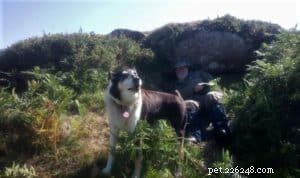
When a little girl went missing in Wales, it was a very high profile case and the eyes of all in Britain were watching. Eight Rossendale and Pendle team members, plus Finn, were dispatched to Machynlleth to aid in the search, which went on for several days without success. (Much later, her convicted killer went to prison for life.)
Of course, they had their share of more joyful conclusions. In one celebratory social media post, Stephen laconically commented: “Two searches this weekend and two live people recovered, which is nice.” And people are grateful. On the RPMRT’S Just Giving donation page, one touching comment reads:
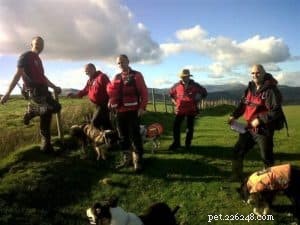
At times, things got pretty exciting. Not in a “yay” sort of way, but in an intense and stressful sort of way. Here’s a condensed RPMRT callout incident report to prove it. (I left out the part about the punctured tire.)
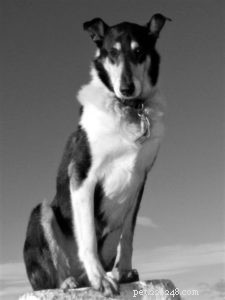
Bodmin Moor is a granite moorland in Cornwall, an area where many rivers have their origins, and it was also the scene of a successful search in which Stephen and Finn took part. It was the farthest Stephen had been into the South West of Britain since 1973. As he said, “You get called all over the country because [the dogs] are so good at the job.”
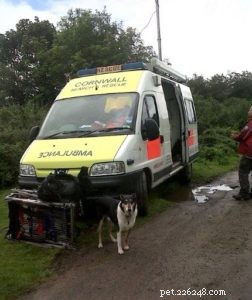
Community Outreach
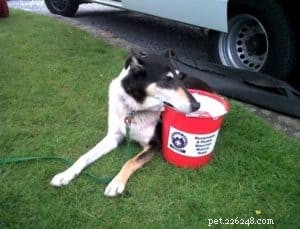
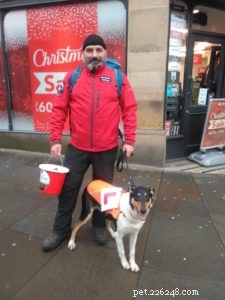
Sometimes local businesses like Downham Ice Cream Shop hold fundraisers to support the volunteers’ vital Search and Rescue work. At this particular event, Stephen, Finn, and other members of the RPMRT displayed their rescue equipment to the public, and many good-hearted citizens put money into their collection buckets.
Perhaps my favorite record of community outreach was this gem, particularly the bit about Finn’s participation.
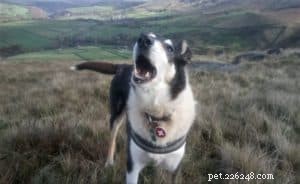
It seems Finn may have made a habit of interjecting during human speeches, as per this announcement about a RPMRT training event: “Training tonight is on search dogs… It’s being given by our very own dog handler, Steve, and no doubt Finn will add his woof at the appropriate time.”
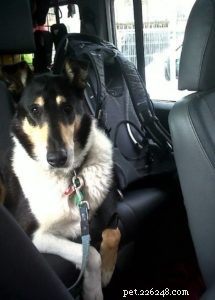
After 35 years with Rossendale and Pendle MRT, Stephen transferred to the Calder Valley Search and Rescue Team in 2018, so the last year or so of Finn’s working career was spent as a search dog for CVSRT.
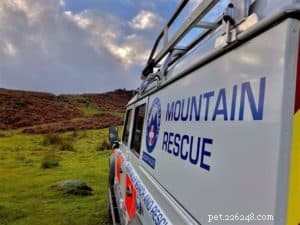
One of Those Classic Ones
The trouble with dogs is that they don’t live forever, much as we wish them to, and the experience of losing one does nothing at all to soften the blow of losing another. Each of our dogs’ lifetimes spans but a decade or so of ours – not nearly enough time. On January 29, 2019, Stephen simply posted in his understated way, “Today has not been a good day. I have had to put Finn to sleep.”
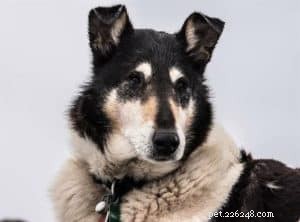
For 11 years, Finn had slept in his bed on the floor next to Stephen’s. They had gone everywhere as a team. Finn had trekked up hill and down dale with Stephen and improved the lives of so many he came in contact with. Together, they had done what they truly loved to do and derived immense satisfaction from each other’s company. Finn had known how to work hard, take joy in it, share that joy with others, then come home and truly relax. That’s more than a lot of us humans ever learn to do.
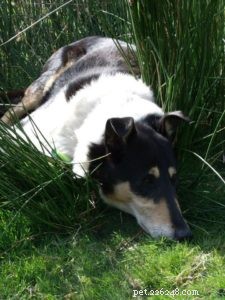
How can you sum up the life of a dog, especially one as grand as Finn? And how can you offer meaningful sympathy to someone who is suddenly, unexpectedly bereft of their life’s companion? You can’t – not really. But you can try, as I’ve tried, and as many of those who knew Finn tried. The comments of sympathy that poured in made a eulogy for a great dog…
Nick: I’m sorry, mate. What a fantastic team you were; what a character he was. Take care and sleep well, Finn!
Tracey: I will always remember him using his avalanche training to find us under a tarpaulin. So close to being dunked that time as he was so strong and determined to find us under there, and we’d chosen to hide a bit close to the river. Fast lesson in choosing your hiding places carefully when bodying! Beautiful chap.
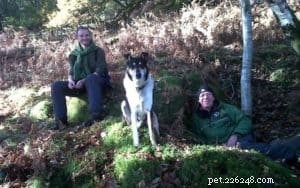
Chris: So sorry to hear that, mate. Some of my happiest times on the hill included Finn trying to “get through the snow” to me at toddy. Hope you’re as OK as you can be. Thoughts with you and Finn.
Kate: I’m sorry you’ve lost your friend. Finn was a lovely dog, so elegant and athletic.
Hannah: You’d revoke that comment if he’d pounced on you, right in the middle of your stomach! ♥️
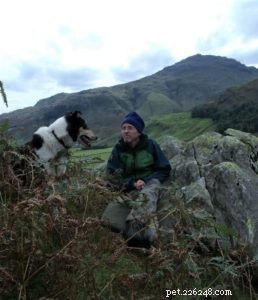
Elizabeth (Lizzie): I’m so so sorry!!! 😔😢😢 I still remember the day you brought him to base and said, “Come look what I’ve got.” Arlene wouldn’t have Jack now without him. Much love and thinking of you. People who have dogs get the heartbreak of losing a best friend. Take care.
Kirsty: Oh no, I’m so sorry. He was such a lovely, amazing boy and such a faithful companion for you.
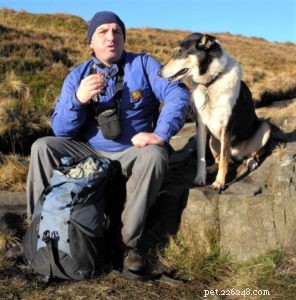
Christyne: Oh no, so so sorry to read that, Gruff 😥 He was such a lovely, big fella. It hits hard when you have such a close working relationship with them.
Sam: I was found by this beautiful, clever boy several times. Good boy, Finn, sleep well. 😥💔
Charlie: So, so sorry to hear your news. It’s every dog handler’s hardest decision ever. Take care.
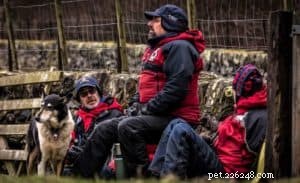
Peter: So sorry to hear this, Steve – hope you’re coping. I will personally miss the most laid-back, chill dog. He could lay out havin’ a kip (nap), when less than 2 feet above him all hell was breaking loose. 🙂
Stephen: He gave you ALL he could and in return you gave him a wonderful life. Together you achieved things some people and dogs can only dream about.
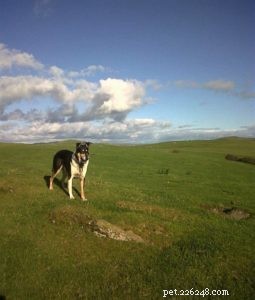
Alex: We have both been there before – not a good time. BUT search dogs have had a great life, playing hide and seek BIG TIME, playing on the hills. I feel your pain.
Duncan: Steve, I’m so sad to hear this. He was a great lad who had the best of lives with you. Will be fondly remembered by all those who bodied, trained with, or had the good fortune to meet him.
Bryan: So sorry, Steve. I know how much you cared for your dog.
Rod: Sad news indeed. However, Finn will not be forgotten – a bonny lad and a brilliant search dog. RIP Finn.
Laura: I have a real soft spot for Finn, who was the first dog that I got to see working when I started bodying for CVSRT. He was a great character, and I’m glad to have had the chance to know him.
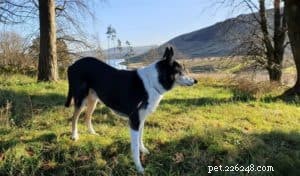
Andy: In the words of the Victorians, Finn was a “quality dog.” He served SARDA well and was a great RPMRT member! May he now run free, chase whatever he wants, and rest well. RPMRT are thinking of you and will see you on the hill, listening out! 😔🙏🏻🙏🏻🙏🏻🙏🏻
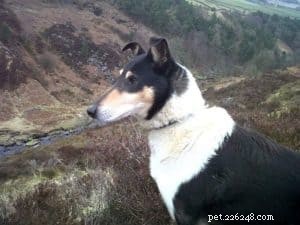
Other terms people used to describe Finn were: cracking pooch, top dog, certainly a class dog, such an ambassador for the breed, fine team member, such a gentleman, brave and wonderful Collie, superb dog, not just a pet but a partner, lovely chap, and a prince among dogs.
Wayne O. shared this memory:
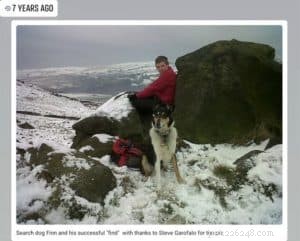
Pat Howarth, as Finn’s breeder, is justly proud of what Stephen and him accomplished together.
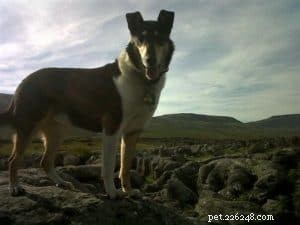
In honor of Finn, Mountain Rescue Search Dogs England posted:
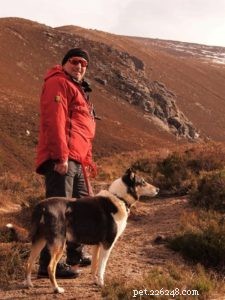
As far as dog relatives, Finn is survived by his litter brother, Jack, and by his great-grandson, Rolf, who is now Stephen’s search dog in training. Arlene said, “Rolf looks a handsome pup. I’m sure Rolf will be spending many hours up in the mountains.”
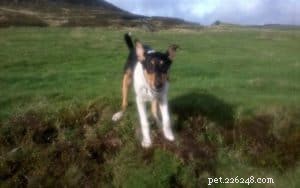
Jack: A Search Dog of A Different Sort
Arlene, Jack’s owner, volunteers with a local conservation group to help preserve the Eurasian Badgers, and Jack assists her.
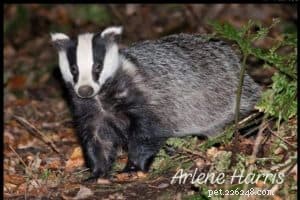
Jack recently had his 12th birthday and is still doing well. His grandmother, Tally, was adopted by Arlene when she was 8 years old and lived to the advanced dog age of 14. “He and Tally were polar opposites but both equally wonderful,” said Arlene. Before her Smooths, she had a Cavalier King Charles Spaniel for 14 years. There was also “Minnie Mouse,” and a “hand-tamed, wild, totally independent, very special blackbird” that flew to Arlene when she whistled for her. “Arlene is like Dr. Dolittle and has a way with animals,” Pat said. “I’d trust her with anything.”
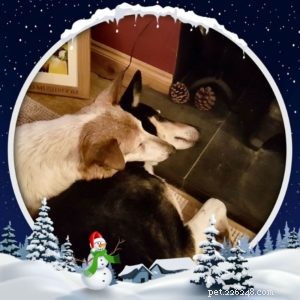
If you’d like to get to know these lovely humans and learn or share more about Smooth Collies, I recommend joining the Smooth Talk Facebook community that Stephen, Finn, and Pat are part of. Pat said, “Both boys, Jack and Finn, are very much ‘people dogs’ – just wonderful, normal Smooths actually.”
Rolf: A New Beginning
Pat has now donated 2 puppies to search and rescue work. Finn fathered 2 litters with her dogs, and she kept Dream, one of his blue merle granddaughters. Rolf, a son of Dream, is nearly a year old now. Pat said, “I hope Rolf is half the dog Finn was,” and added that he is “also a brilliant pup.” She expects him to do well in his training, as “Steve knows just what he’s doing with them.”
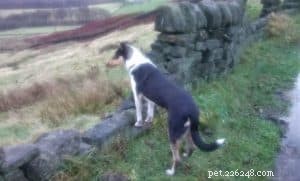
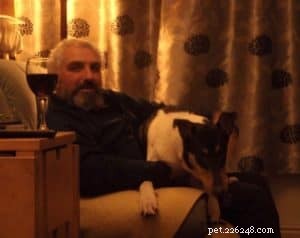
Stephen said Rolf seems to be much the same as Finn, but perhaps with a bit more drive. “I think Rolf will be my last search dog,” he said. As long as nothing goes wrong with Rolf, Stephen plans to be a SARDA handler for another decade or so, which will put him into his late sixties. By then, he will have devoted nearly half a century to the business of search and rescue work. When I asked him if he will always have Collies, he wisely said, “What dog I have next will depend upon what fits the life I have in ten years’ time.”
Rescuers Need Resources
If you want to help Stephen, Rolf, and teammates continue their great work, consider making a donation. Remember, everything goes back into emergency training and equipment, not wages, and they truly are life-savers. Even a small amount can help cover the cost of fuel to transport the rescuers to locations where they are needed – so they don’t have to dip further into their own pockets.
If you can’t contribute financially, please share this story (or pages I linked to throughout) with others who possibly can, or to simply raise awareness. Follow this link if you are interested in becoming one of the CVRST “dogsbodies” who volunteer their time to help train the search dogs and see them in action. You can also click here to find out more about Mountain Rescue Search Dogs England. To keep up with Rolf’s progress specifically (as well as other dog/handler teams), visit Calder Valley Search and Rescue Team’s Facebook page.
Further Reading
- In Search of the Missing: Working with Search and Rescue Dogs by Mick McCarthy and Patricia Ahern
- Ten Thousand MIles with a Dog Sled: A Narrative of Winter Travel in Interior Alaska by Archdeacon Hudson Stuck
- Search dogs in the United States of America
- Search dogs in Canada
- Search dogs in Australia
*All pictures and quotes attributed to Stephen Garofalo unless otherwise indicated.
- Pet Behavior
- Pet Breeds
- Pet Names
- Pet Adoption
- Pet Training
- Pet Information
- Pet Health
- Adorable Pets
- Dogs
- How to Train and Certify a Dog for Search and Rescue Operations
- Why Adopting a Rescue Dog Is a Rewarding Choice
- Pepsi the Collie: Celebrating a Beautiful Soul
- Tag the Smooth Collie: Spokesdog, Local Legend, and His Distinctive Merle Coat
- Key Factors to Evaluate Before Adopting a Border Collie
- Collies: From Sheep-Spotters to Cat-Rescue Heroes
- Prevent Dog Boredom & Chewing: 7 Proven Tips