

Understanding Tortoise Marbling: Causes, Symptoms, and When to Seek Care
 Happy Friday! I hope everyone is having an awesome week so far. This week I wanted to get away from writing about all the troubles we’ve been having with Kit lately (he’s doing really well, though) and put up a more educational type post. I think it’s been a little bit since I last wrote about my tortoises, Koopa and Zamboni. Back in March I shared some of the struggles we’ve been through with Zam, and I’m so happy to report that both Zam and Koopa have been doing really, really well.
The two torts are growing like little weeds. This is a picture I posted of Koopa from when we first got him…
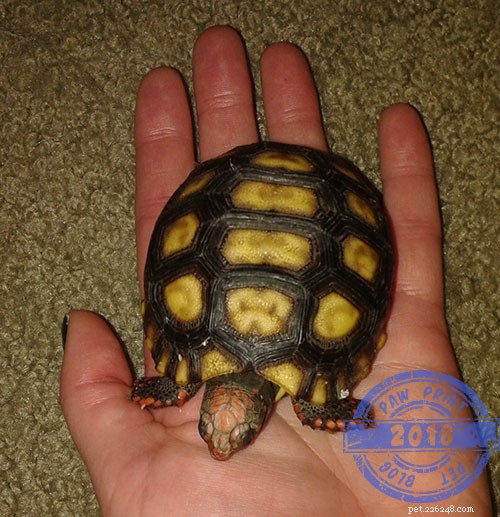
And this is a pic I took of him last week…
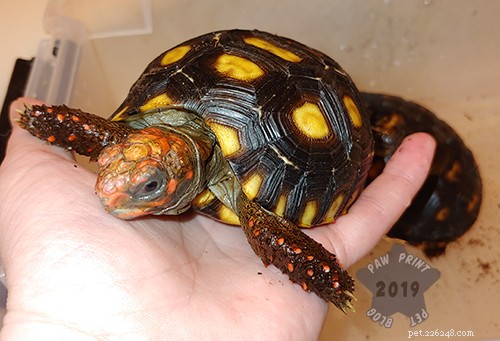
For reference, those yellow spots on his shell will always stay the same size. The reason they look so much smaller in the second picture is because they are surrounded by lots of new shell growth! Zam is growing really well too, despite having a rougher start to life, and is slowly but surely starting to catch up to Koopa.
Today I wanted to write a bit about tortoise shell marbling, sometimes also called mottling. I shared a new picture of Koopa recently and had a few people ask me why his shell appeared to have different coloration in some spots. They were curious whether this was something normal, or if Koopa had some kind of issue with his shell. In this picture you can probably see the coloration I’m referring too. You can see that while the color pattern on Zamboni’s shell looks the same as it always has (he’s just a bit bigger now), some of the new growth on Koopa’s shell is a lighter color.
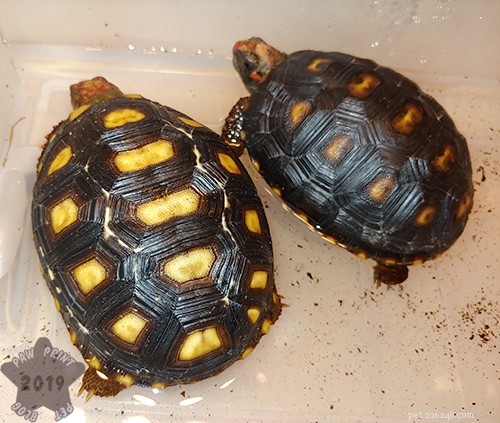
In the tortoise world, this change in coloration as a tortoise grows is commonly called marbling. Koopa and Zam are red foot tortoises, so I know the most and will write mostly about their species, but marbling can occur in other species of tortoises as well. When it comes to red foots, marbling is more commonly seen in Brazilian, or cherry heads, than it is in regular red foots.
By the way, cherry head red foots and regular red foots are actually the same species of tortoise! Cherry heads are a population of red foots that originally came from Brazil. They are generally a bit smaller, and more colorful than ‘regular’ red foots. However, they are the same species so their care is the same, and the two types of red foots can be bred together. The scientific name for red foot tortoises, whether they are cherry heads or not, is Geochelone carbonaria.
Shell marbling isn’t usually seen in hatching or very young tortoises, instead appearing over time as they grow. As new growth develops, you’ll start to see some of that growth appearing to be a different, lighter, color than the rest of the shell. In some species and/or individual tortoises, lighter growth can eventually darken to match the rest of the shell. In others it will always remain lighter, giving their shell a unique mottled appearance.
Marbling can usually be noticed first on a tortoise’s plastron (the bottom of their shell). Quite awhile before I noticed any distinct color change on Koopa’s carapace (the top shell) I started to notice the new growth of his plastron growing in lighter. This is what his plastron looks like as of last week…
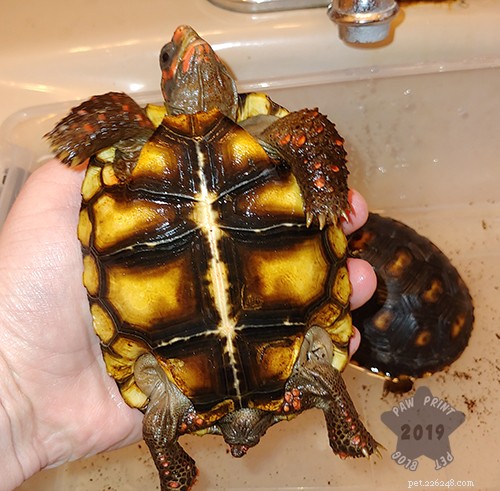
The interesting thing is that although Zam currently has no marbling on his carapace, he actually does have a bit on his plastron. I wonder if, in time, the top of Zam’s shell will start to marble as well.
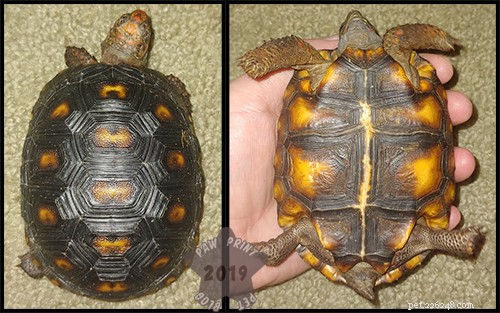 So marbling is part of the normal growth/coloration of some tortoises. Why exactly it occurs is not completely known. It does seem be be genetic, at least in red foot tortoises. In some other species, keepers have reported that marbling seems to be triggered by periods of illness or stress. The lighter coloration is essentially caused by either the loss, or turning off, of pigment cells in portions of the shell. In general, proper diet and lighting will enhance a tortoises natural coloration. Although it’s not currently thought to cause marbling, tortoises who receive a proper healthy diet and natural lighting often show more intense marbling, and coloration in general.
Why exactly some tortoises marble is still up for debate. One theory that makes a lot of sense to me is that marbling may help to enhance the natural camouflage of tortoises, especially those that live in forest undergrowth. The lighter splotches of coloration may help tortoises blend in better to an environment where splotches of light shine through the tree canopy. Red foot tortoises, one of the main species of tortoises known to marble, are found naturally in a wide variety of habitats – everything from dry savannas to humid tropical forests. Most often, they enjoy humid areas and can be found living near waters’ edge, and in the transitional habitats between forests and plains. Because they generally marble more, I’d be interested to learn whether Brazilian red foots in particular naturally prefer forested areas verses other habitat types. Perhaps this could, at least in part, account for the different levels of marbling in cherry head verses normal red foot tortoises.
Whatever the cause, depending on the species of tortoise, marbling is normal and should not be a cause for great concern. In fact, in red foot tortoises at least, keepers seem to prize marbled tortoises and they are often sold for much more than their normal colored counterparts. If you get your red foot tortoise as a hatchling, as I did mine, there’s no sure way to know whether your little one will marble or not. If possible, you can look to the parents for some indication, since marbling in red foots seems to be a genetic trait. However, the only sure fire way to know your hatchling tortoise will marble is when he/she starts marbling! Even then, marbling does oftentimes fade over time.
I’ll for sure keep you all updated on the progress of Koopa and Zamboni. I’m excited to continue to watch them grow and develop. I personally love that my little ones are starting to marble, as I like that the marble patterns are so unique to each tortoise. Of course, I would have loved them all the same either way though. I mean how could I not, just look at how adorable they are (this is Koopa again, but I promise Zam is just as cute!).
- Pet Behavior
- Pet Breeds
- Pet Names
- Pet Adoption
- Pet Training
- Pet Information
- Pet Health
- Adorable Pets
- Dogs
- Understanding Your New Puppy’s Heart Rate: What’s Normal and When to Seek Help
- Understanding Normal Liver Enzyme Levels in Dogs: A Guide for Pet Owners
- Understanding the Typical Dog Pregnancy Duration: Key Facts for Owners
- Understanding Your Dog’s Normal Body Temperature: Signs of Fever & How to Check
- Dog Body Temperature: Normal Range & How to Measure It Safely
- Dog Sleep 101: How Many Hours Is Normal for Puppies and Adults
- Understanding Your Dog’s Normal Heart Rate: A Practical Guide