

Why ‘No’ Isn’t the Problem – It’s How We Use It
I don’t expect this post to win any popularity contests, but it’s been on my mind.
Dog trainers spend a lot of time teaching owners alternatives to the endless "No!" when a dog misbehaves. Even experienced owners slip into the habit from time to time.
What many people call a "pitfall" of saying "No" is actually a training failure.
The Common Objection to “No”
In a recent discussion, a dog owner was scolding her dog with "No!" whenever it performed an unwanted behavior. Several commenters pointed out two facts:
- "No" is not a behavior.
- "No" doesn’t tell the dog what it should do.
Both statements are true, but they reveal a missing cue‑behavior link, not a magical property of the word itself.

Every verbal cue—"turn around", "sit", "lightbulb"—requires training before it conveys any meaning. A cue is simply a discriminative stimulus; the behavior it predicts is learned through positive reinforcement.
Positive‑reinforcement (R+) trainers often say two things that sound contradictory:
- Any word (or even a hand signal, a sound, a scent) can become a cue if it’s consistently paired with a behavior and a reward.
- "No" is not a behavior, but that’s irrelevant. Like "sit" or "down", "no" is a cue. It only works when it reliably signals that a reinforcement is available for a specific response.
Singling out "no" as uniquely meaningless is illogical.

The Real Problem with "No"
Most owners never train "no" as a cue. When the word fails to interrupt the dog, people tend to escalate—yelling louder, clapping, or even resorting to physical aversives. Consequently, "no" becomes associated with punishment rather than with a helpful, reinforced behavior.
Good trainers advise starting over with a dedicated cue (e.g., "leave‑it" or a custom interrupter) because it’s rare to say "no" in a calm, pleasant tone.
That said, it is possible. A friend of mine trained her service dog to respond to a softly spoken "no" as a leave‑it cue.
When I Yelled "No!"
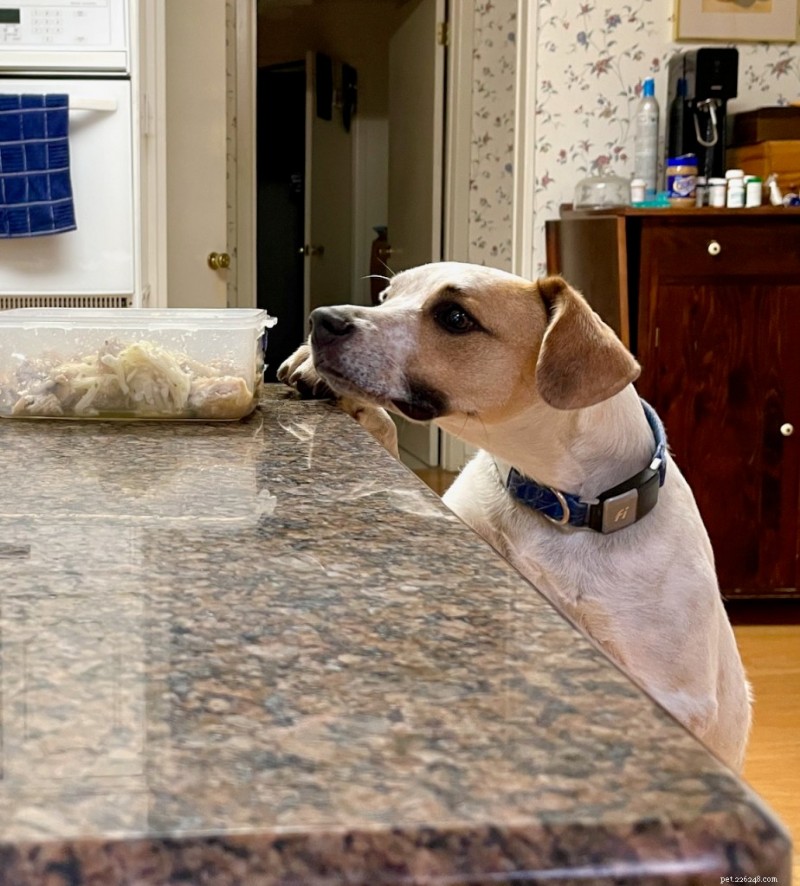
Ironically, I shouted "No!" the same day I started writing this article. I had left a warm chocolate dessert on the counter, and my dog Lewis was about to snatch it.
Even though I’d taught Lewis a leave‑it cue, panic made me yell "NO!" and clap my hands, hoping to startle him. He didn’t flinch; instead, he calmly slid down, approached me, and waited for a treat, which I gave him as I moved the dessert out of reach.
Lewis didn’t react to the word itself. He responded to the broader context I’d already trained: a cue that tells him to come to me and wait for a reward. Over time I’d conditioned several cues—"Pas" (leave it), "Excuse me" (four‑paw sit), and my name in a singsong tone—to predict good things. By generalization, the word "no" piggy‑backed on that existing training.
This experience shows that any word can become a functional cue if it’s consistently paired with a reliable outcome. The key is the training, not the word.
It’s More Than Semantics

I’m not advocating yelling "No!" as a training method. The problem is the habit of using an untrained, aversive word that offers no clear alternative behavior. When owners focus on the semantics—"no isn’t a behavior"—they risk reinforcing the mistaken belief that verbal commands automatically translate into actions.
Understanding cues as discriminative stimuli helps owners replace "no" with a positive‑reinforcement cue that actively shapes the desired behavior.
Related Posts
- Good Sit!
- Yelling at My Dogs
- Don’t Be Callous: How Punishment Can Go Wrong
Copyright 2022 Eileen Anderson
Discover more from eileenanddogs
Subscribe to get the latest posts sent to your email.
- Pet Behavior
- Pet Breeds
- Pet Names
- Pet Adoption
- Pet Training
- Pet Information
- Pet Health
- Adorable Pets
- Dogs
- Effective Antibiotics for Treating Dog Ear Infections
- Top Small Short‑Haired Dog Breeds for Apartment Living
- Optimal Nutrition for Dogs with Diabetes: A Comprehensive Feeding Guide
- Managing Hip Dysplasia in Dogs: Expert Care & Support for Your Pet
- Create a Dog‑Friendly Home: Expert Tips from First Fence Company
- 3 Simple Homemade Dog Treats to Boost Training Success
- Understanding Atadenovirus (ADV) in Bearded Dragons: Symptoms, Diagnosis, and Care