

Rare Frogs Breed in Captivity and Lost Species Rediscovered: Amphibian Conservation Milestone
 Frogs and frog enthusiasts have much to celebrate these days. The endangered Lake Titicaca Frog, Telmatobius culeus, has reproduced in captivity, and 6 Haitian frogs, lost to science for decades, have been found.
Lake Titicaca’s Aquatic Giant
The huge, skin-breathing, cold-adapted Lake Titicaca Frog ranks as one of the world’s strangest amphibians. Known only from this lake, which straddles the Peru-Bolivia border at 12,500 feet above sea level, the unique creature is threatened by the food trade and pollution.
I had the good fortune to work with what was, at the time, the only Lake Titicaca Frogs in captivity. Despite nearly 2 decades of trials, I and my co-workers failed to raise the few tadpoles that were produced (please see article below). However, Peru’s Huachipa Zoo, in association with the Denver Zoo, has announced that 5 apparently healthy tadpoles are now being reared. A museum in Bolivia has been successful in breeding a close relative, the equally-rare Water Frog, Telmatobius hintoni.
Holding on in Haiti
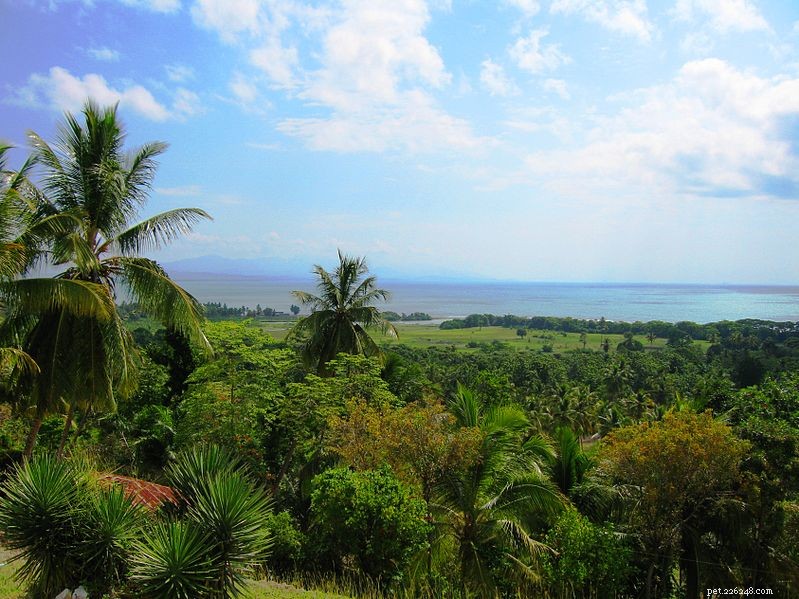
Biologists feared that Haiti’s devastating earthquake of 2010 had pushed a number of frogs to extinction, as most were already limited in range to Haiti’s remaining forests (a mere 2% of their original size, please see photo). One species in particular, the La Selle Grass Frog has not been seen in 25 years. This frog was the subject of a recent IUCN effort to find “lost species”, the Global Frog Search.
Researchers focused on the most likely habitat, the relatively untouched cloud forests of Haiti’s southwestern mountains (please see photo). Although the elusive Grass Frog remained unseen, they did uncover 23 of Haiti’s 48 amphibian species, 15 of which are found nowhere else on earth. Included among these were a few pleasant surprises – 6 rare frogs that had not been observed for decades. Some brief notes on each will illustrate the amazing diversity of Haiti’s amphibians, a staggering 92% of which are threatened with imminent extinction:
Mozart’s Frog: although not discovered by its namesake, this frog produces a call that, when illustrated on a spectrogram, resembles musical notes.
La Hotte Glanded Frog: striking blue eyes distinguish this frog from all others.
Hispaniolan Ventriloquial Frog: this frog seems able to “throw” its odd, rising/falling call.
Macaya Breast Spot Frog: one of the world’s smallest frogs.
Macaya Burrowing Frog: unique in laying eggs below ground; there is no tadpole stage.
Hispaniolan Crowned Frog: sporting a head ringed by bumps, this arboreal frog breeds in Bromeliads.
- Virginia Records 22 New Frog Discoveries
- Discover Texas' Top 10 Frog Species – A Biodiversity Spotlight
- Top 10 Maryland Frog Species & Images: A Field Guide
- Explore 8 Native Frog Species in Pennsylvania
- Michigan's 12 Native Frog Species – A Comprehensive Visual Guide
- Discover 24 Native Florida Frog Species – Complete Guide with Photos
- 2012's Newly Discovered Reptile & Amphibian Species—Snakes, Frogs, and Lizards