

Newly Discovered Permian Reptile 'Pampaphoneus biccari' Resembles a Komodo Dragon–Tiger Hybrid
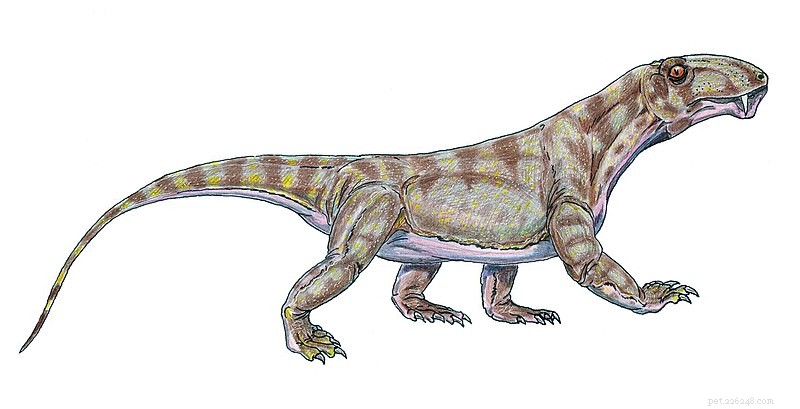 A farm in southern Brazil’s pampas region has yielded the bones of an ancient mammal-like reptile loosely described as a terrifying cross between a Komodo dragon and a tiger. Having worked with both of these modern-day predators, I was immediately intrigued by the newly-described creature (Proceedings of the National Academy of Sciences, Dec., 2011), dubbed the “Pampas Killer”.
A Reptile, but…
The Pampas Killer, or Pampaphoneus biccari, haunted Brazil’s grasslands during the Permian Period, some 260 million years ago. It has been classified as a Dinocephalian Theraspid, or “Mammal-like reptile”. Interestingly, today’s monitor lizards are also sometimes described as “mammal-like” by those familiar with them.
The Paleontologists (scientists who research ancient creatures and the history of life on earth) who are studying the Pampas Killer believe it possessed characteristics of both monitors and predatory mammals such as tigers – yikes! It and related dinosaurs may have been an early step in the evolutionary march towards warm-blooded, furred mammals, which appeared 35 million years later. Please see the drawings and articles below for artists’ re-creations of the Pampas Killer and its relatives.
Natural History of a Top Predator
As you can see from the photo of the Pampas Killer’s skull, it was a formidable predator, likely at the very top of the local food chain. Its four enormous canine teeth were hooked, and the body was thick-set and powerful… “like something out of science fiction”, as one paleontologist put it. Up to 10 feet long and weighing approximately 450-600 pounds, it was capable of preying upon Pareiasaurs and other large, heavily-armored creatures.
Scientists are especially excited by the new find because very few carnivorous dinosaurs have been uncovered in South America. Creatures similar to the Pampas Killer are also known from South Africa and Russia, so the new-found fossils may help us to understand an important, world-wide evolutionary trend.
Extinction Crisis, Then and Now
 The Pampas Killer lived during the Permian Period, a time that saw the world’s greatest number of extinctions. Today, amphibians, turtles and many other groups are disappearing at a rate that may, in time, rival even that. I’ve had the chance to work on several related conservation projects and rescue efforts, and was stunned by the scale of the population declines in some regions. You can read more about Asia’s massive turtle declines here.
- Introducing New Bearded Dragons: A Step‑by‑Step Guide for Stress‑Free Co‑habitation
- Understanding New World Tarantulas: Key Facts & Characteristics
- Can Tarantulas Be Cross‑Breeded? Insights & Community Concerns
- Finding a New Normal: Rebuilding Life and Well-Being After Uncertainty
- The Ultimate Reptile Care Checklist for New Owners
- New Dinosaur Species Mirrors Horned Lizard on a Massive Scale
- New Fossil Discovery Pushes Dinosaur Origins Back 10–15 Million Years