

How High Can Cats Jump? The Science Behind Their Impressive Leaps
Cats are celebrated for their remarkable athleticism—think of the way a feline can spring from a couch to the top of a refrigerator in a heartbeat.
In 2024, the Guinness World Records recognized Sputnik, a domestic cat, for the longest horizontal jump, leaping an astonishing 7 ft 6 in.
Such feats aren’t mere tricks; they reflect a biology honed for hunting and survival. One cat even survived a 32‑story fall in New York City, a testament to their remarkable resilience.
While many of these displays are vertical, let’s explore the science behind how high cats can leap.
How Do Cats Jump So High?
Dr. Christina Montalbano, a diplomate of the American College of Veterinary Sports Medicine & Rehabilitation, explains that a cat’s jump originates from powerful hind‑limb muscles, a flexible spine, exceptional balance, and precise spatial judgment. "When a cat crouches before a leap, its muscles and spine act like a spring, storing potential energy that is released with a rapid contraction," she notes.
Dr. Emily Swiniarski, medical director of the Anti‑Cruelty Society in Chicago, adds that climbing is instinctual. "Cats seek elevated positions to survey potential prey and predators, and high spots also provide a safe, comfortable retreat," she says.
How High Can a Cat Jump?

According to Dr. Swiniarski, an average domestic cat can leap roughly nine times its own height—about 3 to 4 feet for an average 4‑foot‑tall cat. Individual variation is significant, with factors such as age, breed, and health influencing the maximum height.
She recalls a shelter cat that astonishingly leapt straight up from the floor to balance atop a door, a maneuver that left her staff bewildered and prompted a review of the security footage.
How High Can Kittens Jump?
Kittens develop their jumping ability as they grow. Dr. Montalbano explains that young cats often test the limits of their strength and balance, experiencing several failed attempts before mastering the skill. "Providing ample opportunity for safe, repeated jumps during the first months is essential for building future agility," she stresses.
Other Factors That Impact a Cat’s Jumping Ability
Peak jumping performance typically occurs in young adult and middle‑aged cats. Dr. Swiniarski notes that arthritis, affecting up to 90 % of geriatric cats, can severely reduce a senior cat’s ability to leap. Medical conditions that compromise bone, joint, or muscle integrity—or neurological issues that impair balance—can also limit jumping. Certain breeds, such as the Munchkin with its naturally shortened limbs, inherently jump less far.
How Do Cats Always Land on Their Feet?
Cats possess a "righting reflex" that enables them to orient their bodies mid‑air. Dr. Swiniarski highlights two key elements: a unique inner‑ear vestibular system with three orthogonal semicircular canals that rapidly detect imbalance, and highly mobile shoulder joints that allow the front half of the body to pivot independently.
While most cats can right themselves, the ability depends on fall height and time available to rotate. Short drops may not allow enough time for a full twist, and extremely high falls can generate forces that exceed the animal’s structural limits, potentially causing injury.
Cats and Jumping: Helpful Tips for Around the Home
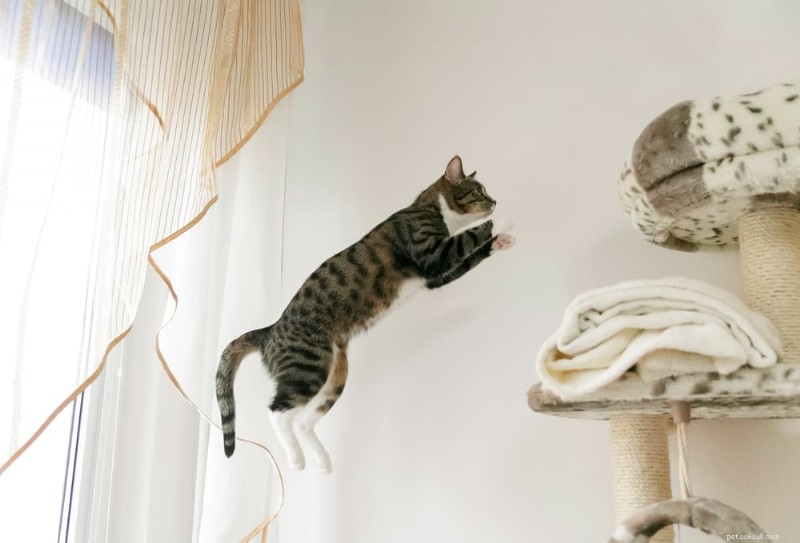
Because climbing and jumping are natural behaviors, owners should create safe, designated high‑perches—such as sturdy cat trees positioned by a window for visual stimulation or secure wall‑mounted shelves. Shelves should be evenly spaced, firmly anchored, and provide good traction (e.g., carpeted surfaces).
If installing purpose‑built furniture isn’t feasible, ensure that existing bookshelves and cabinets are securely fastened to the wall to prevent tipping when a cat lands or leaps. Both Dr. Swiniarski and Dr. Montalbano agree that preventing injury is best achieved by providing supervised, safe environments rather than attempting to curb instinctual behaviors.
- Pet Behavior
- Pet Breeds
- Pet Names
- Pet Adoption
- Pet Training
- Cat Stories
- Pet Health
- Adorable Pets
- Cats
- Capture Stunning Pet Photos: A Professional Guide
- 7 Must-Love Things Your Cat Will Adore
- Decoding Dog Body Language: What Your Canine Is Really Saying
- Create Stunning Cat Videos: A Step‑by‑Step Guide to Professional‑Quality, Share‑worthy Footage
- Is Coconut Safe and Beneficial for Dogs?
- Explore 7 Trending Designer Cat Breeds: Traits, Care, and Popularity
- When Will Your Chickens Begin Laying Eggs? 5 Key Signs to Spot