

Bengal Cat Breed: History, Personality, Health & Care Guide
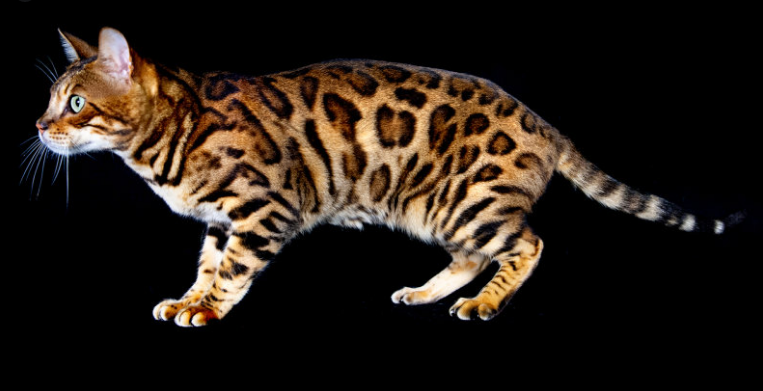
When I showed my friend a picture of my Bengal Cat, he decided he must adopt one. And you can’t blame him, the beauty of this cat breed is irresistible.
In this article, I provided every vital information on the Bengal Cat Breed. Whether it is your first time learning about this breed, or you are simply seeking more knowledge, you’re bound to fall in love.
As you read on, you will find its history, personality, health risks, and more.
Let’s paw in!
History and Background Of The Bengal Cat Breed
In the USA, the origin of the Bengal cat breed dates as far back as the 1960s when the first attempt to pair Asian leopard cats and domestic cats were made.
By the 1970s, Breeder Jean Mill (then Jean Sudgen) received a group of cats from Dr Willard Centerwall of Loyola University. He was trying to reproduce the immunity of Asian Leopards to feline leukaemia in domestic cats.
Ms Sudgen saw it as a good opportunity to produce the Asian leopard hybrids she had always wanted. She selected cats with the best spotting patterns and showed a propensity for domestic temperament.
And with that, she set to work, the resistance from the Cat Fanciers Association notwithstanding. It wasn’t easy though as the firstborn males were sterile.
Luckily by 1982, she found a perfect leopard-like cat that qualified for the spot. One trial after the other, and in the 4th generation, this fancy Bengal cat breed became a reality.
The Bengal Cat Breed was endorsed by the International Cat Association in 1991. From that time onwards, the breed has risen in popularity.
As a matter of fact, it has been among the top 3 on the list of most popular/registered cats since 2010.
However, taciturnity toward the breed remains in some circles. But it didn’t stop the Bengal cat from being a great breed as you will see later in the article.
Keep reading!
Appearance Of The Bengal Cat Breed
Without any doubt, the Bengal cat breed is one of the most good looking cat breeds in existence.
Beginning from its lush coat to its facial features and other parts of its body, the Bengal cat is quite irresistible. Little wonder why most homes have adopted this cat.
I briefly described the physical characteristics of this cat below. Have a look:
Size – medium to large, long & muscular
Length – 17 to 22 inches
Weight – 8 to 17 pounds
Head – wide head, broad muzzle, definite whisker pads, round & wide eyes with dark markings around them (like a mascara), heightened cheekbones, and small ears with rounded tips.
Limbs – back legs are slightly longer than the front legs
Gait – very agile, loves to climb and jump, can also move quietly and with stealth
Coat – Dense and soft having varieties of leopard-like spots
Colour – most common are black or brown spotted, and black or brown marbled, snow spotted (white), and snow marbled.
Impressively, this cost usually has gold or pearl sheen. It looks really great and this trait in the Bengal cat is called glittering.
Personality Of The Bengal Cat Breed
These cats are super friendly and show lots of affection. They are full of energy and love to play. It is not strange to find a Bengal cat climbing everywhere and playing with any item in his way.
Also, Bengal cats are popular for their vocal nature. They make sounds from cooing to chirping to graveling and shrill sounds.
These cats are very intelligent as well.
Life Span
The Bengal cat breed can live up to 10-16 years
Health Risks Associated With The Bengal Cat Breed
Under normal circumstances, Bengal cats are very healthy. Nevertheless, the breed has some associated diseases that you should know. They include:
- Distal neuropathy – this is a disorder of the nervous system that results in weakness. Affected cats usually recover on their own but some relapse. Bengal cats are susceptible to this disease as early as 1 year of age.
Studies show that neuropathy is a sign of prolonged hyperglycemia. So, you want to have your cat checked when you observe an unusual level of weakness.
Also, Methylcobalamin (a specific form of Vit. B12) can be used to manage the situation.
- Flat-chested kitten syndrome – from the name you can see that this disease is peculiar to young Bengals.
It is characterized by a collapsed rib cage or thorax. This condition is mild in some cats and severe in others.
The underside of the chest is flattened in mild cases. For the severe cases, the whole thorax is flattened, making the kitten appear like it was stepped on.
By adulthood though, some cats may not display signs of this disease anymore.
It can be managed by administering Dexamethasone and Amoxicillin.
- Hypertrophic cardiomyopathy (HCM) – this is a heart disease that is characterized by regional thickening of the walls of the ventricle.
Bengal cats with this condition experience difficult or fast breathing, open-mouth breathing, and dullness.
In some cases, there may be a blood clot in the heart. HCM is heritable.
Your vet will let you know the appropriate medication for your cat’s condition.
- Hip dysplasia – a degenerative disease of the hip joint that can lead to lameness in the long run.
Sadly, this condition is not usually detected early because Bengals hardly show that it is present.
However, as the cat ages, it becomes obvious with pain and stiffness while walking.
The condition can be corrected with surgery.
- Patellar luxation – this refers to a dislocation of the kneecap.
Affected cats will display intermittent lameness, skipping of the leg while walking/running, may not jump easily.
You may also notice that the lower part of the affected leg is always positioned to the side.
This condition is also hereditary and it can be treated with surgery.
- Progressive retinal atrophy – a degenerative eye disease that is caused by a defect in the cat’s genes.
Over time, the condition results in blindness. There is no cure for this condition but if discovered early, it can be managed to prevent spread to other cats.
Care For The Bengal Cat Breed
The above diseases notwithstanding, your cat will do great with proper care. Follow these tips to give your cat the best care:
1. Brush his coat
Your Bengal cat has a short, thick coat. You should comb it weekly to keep it clean and free of dead hair. It will also help distribute skin oils.
If you brush your cat weekly, he will rarely need a bath.
2. Brush his teeth
Secondly, you can care for your Bengal cat by brushing his teeth regularly.
This is a good way to prevent periodontal disease. It is recommended that you brush his teeth daily but when you can’t afford to do that, endeavour to brush the teeth at least once a week.
3. Trim his nails
You don’t have to wait till you hear those nails hitting on the floor. Trim your pet’s nails once every 2 weeks.
When his nails are well-trimmed, the chances of infection through that spot are reduced. Also, he will not injure himself as he scratches.
4. Clean his eyes
Earlier, we saw an eye disease associated with the Bengal Cat Breed. So, you need to care for your pet’s eyes too.
As often as you can, use a soft, damp cloth to clean the corners of his eyes. Use different cloths for each eye.
This will remove any dirty discharge and also prevent the spread of eye infections.
5. His ears need care too
For efficient cleaning of your cat’s ears, mix cider vinegar and water in equal amounts. Then wet a soft cloth in the mixture and wipe his ears with it.
Alternatively, you can use a cotton ball but do not use cotton swabs, which can damage the interior of his ears.
You should check your Bengal’s cat ears weekly to know when they are dirty, and clean them.
6. Don’t forget his litter box
In addition to helping your cat maintain proper hygiene, keeping his litter box clean always will prevent him from using other parts of the house as a bathroom.
It will also prevent some infections.
7. He is safer indoors
Leaving your Bengal cat outside your home without supervision exposes him to danger. Catfights, dog fights, contagious feline diseases, coyote’s attack, or being hit by a vehicle are negative possibilities of leaving your pet outside.
You can construct an outdoor enclosure for your cat. Then he gets to play to his satisfaction. The fear of your beautiful cat being stolen is curbed. Also, local birds will not be hurt by your pet.
8. Feed him right
Your cat needs adequate nutrients from food to maintain optimal health. Do well to feed him a good blend of wet and dry cat food, in the right quantities, and in time.
Follow the feeding directions on the food packages. Put into consideration your cat’s age and activity level. You can also ask your vet for more ideas.
9. The vet is his friend
If disease causes are discovered early, they can be managed at their early stages.
The old saying, ‘prevention is better than cure’ comes to play here. You shouldn’t take your cat to the vet only when there is a huge problem, rather send him for regular vaccinations, parasite control, and annual health checks.
This will help him stay at his best always.
10. Get him toys
Your Bengal is a very active dog and you want to leave things that way. So, get him lots of cat toys that he can play with.
Take Away – 10 Facts About The Bengal Cat Breed You Should Remember!
- Bengal cat breed is the product of a cross between a wild Asian leopard cat and a domestic cat.
- The Bengal cat became domesticated from the 4th generation.
- Snow Bengal came to be when domestic cats having recessive colourpoint genes crossed with Bengals.
- Bengal is brilliant and has an excellent memory. They are good at mastering instructions and tricks.
- They are exceptional hunters.
- This breed is madly in love with water.
- The Bengal cat is very sensitive to his owner’s moods.
- Bengal cats are very vocal, producing random meows at different times like a wild animal.
- The coat of the Bengal sparkles in the sun because of the glitter in its fur.
- It is quite expensive to own a Bengal.
Conclusion
Indeed the Bengal cat is adorable in appearance and very active as well. When properly trained, he will be a great playmate for your kids.
He’s still a hunter though, don’t leave your hamsters, smaller rabbits, and guinea pigs at his mercy.
READ ALSO: How To Train A Cat – Why & Where You Get It Wrong In Training Your Cat
All the same, the Bengal cat breed makes for a great family pet with its playful and affectionate nature. Don’t miss the opportunity to have one.
Have any thoughts on the Bengal cat breed that you will love to share? Please do so in the comments section. I’d love to hear from you.
Do you know what else will be great? If you shared this post with friends.
- Pet Behavior
- Pet Breeds
- Pet Names
- Pet Adoption
- Pet Training
- Cat Stories
- Pet Health
- Adorable Pets
- Cats
- Havana Brown Cats: Breed Facts, Care & Personality Guide
- Rottweiler Breed Guide: Personality, Health, and Care Essentials
- Ragdoll Cats: A Comprehensive Guide to Their History, Traits, and Care
- Australian Mist Cat: Elegant, Easy‑going Companion – Breed Profile & Care Tips
- Bengal Cat: Complete Breed Profile & Expert Guide
- Turkish Vankedisi Cat Breed Profile: Traits, Temperament & Care
- Himalayan Cat: Breed Profile, Temperament & Care