

Cleft Palate in Cats: Causes, Symptoms, and Effective Treatments
A cleft palate is a potentially serious medical condition in young cats and kittens. Understanding how to recognize it as early as possible is crucial to a successful outcome. In this article, you’ll learn what causes cleft palates, what to look for, and how they’re treated.
Quick Overview: Cleft Palate in Cats
Other Names: Orofacial cleft; congenital cleft palate; primary cleft (lip/nose); secondary cleft (hard and/or soft palate)
Common Symptoms: Trouble nursing or latching, milk or food coming from the nose, coughing while eating or drinking, nasal discharge, poor weight gain, failure to thrive; visible split in the lip, nose, or roof of the mouth in some cases
Requires Ongoing Medication: No (but requires intensive supportive care until surgery; medications like antibiotics may be needed if complications such as pneumonia occur)
Vaccine Available: No
 Treatment Options: Surgical repair is the only definitive treatment and cure. Surgery is typically performed at ~3–4 months of age when the kitten can safely undergo anesthesia. Hard palate defects require tissue flap techniques; soft palate defects are sutured directly. Nose and lip defects can also be surgically corrected. Board-certified surgeons or veterinary dental specialists are often involved.
 Home Treatment: No curative home treatment. Intensive supportive care is critical until surgery, often including tube feeding to prevent aspiration, strict monitoring for pneumonia, maintaining body warmth, and careful feeding transitions. Kittens that cannot nurse must be tube fed multiple times daily. If this level of care isn’t possible, early transfer to a rescue or foster experienced with cleft palate care is strongly recommended.
What is a Cleft Palate?
As the word “cleft” suggests, a cleft palate involves a separation in the tissues of the roof of the mouth.This may include the hard palate (the front part of the roof of the mouth), the soft palate (back part) or may include both. These are called secondary clefts. Primary clefts affect the nose and lips.
Causes of Cleft Palate
In an overwhelming majority of cases, cleft palates occur during the development of a kitten while a fetus. You can think of the middle of the nose, lip, and roof of the mouth as a kind of seam. Sometimes during fetal development, the two sides of the seam don’t quite meet and join, causing an opening that remains at birth.
In some cats, especially purebred cats, this issue may be an inherited, or congenital, condition caused by genes passed down from parent to offspring. Sometimes, trauma during pregnancy may also result in a cleft defect.
There are some other less common causes affecting the mother which may result in a cleft palate for the kitten including:
- Too little folic acid
- Too much vitamin A
- Medications (steroids, anticonvulsants)
- Viral or bacterial infections
Symptoms of Cleft Palate
A primary cleft palate affecting the nose and/or lips can easily be seen. Appearances can vary from an asymmetry to the nose or lips appearing to be uneven to part of the lip or nose appearing to be missing entirely.
Secondary cleft palates affecting the roof of the mouth are more challenging as they may be easily missed unless looked for directly. Defects may also sometimes be small and hard to see.
Larger cleft palate defects often communicate with the nasal cavity, allowing anything swallowed to essentially end up in the nose.
In newborn or nursing kittens, signs of a cleft palate may include nasal discharge or signs of coughing when nursing, eating, or drinking. If this is seen in only one kitten but not others in the litter, it should prompt a close look in the mouth.
Some smaller secondary cleft palates are harder to see and identify. These kittens may not have as severe signs. Coughing and nasal discharge may be rare. Instead, the cleft palate may not be suspected until later due to a kitten not gaining weight properly compared to their littermates.
Complications of Having Cleft Palate
Unfortunately, a lot of serious complications can result from a kitten having a cleft palate.
The abnormalities of the face and/or mouth often affect the kitten’s ability to suckle and nurse properly. These kittens can fail to thrive and grow very weak very quickly.
In kittens that do attach and nurse, milk will end up in the nasal passage, which in turn can end up in the lungs instead of being swallowed properly. These kittens will often develop pneumonia. Treating these kittens is extremely difficult. The combination of trying to medicate with antibiotics and provide adequate nutrition poses great challenges for caretakers.
While a cleft palate in a young kitten is treatable, many newborn kittens develop complications early, especially with large defects, and may often die from them before the problem is identified and meaningful intervention can be made.
Defects of the nose and lips where there is no defect of the palate typically have fewer consequences. The defects in these areas are often more of looks and aesthetics instead of function.
Diagnosis of Cleft Palate
A cleft palate is always diagnosed by directly visualizing the defect. With primary cleft palates affecting the nose and lips, identification is fairly simple.
For secondary cleft palates, a thorough exam of the roof of the mouth is needed. Defects in the hard palate, especially large ones, are not hard to identify. Smaller defects in the back of the mouth affecting the soft palate, may require a veterinarian to identify them.
Cleft palates in very young animals can usually be diagnosed without the need for sedation. Given the very young age of these patients, sedation is avoided if possible.
Treatments for Cleft Palate
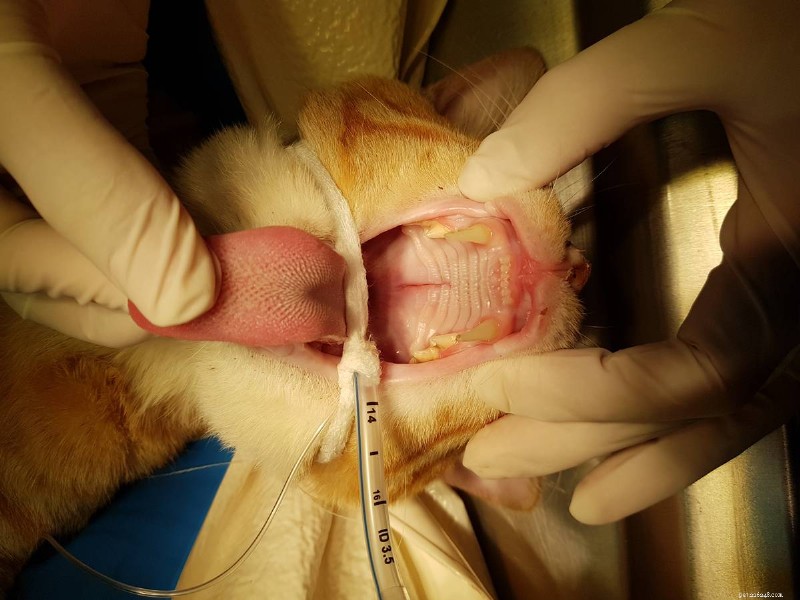
This is an acquired cleft palate in a cat resulting from a hard palate fracture after a fall. Most cleft palates occur prior to birth, but can appear similarly. Many resulting from a birth defect may appear wider. docjavetTH / Shutterstock.com
Instead of there being multiple treatment options for cleft palates, it’s more important to think of treatment in phases. Surgery is always the treatment of choice for cleft palates and the only choice for serious defects for a cat to have a healthy life. But surgery often cannot be pursued immediately. Because cleft palates occur in newborn kittens who are not yet candidates for surgery, special medical and home care is almost always necessary to maintain a kitten’s health as best as possible until they are at a safe and appropriate age to have the defect(s) surgically repaired.
Surgery
This is the definitive treatment and cure for a cleft palate. For the hard palate, a surgical technique called an overlapping tissue flap is used. Essentially, soft tissue on both sides of the opening is loosened up and away from the bone of the roof of the mouth. The tissue on one side is then tucked under the tissue on the other side and sutured down.
With this technique, continuous tissue is used to cover the defect. This reduces the risk of an opening reforming in the soft tissue where the opening in the bone still resides. The defect in the bone itself cannot be repaired, but the very sturdy tissue of the hard palate is enough.
A defect in the soft palate is a little easier, as the two edges can just be sutured together. The soft palate is not attached to any bone.
Defects of the nose and lips can be repaired surgically as well. Care is taken to not only ensure a sturdy closure, but to make sure the result is also aesthetically pleasing, which is usually a chief goal when repairing these more visible defects.
While some general practitioners may have experience with these surgeries, many cleft palates are repaired by board certified surgeons or dental specialists. Surgeons may repair more of the primary cleft palates of the nose and lips, while dental specialists take care of the hard and soft palate defects.
Medical Care
Cleft palates of the soft and hard palate but especially larger defects of the hard palate, cannot be medically managed successfully in place of surgery.
Instead, medical care is used to keep a kitten as healthy as possible until they are a surgical candidate to repair the defect.
Medical care for cleft palates is intensive and difficult but doable for a dedicated caretaker.
Newborn kittens who cannot nurse properly or who are at a high risk for inhaling or aspirating milk and developing pneumonia must be tube fed. This involves passing a small, soft rubber feeding tube into the esophagus or stomach of the kitten and infusing the right volume of milk with each feeding.
For a newborn kitten, this has to happen several times a day (and at night) for the first couple of weeks. Tube feeding requires training from someone experienced like a vet, vet tech, or someone otherwise experienced in animal rehabilitation.
Constant care and monitoring is essential because the risk of choking, aspiration, and pneumonia is very high.
Challenges and pitfalls with tube feeding include:
- Infusing too much volume of milk or milk replacer
- Inserting the feeding tube into the trachea (airway) instead of the esophagus
- Not taking care to close off the tube while removing it, risking fluid into the airway
Medical care needs to be continued until at least 3-4 months of age, a time where a kitten’s body can handle anesthesia and there is a reduced risk of further body growth affecting the surgical closure as the kitten grows bigger.
Continuing tube feeding and close monitoring for this length of time can be exhausting. Kittens may be transitioned normally to a “gruel” or soft food mixed with milk or milk replacer around 6-8 weeks of age. However, you have to be careful as this type of mixture can be easily aspirated by a kitten with a cleft palate.
Soft “meatball” morsels of pate type wet food may be used instead, but very close monitoring is still needed.
Considering Quality of Life
Kittens with cleft palates should never be euthanized prematurely. Surgical techniques to repair these defects have become better described in the last 20-30 years. If they can be nursed successfully to 3-4 months of age, many cats can have a great quality of life after surgery.
However, there are unfortunately situations where euthanasia of a newborn kitten, while heartbreaking, may be best. Kittens who have already developed complications, like pneumonia or malnutrition, can be very hard to treat successfully. Some kittens with cleft palates are only presented to a veterinarian because these complications have already developed and a cleft palate was not yet known about.
Kittens incapable of nursing must be tube fed. If this cannot be pursued, complications will always develop, causing significant quality of life issues. If you know from the start that you cannot keep up with the intense care needed to maintain a good quality of life until surgery, a kitten needs to be given to a rescue or individual capable of providing the right care.
Cat Care Tips
Here are some tips for identifying a cleft palate:
- If you have a newborn kitten that has trouble latching on or doesn’t appear to suckle well, closely inspect the oral cavity for signs of a cleft palate.
- Any newborn kitten with signs of nasal discharge (especially resembling milk), coughing, or trouble breathing should be checked for a cleft palate.
- Cleft palates rarely affect more than one kitten in a litter. Any kitten that seems off in terms of nursing or thriving should be examined by a veterinarian. If possible, a vet that makes housecalls can be better to avoid disrupting the litter and risking rejection of any of the kittens by the queen.
- If you need to bring a newborn kitten to the vet, make sure to keep them very warm, as they are unable to regulate their own body temperature until 3-4 weeks of age.
- If moving the kitten for a vet exam is not possible or too risky, take a photo of the kitten’s oral cavity and send it to your vet if you think you may see a cleft palate.
- Cleft palates never close on their own over time. If surgically repairing a cleft palate is not possible or affordable for you, it’s best to relinquish the kitten as soon as possible to a rescue group with a foster experienced in these situations.
Tips for Managing a Kitten with a Cleft Palate
- Ensure you and other family members are committed to providing intense care for the kitten for at least 4-5 months.
- If you don’t have experience with tube feeding, learn from someone experienced in the process. Contact your veterinarian, local rescue groups, or your local shelter for resources.
- The volume of milk needed for tube feeding must not exceed the stomach’s capacity.
- Always verify you are in the stomach before infusing any milk or other nutrients.
- When removing, always pinch the tube to prevent any contents from leaking out.
- For a short but detailed summary on tube feeding kittens, see the Humane Society of the Huron Valley’s document on Tube Feeding Kittens
- Kittens who are tube fed may or may not remain with their litter. It is possible the queen may reject the kitten, requiring you to provide additional care (warming, stimulation to urinate/defecate, etc.)
Prevention of Cleft Palate
There is no guaranteed way to prevent cleft palates in kittens because these defects typically occur during fetal development.
However, at least in purebred cats, breeding programs can help reduce the likelihood. Any kitten with a cleft palate (or other congenital defect) should never be used in a breeding program.
If you have a pregnant queen, always make sure to check with your veterinarian before you give her any medications or supplements. It’s also very important to ensure your queen is eating a balanced and appropriate diet for pregnant cats. Some medications, supplements, or dietary choices may contribute to congenital defects.
-
Hoyer, N. (2025, January 29). What is Cleft Palate in Dogs and Cats? Colorado State University.
-
Brister, J. (2019, October 23). Cleft Palate or Lip in Puppies and Kittens. Veterinary Partner.
-
ACVS. (n.d.). Cleft Palate. American College of Veterinary Surgeons (ACVS).
-
Walker, K. (n.d.). Cleft Palates in Pets: Understanding a Treating a Birth Defect. MedVet. Retrieved January 16, 2026, from
-
Garnier, P., Viateau, V., Manassero, M., & Maurice, E. (2022). Surgically treated congenital cleft palate in a 4-month-old kitten: medium-term clinical and CT assessment. Journal of Feline Medicine and Surgery Open Reports, 8(1), 20551169221082556. https://doi.org/10.1177/20551169221082556
-
Humane Society of Huron Valley. (2021). Foster cats: Tube feeding kittens [PDF]. Humane Society of Huron Valley.
- Pet Behavior
- Pet Breeds
- Pet Names
- Pet Adoption
- Pet Training
- Cat Stories
- Pet Health
- Adorable Pets
- Cats
- Build Your Own Hedgehog Carrier: 2 Simple, Safe DIY Plans
- Rottweiler Puppy Training Guide: Building a Loyal, Well‑Behaved Companion
- Understanding Cat and Dog Allergies: Causes, Symptoms, and Treatment Options
- Luna the Ragdoll Cat: Girlish Meows and Cartoon‑Like Charm Take TikTok Viral
- Safely Managing Corticosteroid Use in Dogs: A Veterinary Guide
- How to Safely Keep Dogs Out of Flower Beds: Expert Tips & Tricks
- 20 Easy & Healthy Frozen Dog Treats to Keep Your Pup Cool