

Inside the UT Veterinary School: Key Takeaways from the PetSafe Summit
One of the best parts of the PetSafe summit was our afternoon at the UT vet school. There were three BIG take-aways for me that I want to share here.
A quick note: While there were animals all over the place, we weren’t allowed to share pictures. Our guide explained their policies as “HIPAA for animals” so I took what I could. You’ll just have to imagine the animals that were there. (Including a TIGER! Having SURGERY! Which I SAW!!! I have the pics on my phone if our paths ever cross…)
Take-away one: We need a better understanding of the root cause of animal behavior. That means scientific inquiry, rather than just theory.
At veterinary schools around the country, behavior is diminished in importance compared to other specialties. The reason? According to Dr. Julie Albright, the PetSafe Chair in Small Animal Behavioral Research, it just doesn’t bring in the money that other areas – like oncology – do. At UT, PetSafe pays for a board-certified veterinary behaviorist to hold a post at the school where she sees patients, consults on behavior issues, and conducts research. This is huge since there are so few veterinary behaviorists around the country, and PetSafe is ensuring UT keeps one in their school. We spent some time chatting with her and learned, not surprisingly, that her most common dog cases are aggression (cats are inappropriate elimination). But she made the fascinating point that there still isn’t a genuine understanding of the causes of aggressive behavior – there’s a lot of theory, but the data isn’t there. Her research is looking at play behavior among puppies, mapping the differences between breeds and changes in play as the puppies develop.
Take-away two: The care available to our animals is far more sophisticated than I ever imagined.
And it’s such an uplifting demonstration of the compassion and love we have for the animals in our lives. I was amazed at the resources they have, like physical rehabilitation and sports medicine to stem cell therapy and emergency care. They have two hyperbaric chambers – one for small animals, which was even used on a guinea pig who had smoke inhalation, and one for horses/large animals. Here’s the small animal one:
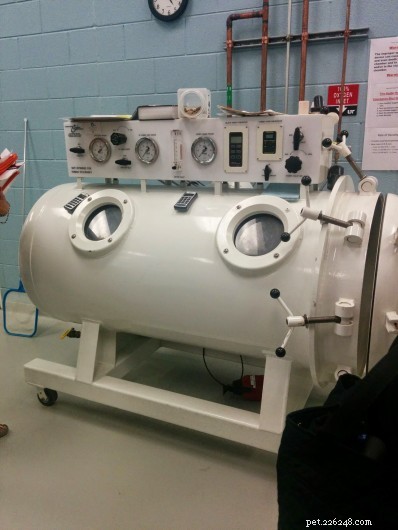
They’re able to treat avian and exotic animals all the way up to that tiger mentioned above. The Equine Performance and Rehabilitation Center was unlike anything I’d ever seen before. There was an underwater treadmill designed exclusively for horses.

State-of-the-art equipment and procedures are available for every type of animal you can think of. The entire place blew me away, and it made me feel all warm and fuzzy thinking about all the attention and care our beloved animals are receiving. They literally have the benefit of every type of treatment under the sun. (Like, the CT machine there was IDENTICAL to the one at my oncologist’s office!)
Take-away three: Veterinary social work is an important emerging field. We need more of it.
There aren’t a lot of these programs. Yet. But they play such a critical and often overlooked role in veterinary medicine: caring for the people. We happened to be at UT shortly after Dr. Sophia Yin’s tragic suicide, and there was a somber mood as they spoke to us about this program. But there was a light, too. These social workers are specializing in the veterinary field so that they’re able to support vets. At UT, they’re offering courses on wellness and self-care, suicide prevention, and more for the veterinarians. But they also support the patients. They help upset or confused clients communicate with the medical stuff. They arrange community resources and pet loss support groups. In the hospital, they provide emotional support to patients who have to make difficult decisions and are available to be present during euthanasia. They provide grief counseling. And so much more. Can you even dream of a better service to be offered in a veterinary hospital? And it makes so much sense, right? We have those services in human hospitals across the country. This, to me, is a natural and much needed extension of that, and I can only hope that this field grows rapidly! So much warm-fuzzy here, too!
Overall, it was an amazing visit. I learned so much, and I was inspired to see how perfectly the school combines compassionate care with technology.
(Oh, incidentally: We heard a presentation from a veterinary nutritionist. I think Cooper needs one of those. I’m going to see if we can get some sort of referral at his next appointment…)
- Pet Behavior
- Pet Breeds
- Pet Names
- Pet Adoption
- Pet Training
- Pet Information
- Pet Health
- Adorable Pets
- Dogs
- Do Dogs Perceive Vet Visits? Understanding Their Experience
- 10 Common Reasons Cats Visit the Vet: What You Should Know
- My First Interferon Week: A Glimpse into the Pet Therapy Experience
- Caring for a Shepherd Mix Who Ate Pin Cushion Pins: My Emergency Vet Visit
- Helping a Rescue Dane Overcome Vet Anxiety
- 3 Simple Steps to a Stress‑Free Vet Visit for Your Dog & You
- Why Dogs Go to the Vet: Top 10 Causes Revealed (Infographic)