

How Long Should a Dog Leash Be? Expert Guide to Choosing the Right Length
This post may contain affiliate links. We may earn money or products from the companies mentioned.
When selecting a leash, the most important considerations are the environment, activity, your dog’s temperament, and its size. 4‑foot versus 6‑foot, retractable or fixed—each option has a purpose.
Quick tip from a seasoned dog walker: I use a 4‑foot nylon leash for guide‑dog puppies when they’re 8 weeks old because it keeps them close while they learn basic commands.

Below you’ll find a clear framework for picking the ideal leash length for any situation.
Different Lengths of Dog Leashes
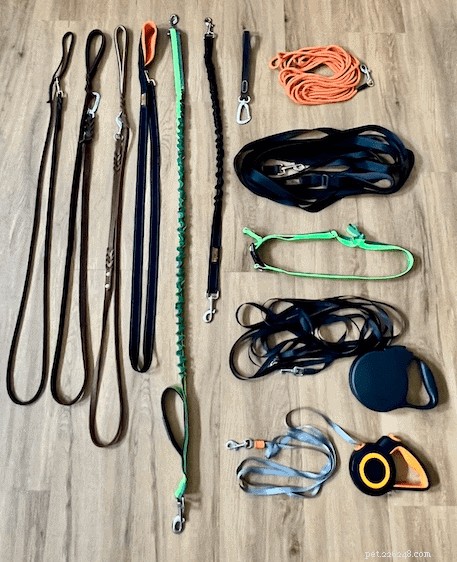
- 10–12" leash tabs
- 3–10 ft static leashes
- Long leashes >10 ft
- Retractable leashes up to 30 ft
- Extra‑long leashes >30 ft
- Super‑long leashes 50–100 ft
Leashes also come in static, bungee, retractable, and handle‑free styles, and in materials such as nylon, rope, leather, biothane, cable, and chain. Each combination is designed for a specific use.
Standard Dog Leash Length
The industry standard is a 6‑ft leash, which most trainers recommend for obedience classes. 6‑ft leather leashes are favored for their durability, though nylon leashes are lighter and more affordable.

While material choice is personal, the 6‑ft length provides the right balance between control and freedom for everyday walks.
Best Leash Length for Recall Training
Recall is the most challenging obedience command because you must compete with every distraction. A long leash—starting at 10 ft and extending to 30 ft—allows you to gently tug and redirect while giving your dog space.
As recall improves, you can let the leash drag on the ground or release it to give your dog a bit of freedom, then re‑engage when needed.
Tracking, Scent Work, and Gundog Leashes
These disciplines use check cords that can be 50–100 ft long. They are typically handle‑free to avoid snagging on vegetation. Attach them to a harness rather than a collar to protect the dog’s neck.
Long lines are also useful for supervising dogs in water or during post‑surgery recovery, keeping them close while allowing some independence.
Leash Length for Walking in Urban Areas
In crowded downtown streets, a 3–4 ft leash gives you quick control over reactive dogs, while a 5–6 ft leash works well for friendly dogs. A built‑in traffic handle on the far end of a 6‑ft leash lets you keep the dog close when you need to regain control.
In rural settings with open space, a 6–10 ft leash or a retractable leash is acceptable, provided local leash laws allow it and you can maintain clear sightlines to oncoming traffic.
Leash Length for Puppies
For 8–12 week‑old puppies and small breeds, a 4‑ft nylon leash is ideal. It limits distance while encouraging proper leash etiquette. As puppies mature, switch to a 6‑ft leash to give them room to explore safely.

For toy breeds, choose a lighter leash; for larger breeds, a thicker leash provides better control. If your puppy still bites leashes, a bite‑proof cable leash is a practical alternative.
Leash for Dogs That Pull
Dual‑handle leashes (6 ft) combined with a martingale collar, head collar, no‑pull harness, and a weighted backpack give you maximum control and reduce pulling by redirecting your dog’s body and head.
Leash Length for Hiking
Hiking leashes depend on terrain and local regulations. A 6–10 ft leash works for most trails; avoid long leashes on narrow, brush‑dense paths. In wide open spaces with good visibility, a longer leash may be permissible, but always check local leash laws.
Hands‑free systems—belt attachment with leash clips—are excellent for long hikes, keeping your hands free while still maintaining control. Many come with a 4‑ft bungee attachment that extends to 6 ft.
Leash for Vet Visits and Pet‑Friendly Stores
Keep the leash as short as possible—ideally 3–4 ft or a leash tab—to protect other animals and give you better control in confined spaces.
Bottom Line
While the 6‑ft leash is the standard, the right length varies by setting, dog temperament, skill level, and local laws. Shorter leashes or tabs excel in busy or confined areas; longer leashes are best for open spaces, recall training, and specific dog sports.
What leash length do you prefer? Share your experience in the comments below!
Top Picks for Our Puppies
- Best Dog Chew
We love Beef Collagen Sticks—great for redirecting chewing behavior. - Best Puppy Toy
Calmeros Puppy Toy with heartbeat and heat packs helps soothe new puppies. - Best Dog Treats
Crazy Dog Train‑Me Treats serve as high‑value rewards during guide‑dog training. - Best Fresh Dog Food
The Farmer’s Dog offers premium fresh meals—save 50% on your first order.
Explore more favorites on our New Puppy Checklist.
Barbara Rivers
Barbara is a trilingual dog lover, e‑book author, founder, copywriter, dog nutrition blogger, and editor at K9sOverCoffee.
- Pet Behavior
- Pet Breeds
- Pet Names
- Pet Adoption
- Pet Training
- Pet Information
- Pet Health
- Adorable Pets
- Dogs
- Do Humidifiers Benefit Pets? A Guide to Healthier Indoor Air
- The Ultimate Guide to Caring for Pet Budgie Birds
- How to Set Up a Reptile Terrarium: A Complete Guide
- Is CBD Oil Safe for Pocket Pets? Vet-Approved Insights
- The Sunbeam Snake: Southeast Asia’s Iridescent Rarity Revealed
- Caring for Your Pet Lionhead Rabbit: A Comprehensive Guide
- The Ultimate Kitten Care Guide: Feeding, Vet Visits & Long-Term Wellness