

The New Caledonia Giant Gecko: Behavior, Care, and Conservation Insights
Herp enthusiasts are not the only folks in awe of Rhacodactylus leachianus, largest of the world’s geckos. Local people refer to it as the “Devil in the Forest” because, uniquely among its relatives, it can produce loud, growling sounds. Today we’ll review what little is known about its life in the wild, and touch on captive care.
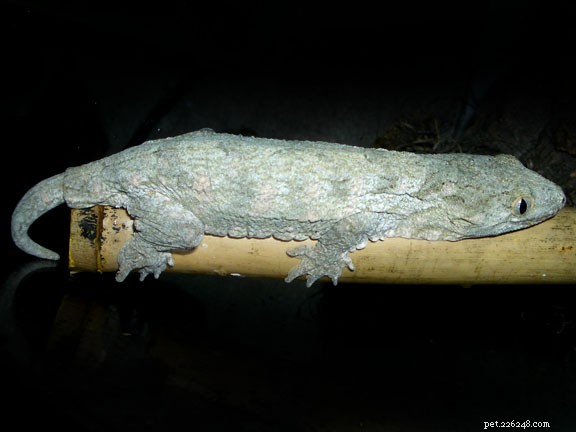
Description
At 14.5 inches, this is the largest of the geckos, but an even larger species may possibly still survive in New Zealand. It is stoutly built with loose skin and a short, blunt tail. In contrast to most geckos, there are claws on the toes and slight webbing between them, as well as a grasping pad on the underside of the tail.
The color ranges from faintly patterned shades of brown, gray and olive-green to nearly black, and provides excellent camouflage against tree bark. New Caledonian Giant Geckos “hide in plain sight”, and are nearly impossible to see when flattened out against a tree trunk.
Range
Three subspecies of this huge gecko, and 5 others within the genus, inhabit New Caledonia and neighboring islands (Isle of Pine, Belep Isle) about 900 miles east of Australia. The subspecies most often seen in the pet trade, R. l. leachianus, occurs mainly in the southern and eastern portions of New Caledonia.
Habitat
Giant geckos are believed to stay in the higher reaches of trees within dense forests. They rarely descend to the ground, and shelter within tree hollows and below bark. Giant Geckos are nocturnal, but sometimes bask in early morning.
I maintained a breeding pair in an exhibit measuring 3’x3’x4’. The enclosure was sprayed heavily in the morning and evening, but allowed to dry out as well each day. Temperatures ranged from 70-82F…others have reported that nighttime temperatures of 65F are well-tolerated.
Status
This species’ status is not well-studied…although widespread, it appears to be uncommon. One subspecies, R. l. aubrianus, is known from only single museum specimen, which has now been destroyed.
Reproduction
Females lay two eggs at a time and in captivity can produce 4-10 clutches per year. The eggs are adhesive, and it is assumed that females attach them to bark within hollows and beneath bark. Oddly enough, captives almost always deposit their eggs on the ground, even when provided with seemingly suitable arboreal sites. The eggs hatch in 40-60 days.
One member of the genus, R. l. trachyrhynchus, gives birth to live young.
Diet
Fruit, sap, nectar, flowers, caterpillars, arboreal invertebrates (tree crickets, snails), nestling birds, bats (the only native mammals), tree frogs and lizards most likely comprise the natural diet.
Those I’ve cared for have thrived and reproduced on a diet of fruit-based baby food into which was mixed honey and over-ripe bananas, papaya, peaches, cantaloupe and other fruits. Pink mice and roaches were the most readily accepted live foods; butterworms, crickets, waxworms, and wild-caught insects were taken sporadically.
A Two-Foot-Long Gecko?
Haplodactylus delcourti, a gecko native to New Zealand, was, at 24.5 inches, a good deal longer than the New Caledonian Giant. This species is known from only a single specimen. It is presumed to be extinct but there are rumors of its continued existence, and detailed surveys of its habitat have not been conducted.
- Accurately Determine Your Gecko's Age: A Practical Guide
- Find Your Lost Gecko Fast: Proven Home Search Tips
- Ultimate Care Guide for Giant Day Geckos (Phelsuma grandis)
- Choosing the Perfect Gecko: A Guide to Matching Species with Your Lifestyle
- The Nosy Be Gecko (Uroplatus ebenaui): Exploring Its Family and Conservation – Part 2
- Day Gecko Care Guide: Ideal Terrarium Setup & Top Supplies for Healthy Lizard Pets
- Gecko Care Guide: Terrarium Setup, Supplies, and Key Facts