

Advanced Care Guide for Aquatic Sunburst & Green Diving Beetles – Part 2
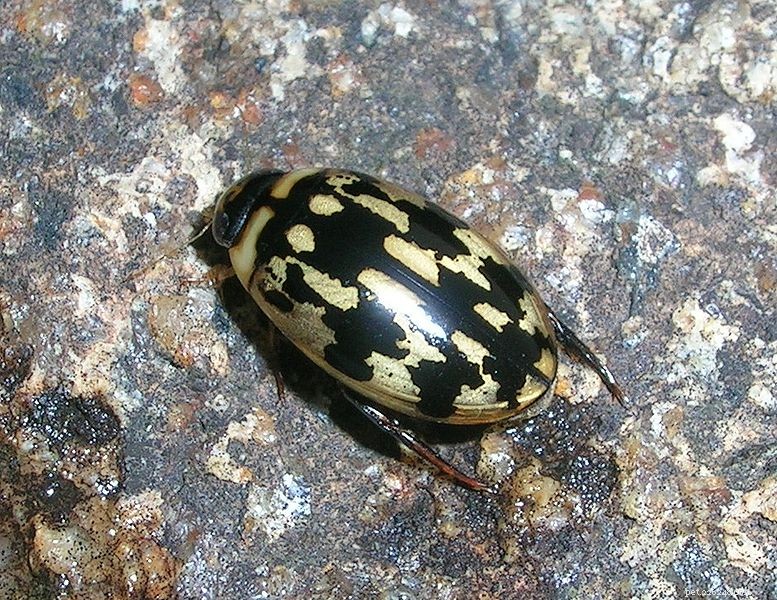 Please see Part I of this article for information on the natural history of the Sunburst or Marbled Diving Beetle (Thermonectes marmoratus), the Green Diving Beetle (Thermonectes sp.) and related insects. These wonderfully interesting aquatic beetles sometimes appear in the pet trade, and they and related species are also rather easy to collect. Today we’ll take a look at their captive husbandry.
Habitat
The beetle aquarium should be tightly covered, as all species can and do fly, especially at night. The tank should be stocked with a variety of live aquatic plants (i.e. Elodea, Anachris, Water Hyacinth) and sticks…despite being strong swimmers, Diving Beetles need to take frequent breaks by clinging to submerged objects; egg deposition occurs on live plants.
Water movement should be mild, as most species are adapted to ponds and sluggish streams, and cannot abide strong currents.
Light, Heat and Water Quality
UVB light is not known to be essential but, as these insects are diurnal residents of shallow waters, UVA light may be important in regulating activity and perhaps breeding behavior.
Temperatures of 70-82 F are well-tolerated.
Diving Beetles inhabit waters that are often subject to widely varying pH and ammonia levels. However, they are best kept in stable environments where ammonia levels are kept low and pH remains between 6.8 and 7.5.
Feeding
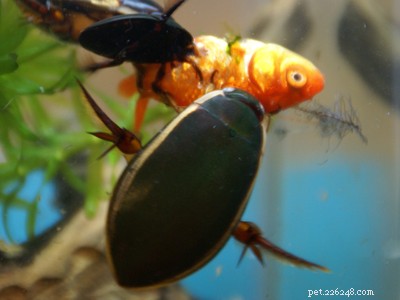
These ravenous little beasts readily accept crickets, crushed waxworms, earthworm pieces, brine shrimp, blackworms and bits of prawn and fish; most take tropical fish flakes and freeze-dried foods as well.
Social Grouping/Compatible Species
Marbled and Green Diving Beetles will get along with others of their kind and with robust aquatic insects such as Whirligig Beetles and Backswimmers. They will be attacked and consumed by Giant Water Bugs and their relatives.
Except for the largest species, most Diving Beetles do not molest fishes. However, even peaceful fishes such as Fathead Minnows will out-compete the Diving Beetles for food. Also, many aquatic insects use a radar-like system to detect fishes (which are major predators) and may therefore be stressed by the presence of even non-predacious species.
Diving Beetles may be housed with snails, crayfish and larger freshwater shrimp.
Captive Longevity
Adults may reach 2-3 years of age.
Breeding
Both Sunburst and Green Diving Beetles deposit eggs on live plants.
A dip in temperature and shortened light cycle for 4-6 weeks may stimulate reproduction, but is not absolutely necessary. Some have reported consistent breeding following a “drought/rain cycle” (water level is dropped for 2 weeks, temperature is raised 5 F, then tank is re-filled with water that is cooler by 10 degrees F than ambient).
Once the larvae reach a length of 1 inch or so, they should be provided with easy access to a container of damp earth for pupation.
Caution!
As is true of nearly all aquatic insects, Diving Beetles can bite – hard!
Diving Beetles fly well and will unerringly locate the tiniest of openings about filter tubes and electrical wires – all such areas should be sealed with tape.
- Breeding Green Iguanas: Choosing the Ideal Indoor & Outdoor Nest Sites – Part 1
- Mastering Green Iguana Nesting: Indoor & Outdoor Strategies – Part 2
- The Ultimate Guide to Selecting the Perfect Substrate for Reptiles, Amphibians & Invertebrates – Part 1
- Discover Sunburst & Green Diving Beetles: A Fresh Take for Insect Keepers – Part 1
- Breeding the Green Basilisk (Plumed) and Related Species – A Comprehensive Guide
- Breeding Green Basilisks & Related Species: Expert Guide – Part 2
- Driftwood Submerged Platforms for Aquatic Reptiles & Amphibians – Expert Guide Part 2