

New 6‑Foot Tree‑Dwelling Fruit‑Eater Unveiled: A Stunning Monitor Lizard
It’s well-known that the world still hides countless “undiscovered” animals and plants – even Central Park in NYC recently yielded a previously unknown centipede. However, it is still something of a surprise when large, colorful creatures remain unseen into modern times. Such is the case for the Northern Sierra Madre Forest Monitor (Varanus bitatawa), a spectacularly colored, 6-foot-long lizard that has been designated as a new species in the current (April, 2010) issue of the journal Biology Letters.
Large, Colorful and Unique
The new species, found only in the northern Philippines (Aurora and Isabella Provinces, northern Luzon), has generated awe among lizard enthusiasts – not only for its large size and brilliant black-and-yellow coloration, but also because of a lifestyle that is quite rare among monitor lizards – it is an arboreal fruit eater.
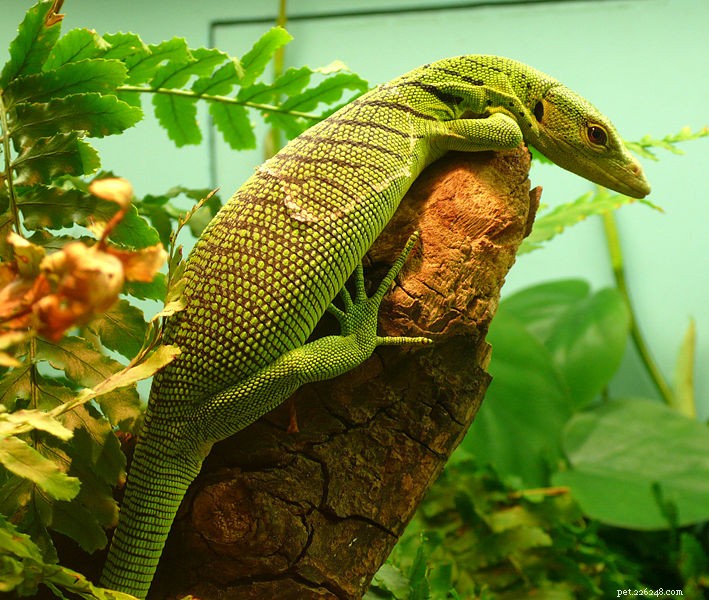
The few other known arboreal monitors are carnivorous and, with the exception of the Crocodile Monitor (V. salvadorii, see photo), are quite small and slender (i.e. the Green Tree Monitor, see photo). The massive Forest Monitor reaches at least 22 pounds in weight. Its diet, as far as is known, consists of Pandanus and Pili Nut Fruits, figs and, possibly, snails.
History: Documenting a New Species
The lizard is only “new” to herpetologists – it has long been hunted for food by the Agta and IIogot people, and, in fact, is found near heavily populated areas. The first known photo of one popped up in 2001, but it was not until 2003 that it attracted serious investigation; an actual specimen eluded biologists until 2009.
Biologists from the Natural History Museum of the Philippines and the University of Kansas (an institution long on the forefront of herpetological research) collaborated to uncover and describe the spectacular creature.
Monitor Diversity
The Northern Sierra Madre Forest Monitor is the third frugivorous monitor lizard to be discovered in the Philippines – these are the only members of the family Varanidae 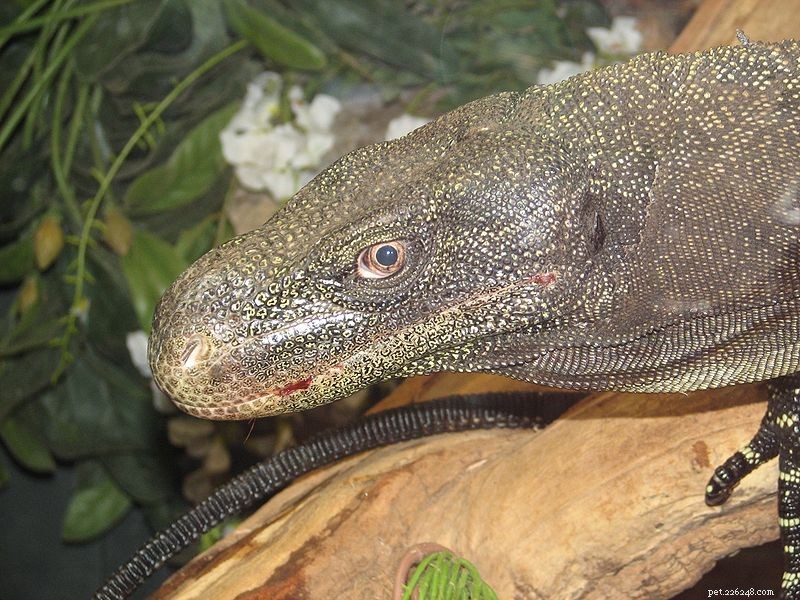 that are not predominantly carnivorous. The Gray’s Monitor or Butaan (V. olivaceus), to which the Forest Monitor may be related, was first recorded in 1845 but was not seen by herpetologists until the mid-1970’s. The other fruit-eater, the Mabitang (V. mabitang) was not officially recognized until 2001. All are believed threatened by logging, mining, deforestation and, possibly, hunting.
The discovery of the Forest Monitor brings to 70 the number of monitor lizard species described thus far. Ranging across Asia, Africa and Australia, they are generally associated with warm climates, but the Desert Monitor, (V. griseus) may be found as far north as Kazakhstan. At 8 inches long, the Short-tailed Monitor (V. brevicauda), is the smallest of the group…the Komodo dragon (V. komodoensis), the world’s largest lizard, occasionally tops 10 feet in length.
Keep Looking!
That such a large, active lizard could remain in relative obscurity for so long fuels the imaginations of those (such as I!) who believe that there are a great many wondrous creatures remaining to be found. Rumors persist in New Guinea of a 20-foot-long tree-dwelling lizard dubbed the “Papuan Dragon” – given the inaccessibility of its presumed rainforest habitat, who knows…?
- Identifying the Sex of Savannah Monitor Lizards: A Practical Guide
- Bosc Monitor Care Guide: Everything You Need to Know About Varanus exanthematicus
- Savannah Monitor Lizard: Care Guide, Lifespan, and Handling Tips
- Ackie Monitor: The Calm, Komodo-Resembling Reptile Pet for Families
- Asian Water Monitor: The Majestic Giant Reptile for Experienced Pet Owners
- Dumeril's Monitor: A Guide to Care, Size, and Stunning Color Changes
- Premier Herpetology Societies & Journals—Open to All (Part 1)