

Mertens’ Water Monitor: Expert Natural History & Captive Care Guide – Part 2
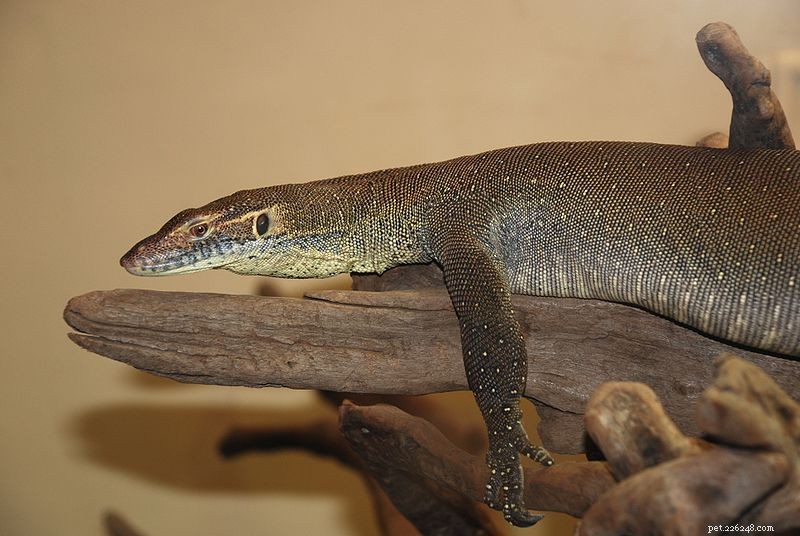 Please see Part 1 of this article for information about the natural history of the Mertens’ Water Monitor, Varanus mertensi, including the threat posed by introduced Marine Toads, Rhinella marinus.
Cage Size and Style
Mertens’ Water Monitors may be the ideal choice for folks interested in keeping larger monitors, but who lack the room for the true giants. Averaging 3.5 feet in length, they are supremely-adapted predators, hunting equally well on land or in the water. I’ve found that their alertness and aggression when hunting rivals that of any monitor I’ve observed, including the famed Komodo Dragon (keep your fingers out of their cage at feeding time!).
Moderate size not-withstanding, however, they are extremely active and demand a large enclosure equipped with a deep pool (please see photo – the cage pictured houses a Burmese Python, but would work well for Mertens’ Monitors) – don’t try keeping these high-energy lizards in an aquarium.
Custom-built cages with and drainable pools are the best option for Mertens’ Monitors… please see attached photo of Burmese Python cage and write in for details and suggestions.
Heat and Light
The cage should be large enough to provide your lizards with a temperature gradient (75- 84 F), and a basking spot of 95-100 F should be available. Despite their aquatic lifestyle, Mertens’ Monitors must dry off completely if they are to remain in good health and avoid fungal infections of the skin.
High levels of UVB radiation are likely essential, and UVA is beneficial in maintaining normal activity cycles. In the wild, Mertens’ Monitors may aestivate/become dormant during hot, dry weather; captives often show evidence of “confusion” as regards the season, and may breed or cease to feed at odd intervals. Establishing a light/heat cycle that mimics the natural one, and providing UVA radiation, should help in preventing this. In large cages, a mercury vapor bulb will be preferable to fluorescent light sources.
Diet
Wild Merten’s Monitors take an incredible range of prey, from tadpoles to birds eggs (please see Part 1), and it is therefore simple to provide captives with a varied, healthful diet. When rearing young Mertens’ Monitors, I’ve not seen any of the calcium-related bone problems that are common in juveniles of other species.
 As mammals form only a small potion of their natural diet, I rely primarily upon whole minnows, shiners and other fishes, and crayfishes, to supply calcium. Pink mice are offered once weekly, furred mice on rare occasions only. Other staples include earthworms, roaches, crickets, super mealworms and other invertebrates, with earthworms used most frequently. Those I housed with Parker’s Snake-Necked Turtles (in a zoo exhibit) even stole turtle chow from the water’s surface!
I did not use supplements, as a large portion of the diet was whole, high-calcium animals such as fishes, pink mice and crayfishes. Young monitors kept at proper temperatures are ravenous, and if fed properly can eat nearly every day without fear of obesity setting in.
Breeding
Clutches range in size from 6-15 eggs; when incubated at 85F they hatch in approximately 275 days.
Mertens’ Monitors have evolved in habitats subjected to fluctuating weather extremes, and their eggs are quite resilient – incubation periods of 180-330 days have been reported.
- Mastering Newt Care: Natural History & Captive Management – Part 1
- Mudpuppy: Natural History & Care Guide – Part 1
- Expert Guide to Mudpuppy (Waterdog) Care – Part 2: Habitat and Light Management
- Softshell Turtles: Comprehensive Natural History & Proven Care Tips – Part 1
- Softshell Turtles: Expert Care & Natural History Guide – Part 2
- Mertens’ Water Monitor: Natural History & Expert Captive Care Guide – Part 1
- Trans-Pecos Ratsnake Care Guide: Natural History & Housing Tips – Part 2