

Scorpions as Pets: Comprehensive Care Guide for Beginners
 I can’t remember a time when scorpions did not fascinate me, and their lure grows stronger with each new species I encounter. In the past, I’ve written on the care and natural history of Emperor, Flat Rock, Asian Forest and other popular scorpions. Today I’d like to present a general overview. I hope it will help you to decide if a scorpion is the right choice for you and if so, how to get started.
What’s in Store for Scorpion Fans
Among the world’s 2,000+ scorpion species we find an astonishing diversity of fascinating creatures, many of which make hardy pets that adjust well to small enclosures. Several reproduce readily in captivity – lucky scorpion keepers may even be treated to the sight of a female feeding her offspring with crickets! At least 15 species are established in the pet trade, and specialists are working with several others.
Natural History
At 8.5 inches in length,the South African Flat Rock Scorpion, Hadogenes troglodytes, is the largest scorpion regularly seen in captivity. It is exceeded in size only by India’s 10-12 inch-long Giant Forest Scorpion, Heterometrus swammerdami. The largest North American species is the 4 inch Florida Bark Scorpion, Centruroides gracilis. Today’s giants are dwarfed by the ancient Sea Scorpions…some were larger than a person (please see article below)! On the other end of the scale, several in the genus Microtityus are a mere 0.3 inches long.
Most scorpions feed upon a variety of invertebrates, but some specialize in catching land snails and other scorpions. Frogs and other vertebrates are sometimes taken by large individuals. All scorpions produce live young, and some are parthenogenic (reproduce without mating).
Females often carry the young on their backs, and several species feed them with shredded insects. Emperor Scorpions and others exhibit complex social behaviors.
Range and Habitat
Scorpions are found on all continents except Antarctica, and live in deserts, grasslands, caves, rainforests, human dwellings and many other habitats. A surprising number thrive in temperate climates, ranging as far north as Canada; 90+ species inhabit the USA. They are frequent stowaways…I was once called to Kennedy Airport to collect a scorpion that had stung a customs inspector as she checked luggage.
Venom
 Scorpion venoms are complex, and are being studied for possible use in the treatment of Lupus, cancer, MS and Rheumatoid Arthritis, and as pain-killers and insecticides.
Most of the 25-30 species capable of delivering dangerous stings are classified within the Genera Centruroides, Androctonus and Tityus.
Scorpions in Captivity
Scorpions are nocturnal, but captives often emerge to feed by day.
Due to peculiarities in molecular structure of the exoskeleton, scorpions fluoresce (“glow”) under UVB light; scientists have not determined what purpose this serves.
Housing
Setting up the Terrarium
Scorpions are best kept in screen-covered aquariums or plastic terrariums. A 10-15 gallon tank is usually adequate for a single adult or pair.
Scorpions need a dark hiding spot. Burrowers such as the Emperor Scorpion will dig their own retreats if provided with deep substrate. Arboreal scorpions will hide behind an upright piece of bark, while South African Rock Scorpions prefer narrow rock crevices. Most also accept inverted flower pots and plastic caves.
Substrate
A mix of coconut husk and peat moss works well for rainforest natives. Burrows will stay intact if you add just enough water so that the substrate sticks together when squeezed.
Arizona Hairy Scorpions and other desert-dwellers can be kept on a sand/gravel mix.
Light
Reptile night bulbs will allow you to watch your pets’ nocturnal activities.
Heat
Most scorpions do well at temperatures of 78-86 F (please write in for individual species details).
Reptile night bulbs or ceramic reptile heaters can be used to warm the terrarium. Heat pads are another option, but these warm the substrate more than the air. Any heating element may dry out the terrarium, so it is important to monitor humidity.
Humidity
Rainforest species require humidity levels in the range of 75-85%, while those from arid habitats do best at 40-50% humidity. Desert-dwelling scorpions spend most of their time in moist burrows, and should be provided a cave stocked with damp sphagnum moss.
Companions
Emperor Scorpions and several others live in social groups that occupy a single burrow system. However, females with young may become aggressive…please write in for further information.
If given enough space, a scorpion colony will establish a complicated maze of burrows.
Feeding
Most scorpions will thrive on a diet comprised of crickets, mealworms and earthworms, but they should also be offered roaches, waxworms, and other invertebrates. Pink mice are not required, even for the largest species.
Once adjusted to their homes, scorpions will often accept canned grasshoppers and snails from feeding tongs. Powdering food once weekly with a reptile vitamin/mineral supplement may be beneficial.
Scorpions obtain water from their prey, but should also be provided with a shallow, easily-exited water bowl.
Health Considerations
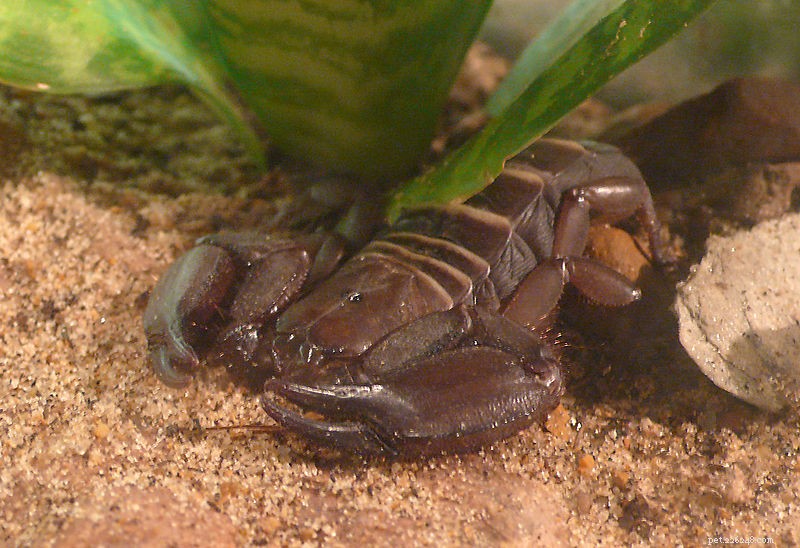 All scorpions produce venom and can deliver a painful sting. While those commonly sold in the US pet trade are not known to have caused fatalities, dangerous species have appeared, either accidentally or purposefully. Also, a serious allergic reaction to any venom is possible. Purchase scorpions only from reliable sources, and be sure you can identify those you are considering.
Scorpions adjust well to captivity, but cannot be “tamed” or “trusted”, and should not be touched with bare hands. Move scorpions by urging them into a clear container with long-handled tongs, or by inverting a container over the animal and sliding the cover below. Lifting by the “tail”, or telson, places you in danger and can injure the scorpion.
- Caring for Pet Garter Snakes: A Complete Guide for Home Keepers
- Caring for Blind Pets: Essential Safety & Health Guidelines
- The Complete Guide to Exotic Pet Types and Their Care
- The Ultimate Guide to Chameleon Care: Natural History & Home Habitats
- Newts as Pets: Expert Guide to Care, Feeding, and Conservation
- Essential Home Pet Care Tips: Keep Your Furry Friends Healthy and Happy
- Smart Ways to Keep Your Pet Healthy on a Tight Budget