

Newts as Pets: Expert Guide to Care, Feeding, and Conservation
 Although my interests are wide, newts and salamanders have always held a special fascination for me. Beginning in childhood, I sought to keep and breed as many species as possible, and I focused on their husbandry and conservation when I entered the zoo field. In time, I wrote a book summarizing my experiences (please see below). The passage of so many years has not dulled my enthusiasm for these fascinating amphibians, and I can highly recommend them to both beginning and advanced herp keepers.
The following information may be applied to the care of Japanese Fire-Bellied, Eastern, California, Ribbed and Paddle-Tailed Newts, as well as most others that appear in the pet trade. Please write in for detailed information on individual species.
Newts as Pets
An ability to thrive on commercial pellets distinguishes newts from other amphibians, and endears them to folks who prefer not to handle live insects. All are brilliantly-colored, active by day, and usually live well in groups at average room temperatures. Most become quite tame over time, and will even accept food from your hand. Several California Newts in my collection have lived to age 20, and others seem bent on exceeding that.
Natural History
The term “newt” is usually applied to small, semi-aquatic salamanders in the family Salamandridae. This family contains 80+ species that range throughout North America, Asia and Europe. During the breeding season, males usually develop bright colors, and some, such as the Banded and Crested Newts, sprout fantastic skin crests. The Ribbed Newt may reach a foot in length, but others average 4-6 inches.
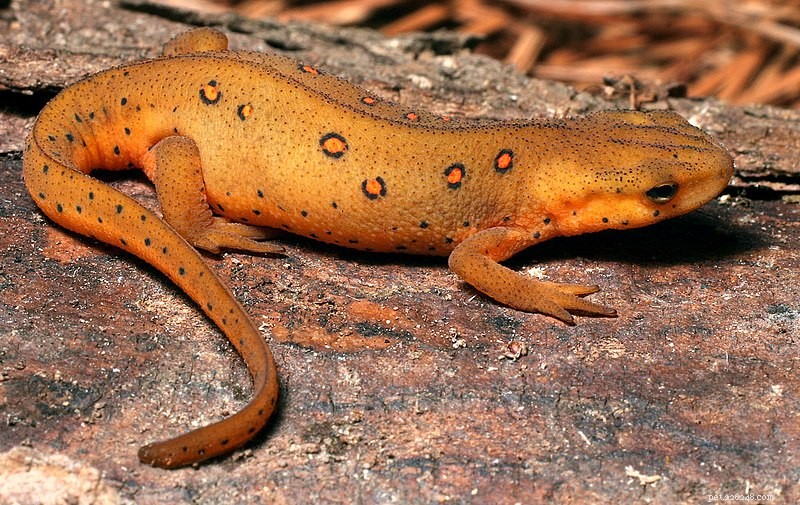
Newt larvae develop in water. Upon maturity, they pass through a land dwelling phase (see photo of Eastern Newt above) and then re-enter the water, where they remain for the balance of their lives. However, certain populations depart from the typical lifestyle; Eastern Newts on Long Island, NY, for example, skip the land stage.
Newts offered in the pet trade are usually in their adult, semi-aquatic stage.
Behavior
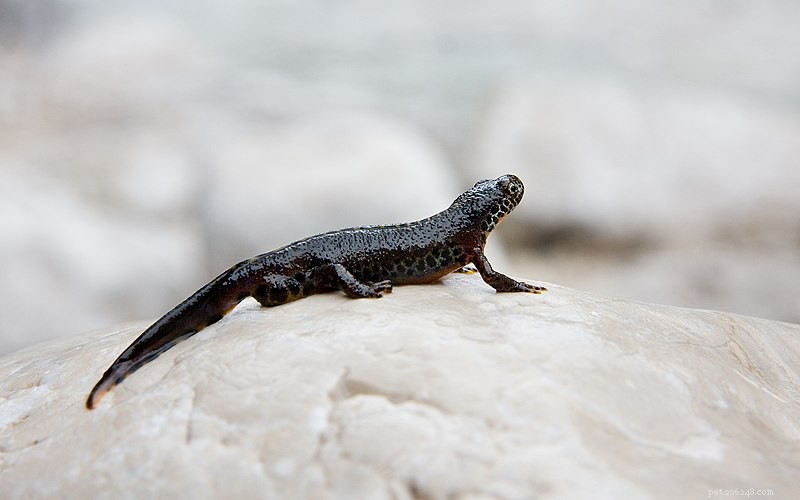 Amphibians are not known for being especially active, but newts are always nosing about for food, exploring, and interacting with tank-mates. They see well and may swim to the aquarium’s side when you enter the room, in anticipation of a meal.
Handle newts only when necessary, and with wet hands so that the skin’s protective mucus covering is not removed.
Housing
Setting up the Habitat
Newts are well-adapted to life in the water, but do need a place to haul out and rest. The water in their aquarium can be deep, provided that egress is simple…cork bark, turtle platforms, and floating live or plastic plants all serve well as resting spots.
Newts are perfectly suited to aquariums stocked with live plants, and spectacular displays can be easily arranged (please see video below). Plants help maintain water quality, and the complex environments they create make life more interesting for both newt and newt-owner.
As newts readily climb glass, a secure screen cover is a must.
Substrate
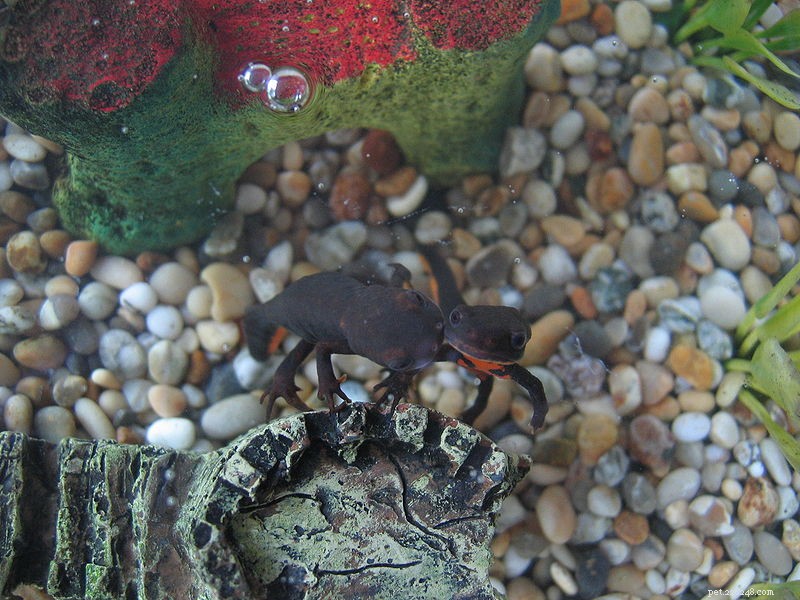 Smooth, rounded gravel of a size that cannot be swallowed is ideal; rough stones will injure the delicate skin. Bare-bottomed tanks are easily kept clean.
Water Quality
Newts have porous skins that allow for the absorption of harmful chemicals. Careful attention to water quality is essential.
An aquarium pH test kit should always be on hand. Most newts fare well at a pH of 6.5 to 7.5, with 7.0 being ideal.
Ammonia, excreted as a waste product and produced via organic decomposition, is colorless, odorless and extremely lethal to newts; a test kit should be used to monitor its levels.
Chlorine and chloramine must be removed from water used for any amphibian. Liquid preparations are available at pet stores.
Copper may be leached by old water pipes; a test kit should be used if you suspect its presence.
Filtration
Undergravel, sponge, corner, hanging and submersible filters can all be used in newt aquariums. Even with filtration, regular partial water changes are essential in keeping ammonia levels in check.
As newts are not strong swimmers, water outflow from the filter should be mild; plants, rocks and movable outflow attachments can be used to reduce current strength.
Light and Heat
Newts seem not to require UVB light. UVA light is not essential, but may encourage natural behaviors.
Most newts thrive at normal household temperatures, but fare best when kept cool (60-68 F). Temperatures above 75 F may weaken the immune systems of some. Please write in for information on individual species. A winter cooling period of 40-50 F encourages reproduction.
Companions
Although often sold as “additions” to tropical fish aquariums, newts do poorly in warm water and feed too slowly to compete with most fishes. Guppies adjust well to cool water, and their fry will be eagerly consumed by newts; limit the number of adults so as to avoid competition for food. Weather Loaches and Corydoras Catfishes will co-exist, and usually do not interfere with feeding.
Feeding
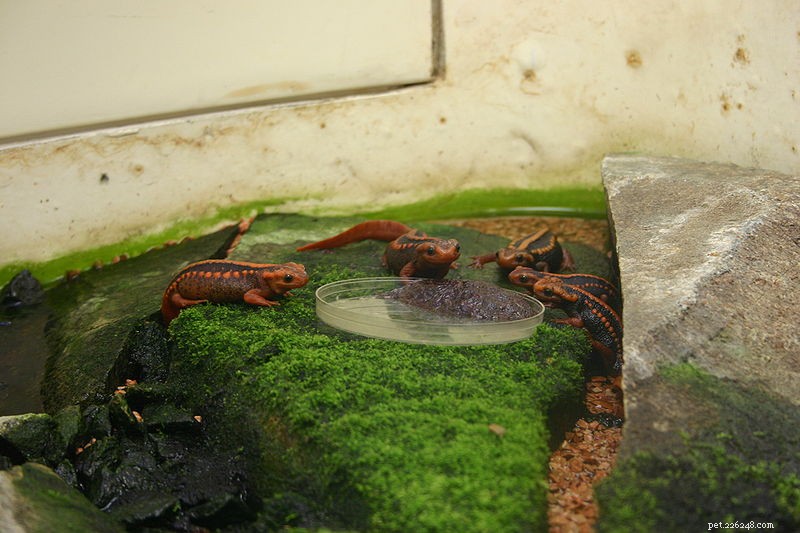 I rely upon Reptomin Food Sticks as a mainstay for the newts in my collection, and for those under my care in zoos. Freeze-dried shrimp (included in Reptomin Select-a-Food) “gelled insects”, canned snails and frozen fish foods (i.e. mosquito larvae) should be offered regularly.
Live food, while not essential, is relished and will help ensure a balanced diet. Blackworms, bloodworms, earthworms, guppies, and small crickets will be eagerly accepted. Stocking the aquarium with live blackworms will keep your pets active and occupied.
Newt larvae and terrestrial sub-adults will usually accept only live food. Please write in for further information.
Health Considerations
Newt skin glands produce toxins such as Tarichatoxin, which can be fatal if ingested (so don’t eat your pet!). Do not handle newts when you have an open cut, and always wash well afterwards. Toxins transferred to the eyes via fingers have caused temporary blindness.
- Spider Ball Pythons: Comprehensive Care & Health Guide
- Caring for Pet Garter Snakes: A Complete Guide for Home Keepers
- Caring for Blind Pets: Essential Safety & Health Guidelines
- How to Feed and Care for Tegu Lizards: A Beginner’s Handbook
- The Ultimate Guide to Chameleon Care: Natural History & Home Habitats
- Scorpions as Pets: Comprehensive Care Guide for Beginners
- How to Care for African Bullfrogs: Feeding, Habitat, and Longevity