

The Ultimate Guide to Chameleon Care: Natural History & Home Habitats
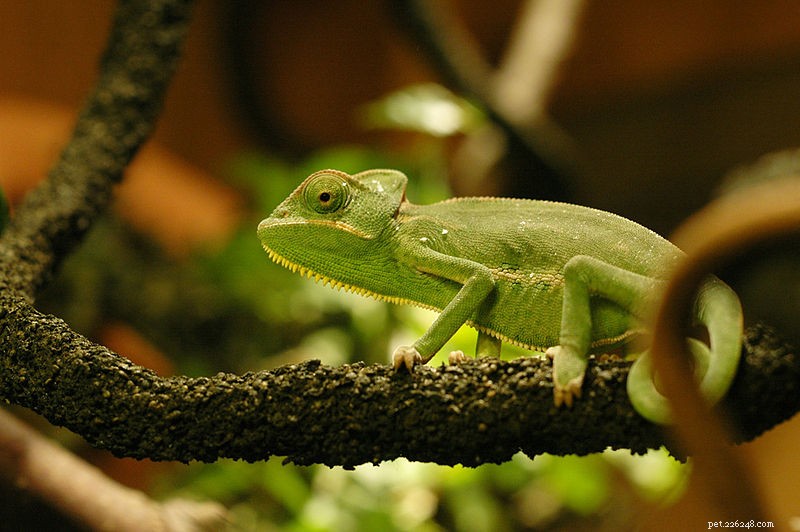 Chameleons, the most unique of all lizards, are truly marvelous creatures to know and care for. In the past, I’ve written about Veiled, Dwarf and Senegal Chameleons, and related topics (please see articles below). Today I’d like to discuss some general principals of chameleon care.
The following information can be applied to most available Chameleons; however, details will vary. Please write in for specific information on individual species.
Natural History
To date, 186 Chameleon species have been described (Family Chamaeleonidae). They range in size from the 1.5 inch-long Pygmy Leaf Chameleons (Rhampholeon spp.) to the Oustalet’s Chameleon (Furcifer oustaleti), which may top 30 inches in length.
Unique characteristics include a tongue that may exceed the animal’s length, mobile eyes, a “swaying” walk that mimics wind-ruffled leaves, joined toes that form grasping “hands”, a prehensile tail and remarkable color-changing abilities. Color changes are mainly used to communicate, but also serve as camouflage.
Chameleons reach their greatest diversity in Madagascar, where over 80 species may be found. Mainland Africa is home to 100+ species, while the Middle East, Europe and India each support 2 species. Veiled and Jackson’s Chameleons have been introduced to the USA and Mexico.
Often though of as rainforest animals, Chameleons have actually adapted to life in a wide variety of habitats, including dry woodlands, desert oasis, montane forests (where they endure snow) and even city parks.
Chameleons as Pets
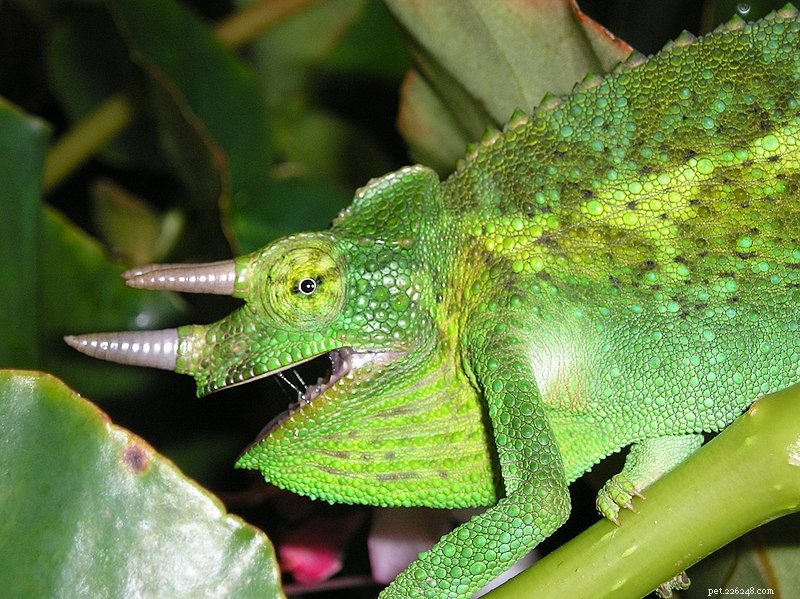 Chameleons are extremely aware of their surroundings and easily startled by sudden movements and other threats. They are best considered as animals to observe, and should not be handled unless absolutely necessary.
Housing
Setting up the Terrarium
Ample space and ventilation are key factors in successfully keeping Chameleons. As most are arboreal, height is an important consideration in cage design.
Youngsters and dwarf species may be raised in large aquariums. Commercial screen cages and terrarium top “add-ons” are ideal for indoor maintenance, and light enough to be moved outdoors as well.
Large individuals are best housed in custom cages or homemade enclosures. In suitable climates, outdoor enclosures, including pre-fabricated bird aviaries, may be fashioned into “Chameleon mansions”.
Numerous branches and vines should be provided. Sturdy live and/or artificial plants (i.e. Pothos, Philodendron and Spider Plants) will provide sight barriers and a feeling of security. Chameleons rarely fare well in bare enclosures.
Substrate
A mix of cypress mulch and sphagnum moss is ideal for rainforest species. Sand can be used for the desert-dwelling Veiled Chameleon (Chamaeleo calyptratus).
Although impactions due to swallowed substrate are rare in arboreal species, food is best offered in large bowls or via feeding tongs.
Light
Chameleons will not thrive without a source of Ultra-Violet B light. Natural sunlight is best, but be aware that glass and plastic filter out UVB rays, and that fatal overheating can occur very quickly.
If a florescent bulb is used (the Zoo Med 10.0 UVB Bulb is ideal), be sure that your pet can bask within 6-12 inches of it. Mercury vapor and halogen bulbs broadcast UVB over greater distances, and provide beneficial UVA radiation as well. UVA, while not essential, may help to regulate activity levels and breeding.
Interestingly, Panther Chameleons (Furcifer pardalis) have been shown to modify their basking behavior in response to the Vitamin D3 content of their food; please see this article for details.
Heat
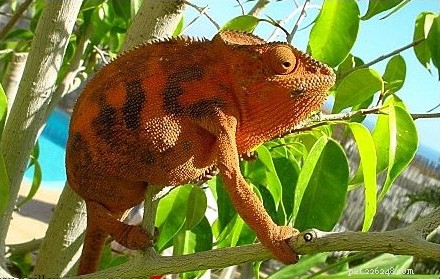 Ideal air temperatures vary widely among the different species, with many preferring cooler temperatures than might be expected. An ambient temperature in the mid 70’s, with a basking spot of 88-90 F, and a dip to 65-68 F at night, will suit most.
Large enclosures will simplify the establishment of a thermal gradient (areas of different temperatures). Thermal gradients, critical to good health, allow lizards to regulate their body temperature by moving between hot and cooler areas.
Incandescent bulbs should be used to maintain temperatures. A ceramic heater or red/black reptile “night bulb” can be employed after dark.
Humidity
Humidity requirements vary by species. Most terrariums should be misted twice daily; commercial reptile foggers are useful for rainforest species.
Companions
Chameleons can be described as “rabidly antisocial”. Both sexes are territorial and will fight savagely. Pairs sometimes co-exist in large, heavily-planted enclosures, but their behavior should be monitored closely.
The sight of a dominant animal can stress others, even if the animals are housed separately. One animal per enclosure, with opaque dividers between cages, is the general rule.
Feeding
A highly-varied diet is essential if you are to have success in keeping Chameleons. Most fare best when fed on a near-daily basis.
Whenever possible, I rely upon wild-caught invertebrates during the warmer months and save crickets and other commercial insects for winter use. During my years with the Bronx Zoo, large insect traps were maintained for our insectivorous herps and birds. The Bug Napper Insect Trap is a smaller version of these, and will help you to collect moths and other flying insects. Moths, butterflies, beetles, grasshoppers, tree crickets, katydids, harvestmen, earwigs, “smooth” caterpillars and a variety of other invertebrates should be offered (learn to identify stinging, biting and toxic species). Chameleons generally react very “enthusiastically” to novel foods. Please see these articles on collecting feeder insects for more ideas.
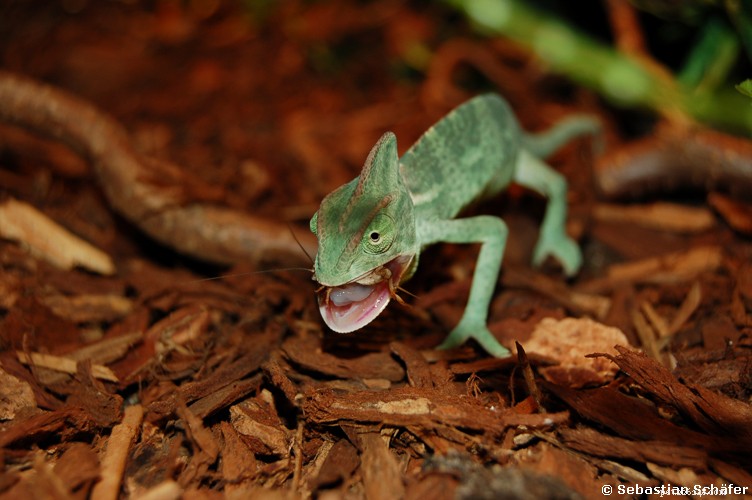 In winter, the main portion of the diet should be a mix of roaches, crickets, butterworms, super mealworms, waxworms, caliworms and commercially-available caterpillars (silkworms, hornworms). Feeder insects should be provided a healthful diet for several days before use. Canned grasshoppers, snails and silkworms are often accepted from feeding tongs, and can be an important means of providing dietary variety.
Parson’s, Panther, Oustalet’s and other large species seem to do well when offered a pink mouse every month or so. Do not use furred mice, as ingested hair may lead to impactions.
The Veiled Chameleon includes vegetation in its diet; other species may also take plants on occasion. Favorites include dandelion flowers and leaves, Ficus, romaine, and Nasturtium/Hibiscus flowers.
Essential food supplements include Zoo Med ReptiCalcium with D3 or a similar product (most meals) and a vitamin/mineral supplement such as Reptivite 2-3 times weekly.
Please see this article for more on Chameleon diets.
Chameleons rarely accept water from a bowl. Most will lap water that is sprayed onto foliage, and a few will drink directly from a hose (obviously this option is best employed in screen-bottomed outdoor cages!). A perforated container on the cage top that allows water to drip over plants is a useful option.
- Mastering Newt Care: Natural History & Captive Management – Part 1
- Dwarf Chameleons: Expert Care Tips & Natural History Insights
- Fire Skink (Mochlus fernandi): Natural History & Expert Care Guide
- Rhinoceros Iguana: Natural History, Care Guide, and Habitat Insights
- Rosy and Sand Boas: Complete Care, Breeding, and Natural History Guide
- Boa Constrictors & Relatives: Natural History & Expert Captive Care
- American Box Turtles: Comprehensive Care & Natural History Guide