

Hermit Crab Care: Expert Guide to Coconut Crabs & Other Species
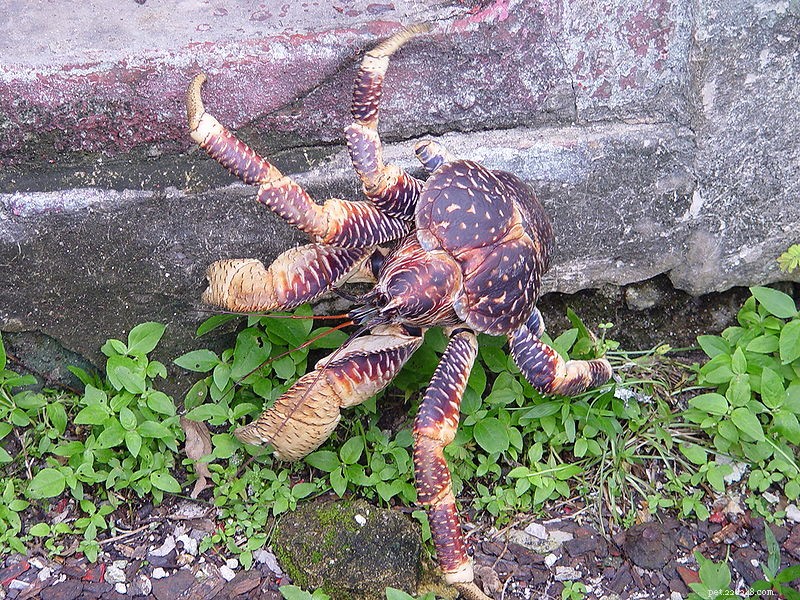 People are often surprised to learn that Land or Terrestrial Hermit Crabs engage in complex social behaviors, are capable of communicating via “chirps” and, with proper care, may live for over 20 years. I’ve had the pleasure of working with them at home, in zoos and the wild, and have even kept the massive, awe-inspiring Coconut Crab. Please read on to learn about their care and natural history, and be sure to post your own thoughts and experiences.
Hermit Crab Natural History
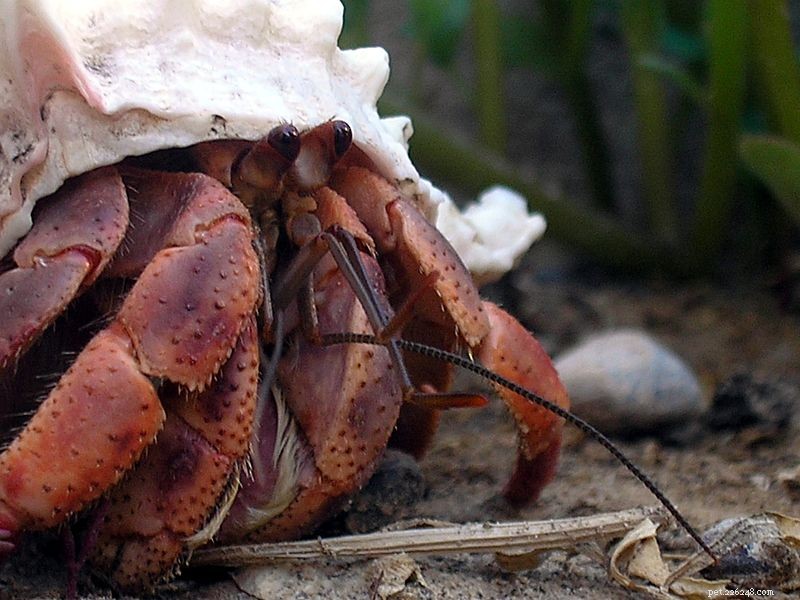
The Purple-Pincher or Caribbean Hermit Crab (Coenobita clypeatus) is the most common pet trade species. It ranges throughout the Caribbean, reaching as far north as Florida and Bermuda.
Some populations live at altitudes of over 3,000 feet, but females return to the sea, usually in one massive migration, to spawn. The larvae, or zoea, float about with plankton for 2 months, after which they take up life on land.
Land Hermit Crabs carry about the discarded shells of other creatures as shelters, and must find larger shells as they grow. Recently it was discovered that they will line up in size order behind an empty shell – as the first crab (the largest) moves into its new home, others in line will “trade up” for the shell of the crab immediately in front of them! Please see the article below for details.
Ecuadorian Hermit Crabs (Coenobita compressus) and several Asian species also appear in the pet trade. The Coconut Crab (Birgus latro) is sometimes kept within its native range.
Crab Behavior
Land Hermit Crabs are nocturnal, but pets often emerge to feed by day. When established in a properly-designed terrarium, they will be quite active and exhibit many interesting behaviors.
Handling is stressful to Hermit Crabs, including long-term pets. They can be grasped by the back of the shell, but often can reach this area with their claw. Large individuals can administer a painful pinch, and I’d bet that the Coconut Crab can break fingers!
Housing
Setting up the Terrarium
 A 10 gallon aquarium will accommodate 4-5 small crabs. Large, naturalistic terrariums will allow the crabs to exhibit a wider range of behaviors than will small, bare enclosures.
Driftwood, cholla wood, reptile caves, up-ended clay flower pots and similar furnishings will add greatly to your crabs’ quality of life. Empty shells should always be available.
A molting tank should be set up if you keep more than one crab. Land Hermit Crabs are soft and defenseless after molting, and will be eaten by their former friends. Check daily for signs of an impending molt – digging, remaining below ground and listlessness are typical. Molting crabs should be isolated (please write in for information).
Substrate
A mix of calcium sand and coconut husk makes an ideal substrate. The substrate should be at least 6 inches deep and mixed with enough water so that is just sticks together when squeezed.
Light
Red/black reptile night bulbs will allow you to watch your crabs after dark. A 12-hour day/12 -hour night cycle is ideal.
Heat
A temperature range of 75-82 F should be maintained. These tropical creatures will not survive long term exposure to temperatures below 72 F.
Incandescent bulbs or red/black reptile night bulbs can be used to heat the terrarium. Ceramic reptile heaters are useful at night. Reptile heat pads can be used to warm the substrate, but these do little to heat the air. All of the above will dry out the substrate, so it is important to monitor the humidity.
Humidity
Land Hermit Crabs possess unique gills that enable them to breathe air. A humidity level of 70-80% is vital to survival, as the gills must be kept moist in order to function. A simple humidity meter should be used. Humidity can be increased by misting, adding water to the substrate and partially covering the terrarium’s lid with plastic.
Companions
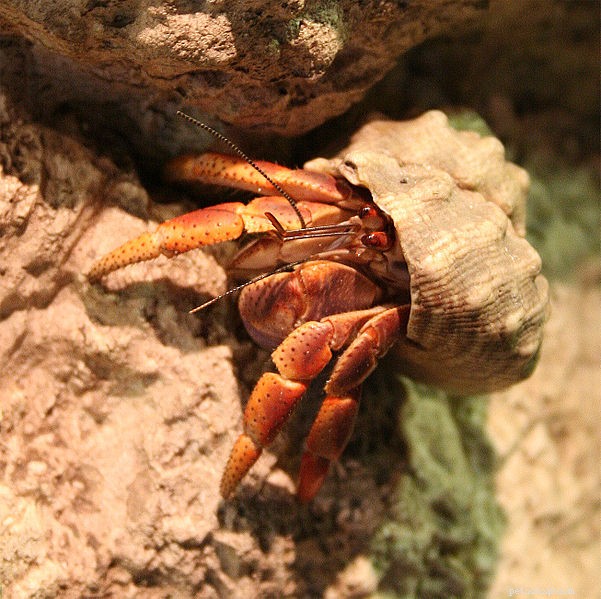 Land Hermit Crabs are social animals, but dominant individuals may prevent others from feeding properly. Crabs that are molting must be isolated or they will be attacked (please see above). A variety of empty shells must be available, or fighting and “evictions” will ensue.
Feeding
Wild Hermit Crabs eat just about everything – animal, vegetable and mineral – that they encounter. Captives will not thrive without a varied, high-calcium diet.
Commercial Hermit Crab pellets may be used as a portion of the diet. The following foods should be included regularly: fresh shrimp and fish, fruits and vegetables (carrot may help to maintain coloration), hard-boiled egg, nuts, seeds, dry seaweed (sold as Nori), oatmeal, fish flakes, canned crickets, and freeze-dried fish foods (krill, plankton, brine shrimp, etc.). They also relish decaying wood and leaf litter; these should be collected from pesticide-free areas.
Cuttlebone bits and reptile calcium powder should be mixed into your crabs’ food.
Often overlooked is their need for a bowl of marine water; marine aquarium salt mixes, not table salt, should be used. Soaking in this water will provide the crabs with essential minerals not present in their food. Fresh de-chlorinated water should also be available. Bowls should be filled to half the height of the smallest crab and be easily-exited, as Land Hermit Crabs drown easily.
A wide variety of specialty cages, supplies and foods are now available. Please post any questions or comments you may have regarding their use.
The Coconut Crab (Birgus latro), aka The Robber Crab
With a 16 inch body supported by legs spanning 3 feet, this impressive beast (described as “monstrous” by Charles Darwin!) is the world’s largest land-dwelling arthropod. I first saw them at the Cincinnati Zoo Insectarium in the early 1980’s, and was instantly hooked. After a prolonged search, I obtained 2 adults for an exhibit at the Bronx Zoo. Unfortunately, they did not fare very well, and this seems to be a common experience (wild individuals may attain age 40+). Losses are especially high during the month-long molt, which is spent underground.
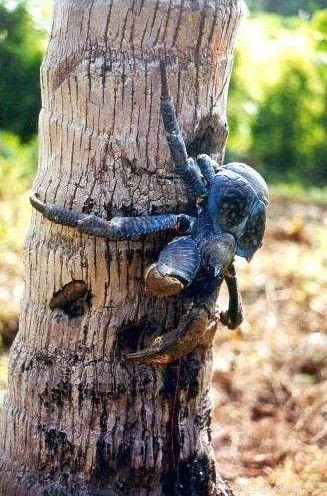 The Coconut Crab ranges throughout the Indian and Western Pacific Oceans. A co-worker of mine found them raiding his garbage cans on Guam; his experiences with refuse-feeding coatis and coyotes elsewhere in no way prepared him for that!
Coconuts may be their best-known food, but form only a small portion of the diet. Generally, the crabs pinch nuts from coconut palms, and then feast on the broken remains below. A crab may also pull back the husk from an unbroken coconut and then pierce the soft “eye” with one of its pointed legs. The rest of the diet is as varied as that of their smaller relatives.
Coconut Crabs are declining in portions of their range. Threatened by food trade collection and predation by introduced rats, ants, pigs and monkeys, they have been extirpated from Australia and Madagascar.
- Hermit Crabs as Pets: Expert Insights on Care and Compatibility
- Which Fruits Are Safe for Hermit Crabs? A Guide to Healthy Pet Crustacean Nutrition
- Land Hermit Crabs as Pets: Care Tips & Benefits
- Inside the Life of the Terrestrial Hermit Crab: From Ocean Plankton to Popular Pet
- Terrestrial Hermit Crab Care: Why Saltwater Is Essential
- Revealed: Unexpected Social Life of Terrestrial Hermit Crabs
- Comprehensive Hermit Crab Care Guide