

Mastering Compact UVB Bulbs: A Professional Guide for Reptile Lighting
The technology behind amphibian and reptile lighting has come a long way since I began working at the Bronx Zoo, when “black lights” and the sun were our only UVB (Ultra Violet B radiation) options. Today I’ll review an important herp husbandry innovation, the compact UVB fluorescent bulb (note: bulbs are referred to as “lamps” in technical papers). My experiences have been positive, but some reptile-keepers have raised concerns, so I’ll address them as well. Please be sure to post your experiences and ideas below, as we still have much to learn about this important topic.
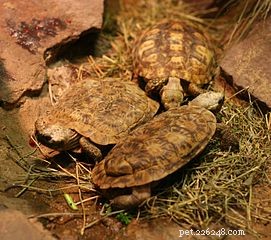
Uploaded to Wikipedia Commons by Dave Pape
Reptiles, UVB and UVA: a Quick Primer
Most heliothermic (basking) lizards, turtles, and crocodilians need exposure to UVB light rays with a wavelength of 290-315 nanometers in order to synthesize Vitamin D3 in their skin. Vitamin D3 allows these animals to utilize dietary calcium. Without D3, dietary calcium is not metabolized and metabolic bone disease sets in. Snakes, highly-aquatic turtles, nocturnal lizards, most amphibians, and certain others can make use of dietary Vitamin D, but most basking species rely on the skin-synthesized form.
However, all is not as clear as we once believed. I know of a situation where several species of Day Gecko (Phelsuma spp.) are getting along fine without UVB (please see this article), and recent research has shown that Panther Chameleons (Furcifer pardalis) can utilize both dietary and skin-generated UVB (please see this article).
UVA radiation (wavelength 320-400 nanometers) appears to promote natural behavior, reproduction and the establishment of circadian rhythms (internal “clocks”) in many reptiles and amphibians. UVA also affects how and what reptiles see. Female Desert Iguanas (Dipsosaurus dorsalis), for example, cannot see the chemical trails laid down by males in the absence of UVA. UVA-generating basking bulbs are now available (please post below for further information); compact UVB bulbs also emit UVA.
Compact UVB Bulb Overview
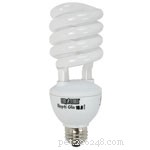 In my experience, one should stay with reputable, well-established companies when investigating newer products. In keeping with this policy, I rely upon ZooMed, ExoTerra and Zilla for compact fluorescent bulbs.
Most compact fluorescent bulbs are designed to be used with clamp-lights or similar incandescent fixtures (Zilla offers a straight pin model as well). The bulbs’ size and low wattages renders them ideal for use with smaller terrariums, isolation enclosures, “sick tanks” and the like.
The companies mentioned above use the same general categories for compact bulbs as has become accepted regarding typical UVB fluorescent bulbs – 2.0 bulbs are suited for many amphibians, invertebrates and snakes, 5.0 and 7.0 for a wide variety of tropical and semi-tropical species, and 10.0 for desert dwellers and others with high UVB needs.
A (possible) Advantage of Compact Fluorescent Bulbs
For most captive reptiles, maximum UVB exposure is best assured by placing the UVB bulb near a basking (heat producing) bulb. As the animal seeks warmth under the basking bulb, it is also positioning itself near the UVB source.
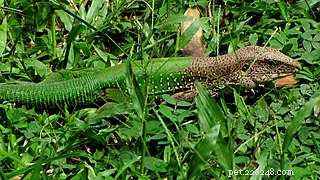
Uploaded to Wikipedia Commons by D. Gordon E. Robertson
It occurred to me that the small size of compact bulbs may allow for more concentrated UVB exposure when they are positioned next to a basking bulb (since the UVB radiation is not spread over a large area, as with typical UVB bulbs). I plan to raise this possibility with manufacturers in the near future.
Using Compact UVB Fluorescent Bulbs
Compact UVB bulbs may be used much as are larger models. Bear in mind, however, that UVB rays are broadcast over a limited area. As mentioned above, this may be advantageous when they are paired with heat-producing basking bulbs.
As with most traditional UVB bulbs, compact bulbs are best used within 5-12 inches of a basking site (see individual manufacturer’s recommendations), as output falls sharply beyond 12 inches. Please see the articles linked below for further information on bulb placement, and be sure to post any questions you may have.
Compact UVB bulbs also supply UVA, which, we are learning, is important to the health and welfare of many reptiles and amphibians (please see “UVA-UVB Primer”, above).
Health Concerns?
On various reptile interest websites, several hobbyists have questioned whether compact fluorescents may be responsible for eye damage seen in certain individual turtles and tortoises. The discussion threads that I viewed did not reference any studies or journal articles on the topic. I have not been able to document any instances of eye damage in peer-reviewed herpetological journals, but will remain alert for new developments.
While consulting for one institution some years ago, I noted cloudy corneas in Wood Frogs and Gray Treefrogs that were exposed to UVB radiation (traditional UVB bulb). I believe this may have been related to the fact that the frogs’ tanks lacked sufficient cover and dark retreats, but veterinary exams were not performed. I have not seen possible UVB-related eye problems in reptiles, or in amphibians kept in appropriately-designed terrariums lit by low-output (2.0) UVB bulbs.
- Essential Lighting Guide for Turtles & Tortoises: UVB & Heat Bulbs
- Mastering Freshwater Aquarium Lighting: A Comprehensive Guide for Beginners
- Optimal Shelter Placement for Reptiles & Amphibians: A Practical Guide
- Reptile Hobbyists: Champions of Conservation or Contributors to Declines?
- Undergravel Filters: A Proven Solution for Reptile and Amphibian Aquariums & Terrariums
- Premium Combo Reptile Lighting: UVB, UVA, Heat & Night Bulbs
- Essential Guide to Reptile-Friendly Fruits and Vegetables