

Greek Tortoise: The Ideal First‑Time Pet Tortoise – Care Tips & Insights
I do not believe that any tortoise species can be classified as “easy-to-keep”, but several are better-suited as pets than others. I’ve covered on of these, the Russian Tortoise (Testudo horsfieldi), in an earlier article (read article here). The Greek Tortoise (T. graeca), while interesting enough for the most seasoned hobbyist, may also be the best pet tortoise, and an ideal choice for first-time keepers. Topping out at 8 inches in length, captive-bred individuals are readily available. They are as personable as any of their relatives, and decades of popularity among European keepers has left us with a good understanding of their needs. I’ll summarize these in the following article, and will also draw from my own experiences with this and related species during my long career at the Bronx Zoo.
Uploaded to wikipedia commons by Richard Mayer
A Note on Classification
Also known as the Mediterranean Spur-Thighed Tortoise (not to be confused with Africa’s Spurred Tortoise, Geochelone sulcata), the Greek Tortoise is one of the smaller of the world’s 53 tortoise species.
Its taxonomy is somewhat complicated, with up to 13 subspecies being recognized. Traditionally, T. g. ibera comprised the bulk of those in the pet trade, and it remains the most widely-bred subspecies. The parent stock seems to have originated mainly from Turkey.
In recent years, other subspecies, marketed as “Golden Greek” or “Dwarf Golden Greek” Tortoises, have become popular. Usually but not always lighter in color than “regular” Greek Tortoises, these individuals generally prove to be Israel’s T. g. floweri or T. g. terrestris, which is native to southeastern Turkey, Israel, Jordan, Lebanon and Syria. Adapted to arid habitats, their care parallels but slightly differs from that of European Greek Tortoises.
Identification is complicated by a high variability in color among all populations, and the fact that captive hybridization has occurred with Herman’s, Russian and Marginated Tortoises.
Range
The various subspecies range from southern Spain, the Balkan Peninsula and Morocco south and east through Greece and Eastern Europe to Iran, Syria, Lebanon, Jordan and Israel.

Uploaded to Wikipedia Commons by Georges Jansoone
Habitat
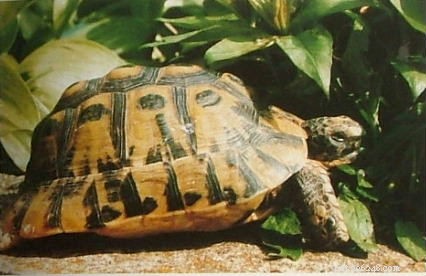
Greek Tortoises inhabit wooded grasslands, thorn scrub and dry forests (please see photo). African and Middle Eastern populations may also be found in arid savannas and coastal dunes.
The Terrarium
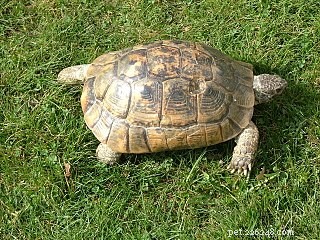
Do not be misled by the Greek Tortoise’s small size – they need a great deal of room. Adults generally do best in enclosures that have been constructed with their needs in mind. Homemade “tortoise tables” are excellent options (please post below for further information). Ideally, a single adult should be provided with an enclosure measuring at least 4 feet by 3 feet.
In glass aquariums, respiratory problems often arise due to insufficient ventilation, and space will be a concern for all but hatchlings (please see the article linked below). Also, most are too small to allow for the establishment of a thermal gradient (see Heat, below).
Outdoor maintenance is possible if you live where the climate is suitable. Please post below for details.
Plastic-based rabbit cages can be used for small individuals, but will be outgrown in time. Plastic bins and cattle troughs can also be modified as tortoise homes.
Uploaded to Wikipedia Commons by Richard Mayer
Substrate
A mix of sand and topsoil, or commercial cypress mulch, is suitable. Damp substrate should be removed quickly.
Although impactions due to swallowed substrate are rare, it is best to provide food in large bowls so that ingestion is limited. Rubber mats can be placed below bowls as an extra precaution.
Ideally, the substrate should be deep enough to allow your tortoise to dig a shallow “sleeping depression” at night. Dry grass clumps or suction-cup equipped plastic plants can also be provided as shelter.
Light
All tortoises need daily exposure to UVB light. Natural sunlight is best, but be aware that glass and plastic filter out UVB rays, and that fatal overheating can occur very quickly.
Use a bulb designed for desert-dwelling reptiles (i.e. the Zoo Med 10.0 Bulb), and position the basking site within 6-12 inches of it. Mercury vapor bulbs broadcast UVB over greater distances, and provide beneficial UVA radiation as well. UVA, which may assist in promoting various natural behaviors, is also supplied by a variety of other bulbs.
Heat
Spotlight bulbs should be employed to establish a basking site of 95 F, and a thermal gradient (areas of different temperatures) of 75-88 F. Thermal gradients, critical to good health, allow tortoises to regulate their body temperature by moving between hot and cooler areas.
Humidity
Greek Tortoises must be kept in dry enclosures, with humidity levels of approximately 35-45%; Golden Greeks do best at 30-40%. Tortoises kept in damp conditions become prone to respiratory tract infections. A small hygrometer is useful for measuring humidity levels.
There are some other points to consider when rearing hatchlings…please post below for details.
Companions
Females and youngsters may co-exist, but must be watched as dominant individuals may prevent others from feeding. Males will fight, and they often harass females with near-constant mating attempts.
Feeding
Greek Tortoises have evolved to consume a diet that is high in fiber and calcium and low in protein, fruit and fat; grasses and herbaceous plants comprise the bulk of their food intake in the wild. Beans, dog food and other protein sources have been linked to kidney failure and excretory system stones. Protein-rich diets are also associated with growth abnormalities. Fruit should be limited to an occasional treat.
Native grasses, weeds and flowers, such as honeysuckle, dandelion and clover, can make up the bulk of the diet if available. Please see the article linked below for information.
The balance of their food may consist of greens such as kale, endive, Swiss chard and romaine; avoid spinach and iceberg lettuce. Zoo Med’s Grassland Tortoise Diet can be added to salads.
Calcium requirements appear to be quite high. All food should be powdered with Zoo Med ReptiCalcium or a similar product. A vitamin/mineral supplement such as Reptivite with D3 should be used 2-3 times weekly. Tortoises cannot utilize calcium without Vitamin D3, which is manufactured in the presence of UVB radiation (please see Light, above).
Water should be available for drinking and soaking, but damp conditions present a health hazard. Use tip-proof bowls and fill to a point where they will not overflow when the tortoise enters.
- Top-Quality Pet Gates for Safe and Stress-Free Home Living
- Caring for Blind Pets: Essential Safety & Health Guidelines
- How to Choose the Ideal Pet Snake: A Comprehensive Guide
- Day Gecko Care Guide: Ideal Terrarium Setup & Top Supplies for Healthy Lizard Pets
- Top 9 Phoenix Veterinarians: Your Trusted Guide to Premium Pet Care
- Top Pet Odor‑Neutralizing Candles & Diffusers for a Fresh Home
- Ultimate Guide to Caring for Your Pet Conure: Diet, Health, and Happiness